


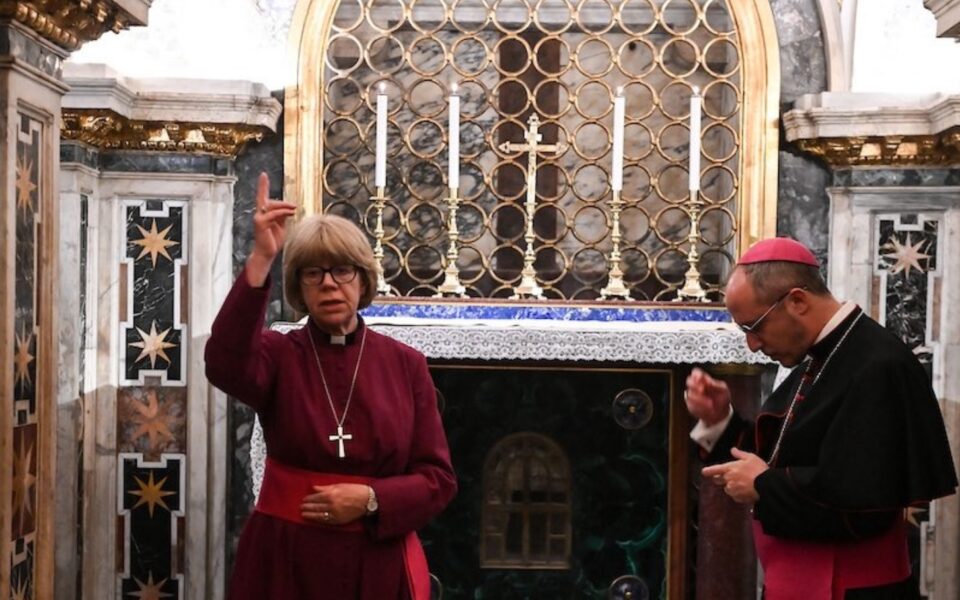
The presence of Sarah Mullally, responsible for the see of Canterbury within the Anglican Communion, in the Clementine Chapel—in the crypt of St. Peter’s Basilica—has generated controversy after images spread showing her performing a blessing gesture in one of the places closest to the apostle’s tomb.
The episode gains greater relevance because Mullally is scheduled to meet next Monday with León XIV, in a meeting that was already planned and which is now preceded by this gesture with strong symbolic weight.
The Anglican Communion has been going through a deep internal fracture for years, largely derived from doctrinal decisions such as the ordination of women and other disciplinary changes. These decisions have caused the breakdown of communion between different Anglican provinces and the emergence of parallel structures.
From the Catholic doctrinal point of view, the issue has been precisely defined since the 19th century. The bull Apostolicae Curae of León XIII, in whose preparation the cardinal Merry del Val played a relevant role, declared Anglican orders invalid. The document concludes that there is no valid apostolic succession in the Anglican Communion due to defects in the form and intention of the ordination rites after the Reformation.
In this framework, gestures that imply acts proper to the priestly ministry in Catholic liturgical spaces cannot be interpreted as equivalent to those of a minister validly ordained according to Catholic doctrine.
The episode in the Clementine Chapel thus introduces an element of objective confusion, occurring in a place of maximum significance within the Church and in a context in which the doctrine on the priesthood and apostolic succession is clearly established. This type of gesture does not correspond to an ecumenism based on doctrinal clarity, but rather dilutes the boundaries that the Church itself has precisely defined.