


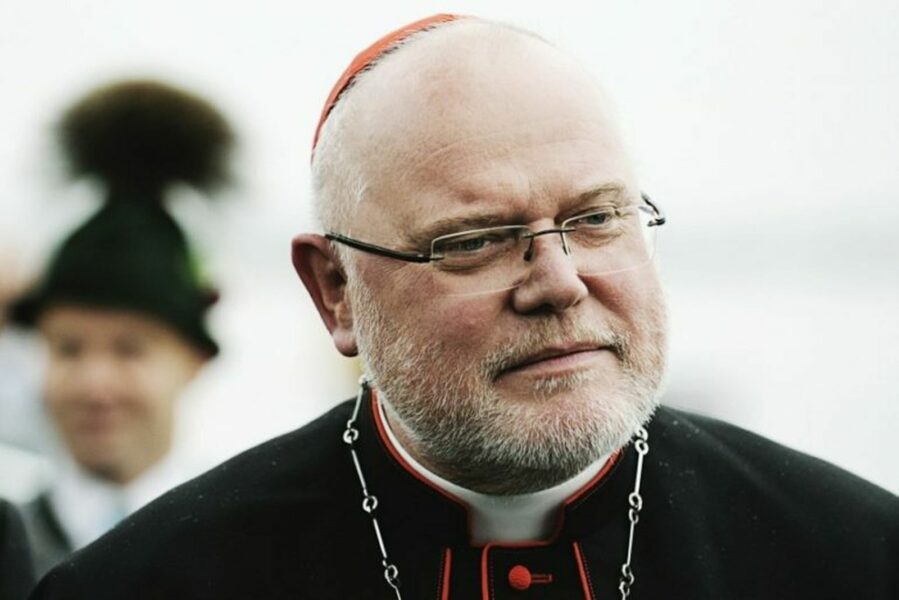
Cardinal Reinhard Marx, Archbishop of Munich and Freising, remains at the center of the latest controversy following his recent pastoral decisions—in line with the German “Synodal Way”—and the direct response from Leo XIV, but also due to an aspect that raises growing concern: the high level of income of the ecclesiastical hierarchy in Germany, sustained by a tax system unique in Europe.
Read also: Cardinal Marx promotes blessings for irregular and same-sex couples in Munich
A system that guarantees billions to the Church
As reported by the French outlet Tribune Chrétienne, the Church in Germany is largely financed through the Kirchensteuer, an ecclesiastical tax that the State collects directly from citizens registered as Catholics or Protestants.
This tax amounts to between 8% and 9% of the income tax and generates annual revenues of billions of euros for the German Church, making it one of the richest ecclesiastical institutions in the world.
The system not only ensures financial stability but also establishes a structural relationship between Church and State: the public administration collects the tax and transfers it directly to the dioceses, effectively integrating the Church’s economic operations into the state apparatus.
Bishops’ salaries comparable to high public officials
In this context, German bishops receive remuneration similar to that of high-ranking state officials. Salary scales place their monthly incomes between 10,000 and 18,000 euros, depending on the diocese and rank.
In the case of Cardinal Marx, at the head of one of Europe’s richest archdioceses, the German press has estimated his salary at around 14,000 euros per month, within the highest levels of this scale.
These figures are also framed within dioceses with enormous economic capacity. The German model allows certain archdioceses to accumulate million-euro surpluses, a direct reflection of the effectiveness of the ecclesiastical tax collection system.
Structural wealth and pastoral decisions under suspicion
The controversy over incomes cannot be detached from the current doctrinal context. In recent days, Marx has promoted the introduction of blessings for same-sex couples and divorced remarried persons, a line already contested within and outside Germany and which has received corrections from Rome.
This interplay of factors—economic abundance, strong dependence on the state system, and pastoral adaptation to cultural demands—reveals in the German Church a model conditioned by its political and social environment.
A model questioned beyond Marx
Beyond the figure of Cardinal Marx, what is at stake is the model itself: a Church with extraordinary resources, guaranteed by a state tax system, which allows it to sustain broad structures but also raises questions about its real independence.
Read also: AfD questions the 600 million annually that the State allocates to churches in Germany
The fact that ecclesiastical incomes depend directly on a public and mandatory mechanism for millions of taxpayers introduces an evident tension: to what extent a Church financed in this way can resist the cultural and political pressures of the environment in which it operates.
In that context, the figure of Marx appears as a symbol of a German Church prosperous in economic terms, but deeply divided in doctrinal matters.