


The profile of Catholic priests in the United States is undergoing a profound transformation that affects both their number and their identity. According to the report National Study of Catholic Priests 2025, prepared by the Catholic University of America, the new generations of presbyters present a clearly more conservative theological orientation, in contrast to the dominant profile in the decades immediately following the Second Vatican Council.
The study is based on a national survey of active priests and offers a representative snapshot of the U.S. clergy. The work collected 1,203 responses, a sample that includes presbyters ordained at different stages—from before the Second Vatican Council to the most recent promotions—, which allows for comparing the theological and pastoral evolution over several decades.
A Clear Generational Shift in Theological Orientation
The study’s data show an evident break between generations. While among priests ordained before 1975 more than 70% identified as theologically progressive, among those ordained from 2010 onward that figure drops to just 8%. In the opposite direction, more than 70% of young priests today define themselves as “conservative/orthodox” or “very conservative.”
This is not a simple readjustment of sensitivities, but rather an almost complete reversal of the internal balance of the clergy over the span of half a century. Progressivism does not disappear, but it ceases to be a significant current among new vocations.
Fewer Priests, but More Defined
The report confirms, at the same time, a trend that was already known: the total number of priests continues to decline, largely due to the aging and passing of the generations ordained during the vocational boom of the mid-20th century.
However, this numerical reduction is accompanied by greater doctrinal cohesion. The emerging priesthood is smaller, but also clearer in its convictions, less dependent on cultural inertias, and more linked to a conscious personal choice.
Greater Pastoral Burden and Signs of Wear
This new profile is not without difficulties. The study warns of growing pressure on younger priests. Nearly half of those ordained after the year 2000 consider that they are required to assume tasks that go beyond their priestly vocation.
Added to this is an increase in the sense of loneliness: 45% of the younger priests show indicators of isolation, a figure significantly higher than that of previous generations.
Although the overall level of well-being remains high—with an average score of 8.2 out of 10—, these data point to a medium-term sustainability problem if pastoral conditions are not corrected.
Pastoral Priorities: Evangelization, Family, and Life
In the pastoral sphere, there is broad consensus among priests around some key priorities. 94% highlight evangelization, youth ministry, and family formation as fundamental, while issues such as the defense of life also figure among the central axes of pastoral action.
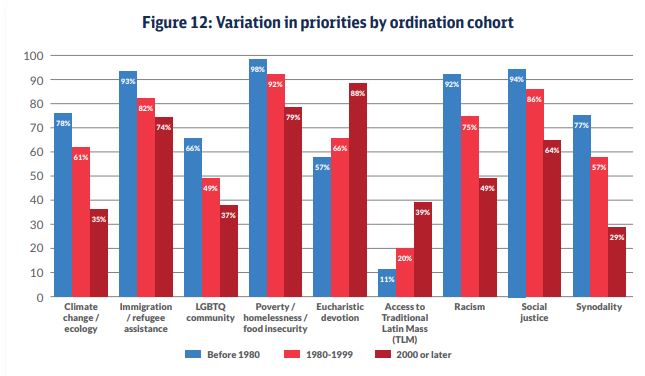
The most significant differences appear when analyzing the generations. Among younger priests, the weight of issues such as synodality or certain social agendas decreases, while the importance of Eucharistic devotion grows clearly, and to a lesser extent, of the Traditional Mass. This shift points to a recovery of the centrality of sacramental and liturgical life, which is consolidated as one of the most distinctive features of new priestly vocations.
A Change that Marks the Future of the Church
The report paints, overall, a clear scenario: a smaller, more demanding clergy that is, at the same time, more coherent in its identity.
As the generations formed in the decades following the Second Vatican Council leave active ministry, this profile will become increasingly dominant. It is not a superficial change, but a structural transformation that points to a Church less sustained by custom and more defined by conviction.
A fact that, beyond the U.S. case, raises a fundamental question for the entire Church in the West: when faith ceases to be a cultural fact, those who remain do so with greater clarity… and with greater demand.