


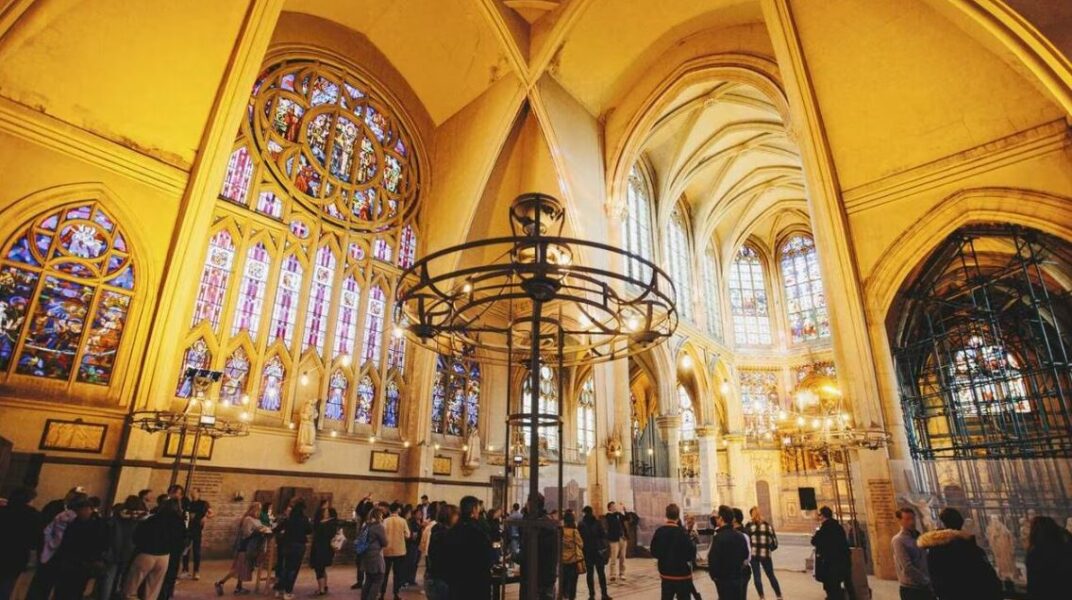
The church of Saint-Nicaise, in the French city of Rouen, will be transformed into a restaurant-brasserie—an establishment that combines a traditional restaurant with a brewery—thus culminating a process of abandonment and desecration that reflects the deterioration of the religious use of many temples in Europe.
From historic church to restaurant
According to Tribune Chrétienne, the city council has approved a project that will convert this former temple into a restoration space, with beer production and a museum area. The change means definitively leaving behind its sacred character to integrate it into a purely commercial activity.
Saint-Nicaise has a long history linked to Christianity in the region. Its origins date back to the 7th century, when a first chapel was built to house relics of Saint Nicasius. Over the centuries, the temple consolidated as a parish and center of religious life, resisting conflicts and transformations without losing its function.
Abandonment and progressive deterioration
The current building was rebuilt after a fire in 1934 and reopened for worship in 1940. However, decades later, structural deterioration, water leaks, and lack of maintenance led to its closure in 2006. In 2017 it was officially deconsecrated.
The economic argument has been decisive in the final decision. Local authorities argue that the restoration cost is too high. However, the temple’s current situation is also the result of years of abandonment and lack of effective conservation.
A heritage stripped of its religious meaning
The church’s grand organ, one of the most important in Rouen, has been dismantled for transfer to Paris, where it will be restored and installed in another temple. Although presented as a preservation measure, the transfer means the definitive break between the instrument and the space for which it was conceived.
Until a few years ago, Saint-Nicaise still maintained a social dimension, with activities to help the most needy, in continuity with the Christian charitable tradition. That function has also disappeared.
From desecration to commercial exploitation
The conversion of the temple into a brewery marks the last step in a clear process: from place of worship to abandoned building, and from there to commercial space. Although architectural elements will be preserved, the meaning of the place is completely transformed.
This case illustrates a reality that is increasingly common in Europe: temples that, after losing their religious use, end up being destined for purposes alien to their original nature, reflecting the loss of centrality of Christian life in society.