


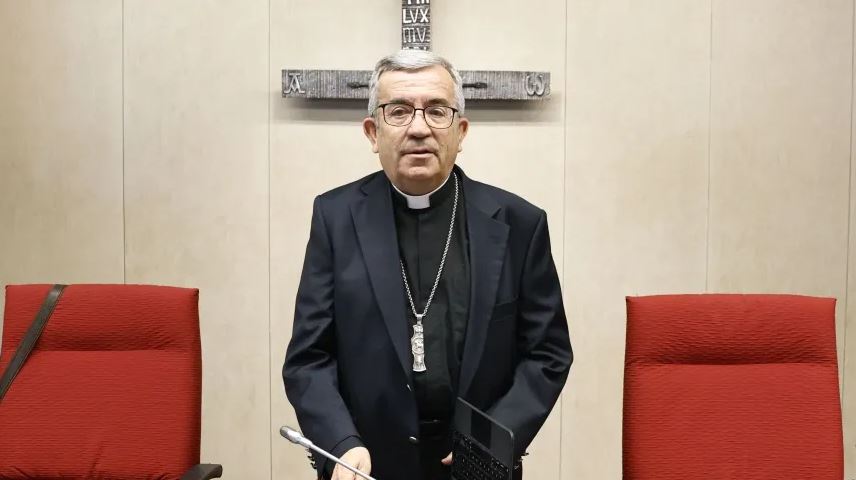
The president of the Spanish Episcopal Conference, Mons. Luis Argüello, delivered a clear message about the political situation in Spain and its relationship with the Church during the opening of the Plenary Assembly. His intervention was not limited to internal issues, but focused on the Government’s actions and the direction it is taking on fundamental matters.
From the outset, the archbishop hinted at a growing concern: that of a State that, despite declaring itself non-confessional, acts as if it had its own “confession.” Not in a religious sense, but ideological.
When ideology takes the place of reason
In that context, Argüello warned that the Executive is assuming a role that goes beyond political management. As he pointed out, it seeks to set criteria on essential issues such as life, marriage, or sexuality from “ideological faith criteria,” without relying on reason or common experience.
A political power increasingly present
From there, the diagnosis expands. Argüello spoke of an “unmeasured desire to intervene in civil society,” a trend that, in his view, is evident in various areas: from institutions to the economic or media spheres.
It is not just about specific measures, but about a style of government that seeks to occupy spaces that traditionally did not correspond to it. In that same vein, he denounced the existence of a “double standard” when addressing certain scandals, depending on who is affected.
The relationship with the Church, marked by conflicts
When he referred directly to the relationship with the Government, Argüello mentioned the main points of contact with the Church, which have centered on abuses and the future of the Valley of the Fallen.
In the case of abuses, he criticized the fact that it is acted upon as if the Church had not taken previous steps, ignoring the work carried out in recent years. And in that context, a phrase appeared that sums up the discomfort well: “the Government decides and the Church pays.”
The archbishop rejected that approach and defended the fact that the Church’s response cannot be reduced to an economic issue, but has a moral and spiritual dimension that cannot be overlooked.
The Valley, more than a political debate
There was also a reference to the Valley of the Fallen, which has become one of the main focuses of tension. Argüello bet on a “reasonable and satisfactory” agreement, but his words reflect a fundamental concern: that political decisions end up altering the meaning of a place with strong religious and historical significance.
Other topics in the president of the CEE’s intervention
Alongside these criticisms of the Government, Argüello addressed other relevant issues in his speech, such as the social and economic situation in Spain, the impact of loneliness and fragility on broad sectors of the population, as well as the need to strengthen community life and the role of the Church as a space of welcome.
He also referred to the international context, marked by conflicts and tensions that also affect Europe, and insisted on the importance of promoting a culture of encounter and dialogue in the face of growing polarization.
A diagnosis that repeats itself
The speech left a recognizable message: the perception that political action is increasingly marked by ideology and by a tendency to intervene in areas that directly affect social life.
In that scenario, the relationship between Church and State no longer moves solely in the realm of collaboration, but also in that of tension. And what is at stake, according to Argüello’s words, are not only specific decisions, but the very way of understanding man and society.