


Pope Leo XIV’s trip to Africa arrives preceded by a climate of political and media tension that did not arise out of nowhere. In the preceding days, statements by the President of the United States, Donald Trump, about the Pontiff had triggered a wave of interpretations of the Pope’s speeches that many media outlets accepted as valid without much scrutiny. From there, every word began to be read in the key of a retort, as if his pastoral agenda had been subordinated to a supposed verbal duel with the White House.
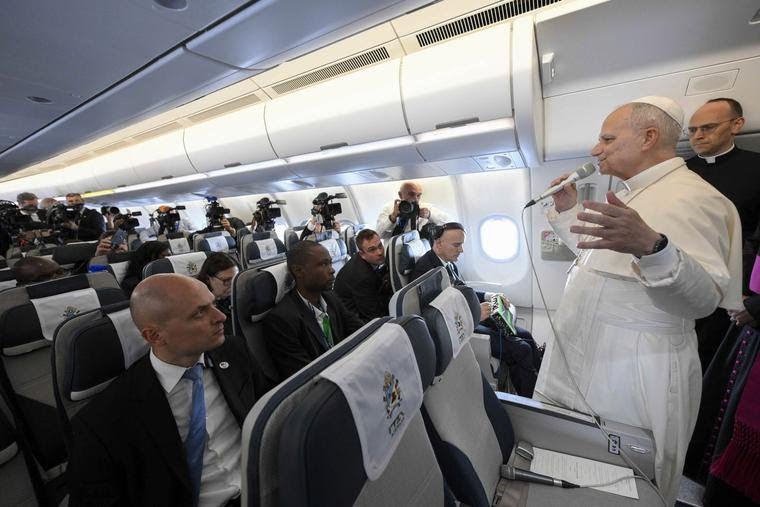
That context explains the clarification that Leo XIV has wanted to make now, aboard the flight to Angola, before journalists. The Pope has not denied that there is a prior crossing nor that his words have been placed by public opinion within that framework of tension. What he has rejected is precisely the journalistic reading that turns any intervention of his into a political gesture against Trump. In his view, an inaccurate narrative has been imposed, built more on successive comments and interpretations than on the real content of his speeches.
The pontifical clarification takes on special importance because part of the press had presented his intervention at the Prayer Meeting for Peace on April 16 as an indirect response to the American president. Leo XIV has refuted that thesis with a concrete fact: that speech had been prepared two weeks earlier, that is, well before Trump made the comments that sparked the controversy. The precision is no small matter, because it dismantles the idea of an improvised response or a message calculated to reopen political confrontation.
In this way, the Pope does not erase the context of friction, which exists and is evident, but he does mark a clear distance from the media coverage that has sought to fit all of his public activity into a scheme of confrontation with the President of the United States. Leo XIV insists that he has not traveled to Africa to intervene in an international political dispute, but to exercise his ministry as Successor of Peter and pastor of the universal Church.
His message, in that sense, seeks to refocus the spotlight. Against journalistic exaggeration and the temptation to interpret every phrase as a geopolitical stance, the Pontiff claims the pastoral nature of his visit. Africa thus does not appear as the stage for a new chapter in the tension with Trump, but as the destination of a trip designed to accompany, confirm, and encourage the Catholics of the continent.
These were the complete words spoken by Leo XIV before the journalists: «A certain narrative has spread, not entirely accurate, due to the political situation that arose when, on the first day of the trip, the President of the United States made some comments about me. Much of what has been written since then has been nothing more than commentary on commentary, in an attempt to interpret what was said. An example is the speech delivered at the Prayer Meeting for Peace on April 16. That speech had been prepared two weeks earlier, well before the President commented on me and on the message of peace that I am promoting. And yet, it was interpreted as if I were trying to engage in a debate with the President again, which is not my interest at all. I come to Africa primarily as a pastor, as Head of the Catholic Church, to be with, celebrate with, encourage, and accompany all African Catholics.»