


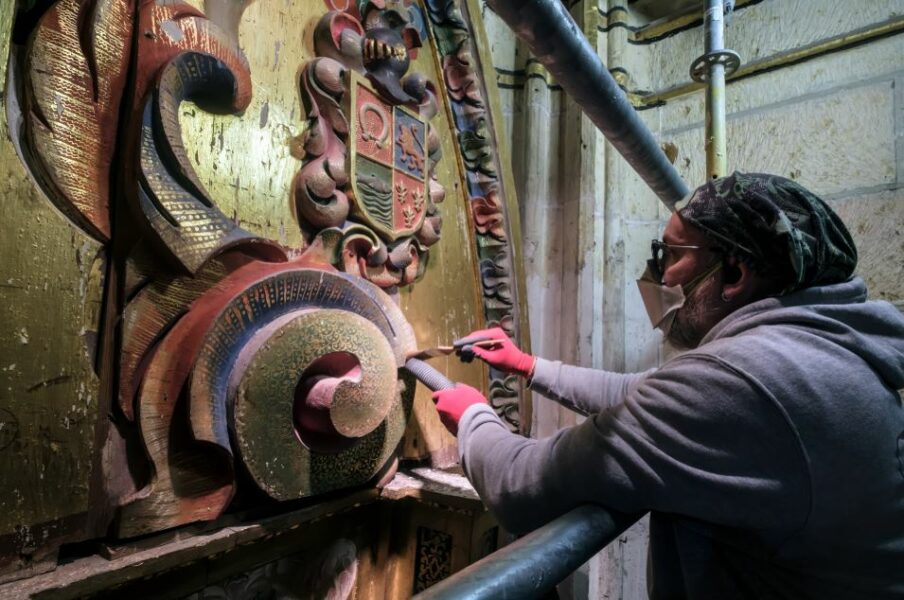
The Cathedral of Segovia has begun the restoration of the Chapel of Christ of Consolation and the doorway leading to the cloister, an intervention of great patrimonial value that will allow the study of the original materials of the ensemble and restore some of its splendor. According to the cathedral itself, the works will extend until autumn and encompass not only decorative elements, but the integral recovery of this historic space.
Beyond the 17th-century Baroque altarpiece that presides over the chapel, the intervention focuses on the true singular piece of the ensemble: the doorway funded by Isabella the Catholic in 1491. It is an element of enormous artistic and historical relevance, linked to the old Cathedral of Segovia and preserved today as one of the most valuable testimonies of royal patronage in the temple.
A royal doorway saved by history
The restorer Paloma Sánchez, responsible for the project, has emphasized that the main interest lies not so much in the current altarpiece as in the doorway and the grille that accompanies it. Both pieces belonged to the old Segovian cathedral and were moved to their current location in 1526, after the War of the Communities.
The doorway was made by Juan Guas, one of the great masters linked to the court of Isabella the Catholic. His name is associated with some of the most outstanding works of late Castilian Gothic, and his intervention in Segovia once again highlights to what extent the artistic history of Spanish cathedrals is intertwined with that of the Catholic monarchy itself.
An intervention that goes far beyond cleaning
The ongoing work has been planned as an integral restoration. This means it will not be limited to a superficial improvement, but will encompass the vault, the walls, the altarpiece, the grille, and also two 18th-century tombs present in the chapel. The objective is twofold: to halt deterioration and to know more precisely the original composition of each of the elements.
That prior study work is key, because it allows identifying pathologies, determining the real state of conservation, and establishing intervention criteria adjusted to the nature of the ensemble. In other words, it is not just about beautifying, but about rigorously preserving a space that has accumulated layers of history over centuries.
The vault still preserves details of great value
One of the most striking aspects of the chapel is the general good condition of its vault. In particular, its keystones stand out, which preserve the gilding applied to the mistion, an ornamental technique of notable delicacy used on stone. Along with this, the restoration will have to resolve some cracks and the marks left by leaks from the roof.
The works began in February with the assembly of a scaffold of special complexity, designed to allow visitor access to the cloister at the same time. Already in March, the superficial cleaning of accumulated dust began, and the forecast is that the entire intervention will conclude in September.
A space transformed by the centuries
The Chapel of Christ of Consolation has not arrived intact from its origin, but has undergone successive modifications. After being acquired in 1530, a disagreement with the chapter motivated the transfer of its first altarpiece. Later it passed into the hands of a canon, received a new altarpiece dedicated to Saint Peter, and housed the grille from the choir of the old cathedral.
Already in the 18th century, the space was transformed again with the transfer of the tombs and the current altarpiece to make room for another piece in the retrochoir. That long chain of changes explains that the current restoration not only has a technical dimension, but also a historical one: each phase of the work helps to reconstruct the material biography of a chapel that summarizes, in miniature, much of the history of the Cathedral of Segovia.