


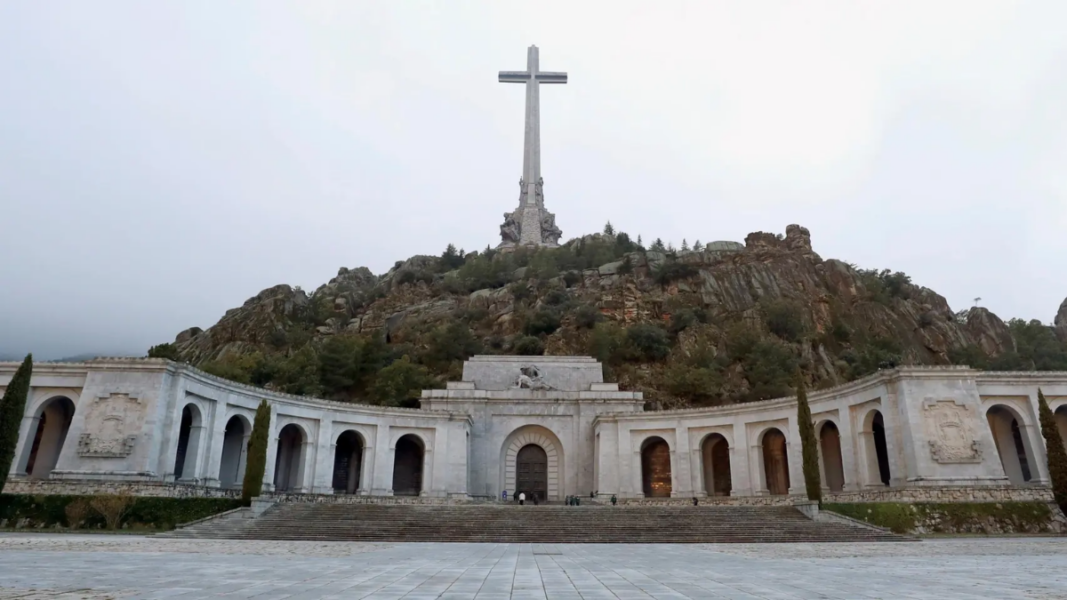
According to what InfoVaticana has been able to learn, the legal and political strategy of the monks of the Valley of the Fallen has been placed in the hands of Antonio Torres, an external actor without a formal position but with decisive influence in decision-making. Torres, father of one of the monks in the community, is a retired businessman who made his fortune in the private sector and who, in the past, tried unsuccessfully to make his way in politics, linked to initiatives like AVANZA alongside Benigno Blanco.
Various sources agree that his role has gone far beyond occasional advice. He has assumed, de facto, strategic direction at a critical moment, in which not only the continuity of the Benedictine community is at stake, but also the very nature of the Valley as a religious, historical, and symbolic enclave. The bet he would have conveyed to various ecclesiastical interlocutors is as clear as it is unsettling: to reach an agreement with Minister Félix Bolaños that «safeguards» the future of the Valley. According to what he told a Spanish archbishop, the plan would be «infallible, without cracks.» The underlying premise is that, if negotiations are conducted within the established margins and a pact is reached, the Government will respect what has been agreed.
The problem is that this hypothesis does not hold up to scrutiny against the accumulated facts of recent years.
The sequence is too consistent to interpret it as a sum of isolated decisions. What has unfolded around the Valley responds to a logic of continuous retreat. Each concession has been presented as the necessary sacrifice to preserve the essential. But that «essential» is never specified, while the losses are always tangible and cumulative. First came the symbols. Then, the exhumation of Francisco Franco, presented as the definitive gesture to close the conflict. It was not. Subsequently, that of José Antonio Primo de Rivera, under the same promise of pacification. That did not work either. Added to this are the change in the denomination of the complex, the sustained pressure on the Benedictine community, and the expulsion of Prior Santiago Cantera.
Each of these steps was justified in tactical terms: concede now to preserve later. But the «later» never arrives. The pattern is constant. And that pattern does not describe a negotiation, but a deferred surrender.
What is relevant is not the existence of political pressure. That is structural and has not varied. What is decisive is that internally, that framework has been accepted as inevitable. Action is taken as if the conflict could be resolved through successive unilateral concessions, under the premise that the adversary will at some point reach a threshold of satisfaction that will lead him to stop. Empirical evidence disproves that assumption. Each concession has been followed by a new demand.
In that context, proposals such as opening a monumental crack in the basilica or creating a museum of ideological reinterpretation are not anomalies. They are the logical consequence of having accepted a prior principle: that the Valley must be redefined in order to survive. From there, the debate stops being whether it is transformed or not, and becomes how far one is willing to transform it. And each prior concession becomes a precedent for the next.
The figure of Antonio Torres fits into this framework with an additional element of risk: the absence of institutional legitimacy to assume a strategic direction of this caliber. Having contributed economically to certain reforms, having offered legal support, or having exercised personal influence does not grant a mandate to decide the future of a complex that is not private property or an individual project. The Valley of the Fallen is a space with historical, religious, and political dimensions that transcends any personal or family initiative.
Sources consulted by InfoVaticana warn that the decisions driven under this orientation have already led to significant failures in the community’s capacity for resistance. It is not just about concrete results, but about the consolidation of a dynamic in which each step back becomes a condition for the next. Under this logic, an outcome cannot be ruled out in which, after successive concessions, what was intended to be preserved is lost.
The underlying problem is one of judgment. It is not possible to defend a reality by accepting the premises of those who seek to transform it radically. It is not viable to preserve an identity if it is assumed that it must be reformulated constantly to be acceptable to the political power of the moment. And it is not sustainable for a community whose strategic decisions respond to external dynamics or leaderships not subject to control or accountability.
The so-called «prudent strategy» has led to a process of progressive disarmament. There is no prudence in conceding without limit. There is none in continuously redefining the object that one seeks to protect. What is observed is an inability to set red lines and sustain them over time. Without red lines, any negotiation is lost from the start.
The result is that the Valley is no longer being defended in its integrity. It is being managed in its transformation. And whoever operates within that framework, even if they do so with the intention of saving what they consider possible, stops acting as a defender to assume the role of manager of the renunciation.