


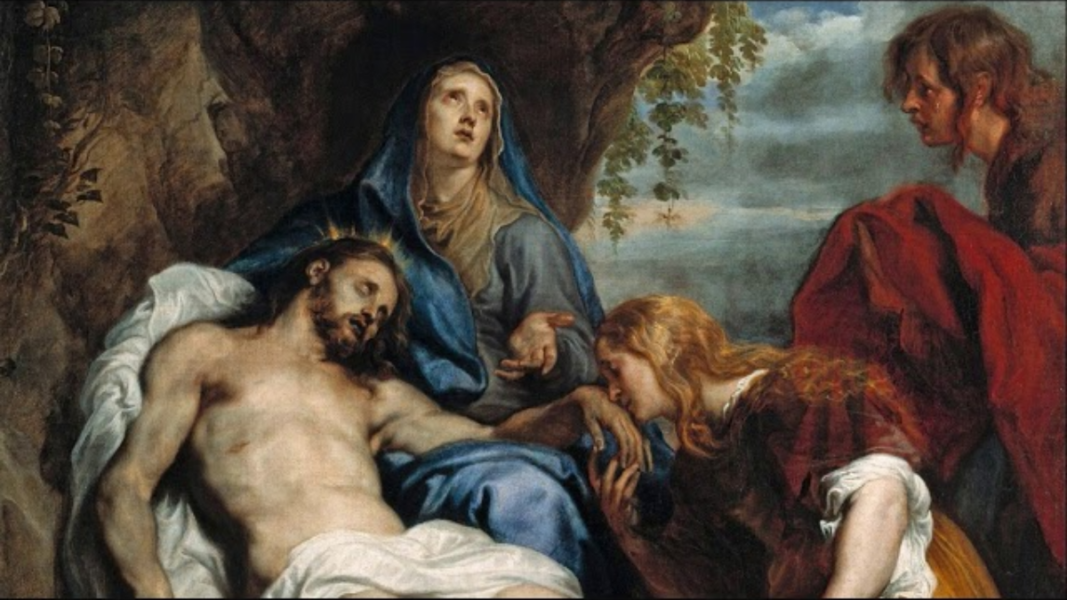
Holy Saturday is the day when, with voices silenced and the sacrifice consummated, the Christian soul can look straight at a truth that is normally overlooked: we no longer belong to ourselves. Christ has bought us at the price of his blood, and Mary, the sorrowful Mother, remains in silence beside that mystery, teaching us not to flee from the Cross when the glory of Easter has not yet dawned.
The price of our redemption was not symbolic
After Good Friday, the Church does not rush to fill the void with words. It is silent. And it does well. Because before the death of the Son of God, all rhetoric is superfluous. The blood has been shed, the body has been laid in the tomb, and the world, though it continues with its pursuits, has been marked forever by an unrepeatable event: our redemption cost the life of Christ.
St. Louis Marie Grignion de Montfort says it with the clarity of one who does not reduce Christianity to a pleasant sentiment: «we no longer belong to ourselves, but we are entirely his, as his members and slaves, bought with the infinite price of all his blood». Here there is no pious metaphor or decorative language. There is a radical affirmation: Christ has not only saved us from sin; he has made us his own.
That is why Montfort adds that «we must no longer live, work, or die except to bear fruit for this God-Man». Redemption is not an idea to admire from afar, but a truth that demands consequences. If we have been bought, then our life cannot continue to be administered as private property. We are not absolute owners of our time, our talents, our works, or our will. Everything has been touched by the blood of Christ.
Holy Saturday is Mary’s day
If Good Friday is the day of sacrifice, Holy Saturday is, in a certain way, the day of the Mother’s silence. The disciples have known scandal, fear, and dispersion. Mary, on the other hand, remains. She does not preach, does not protest, does not rebel, does not demand explanations. She is there. She believes. She waits. She suffers.
That is why this day has a markedly Marian face. Accompanying Mary on Holy Saturday is entering the deepest school of faith. No one like her has seen up close the price of our redemption. No one like her has contemplated the blood of the Son shed to the last drop. No one like her has held in her pierced heart the darkness of this hour.
Beside Mary, the Christian understands that the Cross is the act by which the Son of God rescues us for himself. And precisely because Mary has been beside the Cross, her silence on Holy Saturday is not empty, but a living memory of the sacrifice, fidelity, and hope.
“Jesus Christ wants to gather some fruit”
Montfort reminds us that «Jesus Christ wants to gather some fruit from our poor persons» and immediately specifies what that fruit is: «our good works, because these belong exclusively to him». This affirmation cuts short a comfortable vision of faith. Christ did not shed his blood to leave us settled in a religion without consequences. He has redeemed us so that we may bear fruit.
Holy Saturday invites us precisely to examine that fruit. If we have gone through Lent, if we have contemplated the Passion, if we venerate the Cross, but continue to live as if we were our own exclusive property, then we have not yet understood the price paid for us. It is not enough to be moved by the dead Christ; we must recognize that his death claims our life.
In a time like ours, obsessed with autonomy, freedom, and the right to decide everything for oneself, this message is at least scandalous. But the Gospel was not given to flatter modern pride. It was given to save man. And man is only saved when he accepts that he is not sufficient unto himself, that he has not redeemed himself alone, and that he cannot live with his back turned to the One who shed his blood on the Cross.
Slaves of love, not hired workers of God
The word ‘slave’ sounds strong, restrictive, and surely contrary to respected Human Rights, but, according to Montfort, it is precise, and that is why he makes the distinction between servant and slave. The servant serves for a time, retains rights, sets conditions, expects wages. The slave, on the other hand, gives himself entirely and reserves nothing. It may sound harsh to modern ears, but the saint uses this image to show to what extent our belonging to Christ must be total.
That is why the Marian saint writes that we must serve him «not only as hired workers, but as slaves of love». It is not a humiliating slavery, but a free surrender, born of the recognition of the love received. He who has understood what his rescue cost no longer calculates, no longer haggles, no longer asks how much he must give: he surrenders himself.
And here Mary appears in a decisive way. Because she is the creature who has best lived this total availability. From the Annunciation to Calvary, her entire existence has been a sustained fiat. Mary does not belong to herself. Everything in her is referred to God. Everything in her is obedience, welcome, surrender. That is why Holy Saturday, lived beside the sorrowful Mother, teaches the Christian the concrete form of that slavery of love: to be silent, to remain, to offer oneself, and to wait.
To Christ through Mary
Montfort does not only speak of belonging to Jesus Christ; he also teaches that the surest way to belong to him completely passes through the Most Holy Virgin. His words are precise: «The Most Holy Virgin is the means that the Lord used to come to us. She is also the means that we must use to go to him». And he adds something even more important: «Mary’s strongest tendency is to unite us to Jesus Christ».
Mary retains nothing for herself. She does not compete with Christ, does not obscure his lordship, does not distract from the paschal mystery. On the contrary: she leads the soul toward a purer, quicker, and more complete union with her Son. That is why accompanying her on Holy Saturday is not stopping in the pain of a mother, but learning from that mother to cross the night with faith and to reach Christ without reservations.
The Mother’s silence is not defeat
There is something profoundly instructive in Mary’s silence. While the world judges by appearances and men are scandalized by the failure of the Cross, the Mother remains united to God’s plan. She understands no less than we do; she understands more. She suffers no less than we do; she suffers much more. But she does not withdraw.
That silence, therefore, is not defeat. It is supernatural strength. It is purified faith. It is the highest form of accompanying Christ when there is nothing external left to sustain hope. And that is why Holy Saturday is a privileged day to place oneself beside her and learn to wait. Not with a superficial wait, proper to one who knows that the story will end well, but with the painful and faithful wait of one who has passed through the wound of the sword and, even so, continues to believe.
In the light of this presence of Mary, Montfort’s phrase acquires even greater weight. We have been bought with blood, yes; but that price is better contemplated from the pierced heart of the Mother. She adds nothing to Christ’s sacrifice in terms of its redemptive value, but she does teach us to enter into it and receive it.