


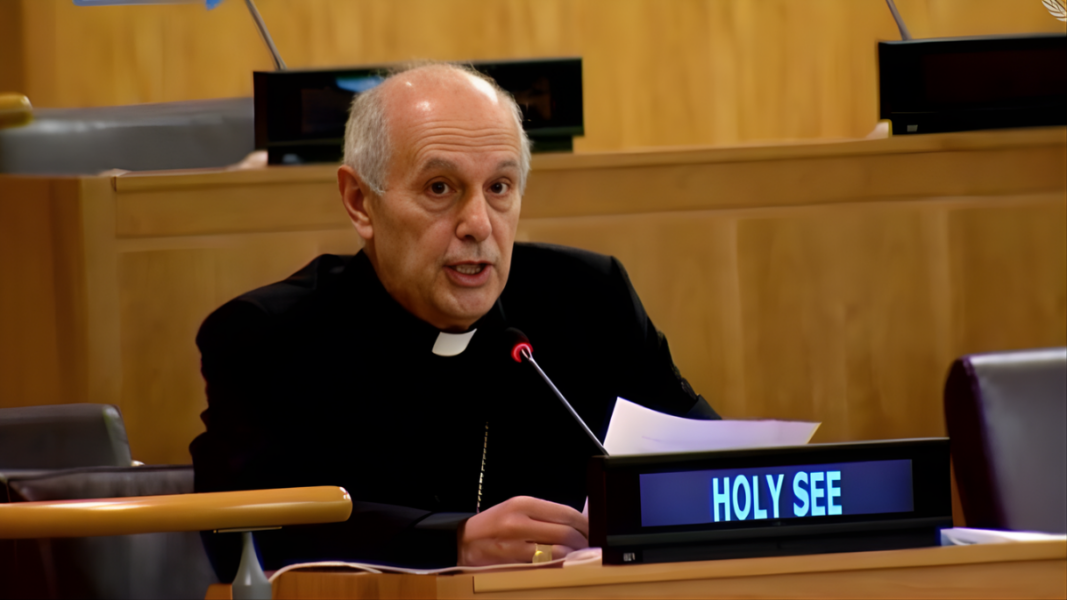
Archbishop Gabriele Caccia, the new nuncio to the United States and until now the permanent observer of the Holy See to the United Nations, has questioned the approach adopted by the UN in its recent resolution on the transatlantic slave trade, especially due to the reference to papal bulls from the 15th century as part of the system that would have legitimized this practice.
The resolution approved on March 25 by the General Assembly, with 123 votes in favor, 52 abstentions, and three against—United States, Israel, and Argentina—declares the trafficking of Africans as “the most serious crime against humanity” and includes mentions of pontifical documents such as Dum Diversas (1452) and Romanus Pontifex (1455).
The UN places the bulls within the process of legal codification of slavery, stating that they would have authorized the reduction of Africans to “perpetual slavery,” along with colonial laws and commercial regulations of the time.
“A partial narrative,” according to the Holy See
In response to this approach, Caccia warned that the resolution’s focus does not adequately reflect the complexity of the historical context.
“The approach contains a partial narrative that, unfortunately, does not serve the cause of truth,” stated the Vatican representative.
The Holy See maintains that these documents must be understood in their historical and political context, and not as an expression of the Church’s doctrine on human dignity.
The Church’s position on slavery
The archbishop recalled that the Church has condemned slavery at various stages in history, citing documents such as the bull Sicut Dudum by Eugene IV (1435), which already denounced the enslavement of peoples in the Canary Islands, or the teachings of Leo XIII in the 19th century.
Read also: The Holy See renounces the “Doctrine of Discovery”
In this vein, he reiterated that the Church rejects any form of slavery, including its contemporary manifestations.
Source: The Pillar