


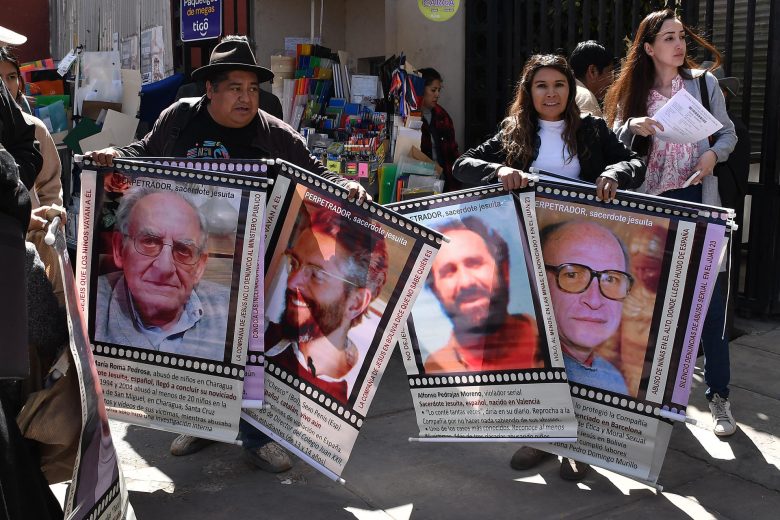
Bolivia was for decades the destination to which Jesuit priests accused of sexual abuse in Catalonia were sent, in what the victims describe as an organized system to hide crimes and avoid justice. This is what the Bolivian Community of Survivors (CBS) claims, which has demanded that the Parliament of Catalonia and the Ombudsman open an institutional investigation.
The report, recently presented by the victims’ association, places the origin of what they consider the largest case of pedophilia in Latin America in the Tarraconense Province of the Society of Jesus, with around twenty identified aggressors and nearly a thousand victims in Bolivia.
A system of transfers to evade justice
As explained by jurist Alejandro Klock, representative of the victims, in statements collected by the EFE agency, the abuses «originate» in Catalonia, which acted as the «mother» province of the Bolivian mission from the mid-20th century.
The denounced pattern is repeated: when a priest was accused or discovered abusing minors in Catalan schools, his superiors chose to transfer him to Bolivia instead of reporting him.
There, far from the European judicial spotlight, these religious continued their activities in especially vulnerable environments. Minors in situations of vulnerability were exposed—according to the victims—to new abuses for years.
«The great aggrieved party is Bolivia; they have created a criminal system that has perpetuated itself for decades,» stated Klock, in statements disseminated by Swissinfo.
The victims have summarized this practice with an expression as harsh as it is revealing: Bolivia was turned into a «dump for pedophiles».
From Pedrajas’s diaries to a broader plot
The case gained international dimension after the investigation published by El País in 2023 on the diary of the Jesuit Alfonso Pedrajas, in which he confessed to abuses against at least 85 minors over years while his superiors protected him.
From that moment, new information and internal documents began to come to light, revealing that it was not an isolated case. The Bolivian Prosecutor’s Office then opened an unprecedented investigation that led to the prosecution of order officials for cover-up.
The CBS report, compiled after years of evidence gathering, includes internal letters, canonical resolutions, and documentation that would evidence that the Company knew about the abuses for decades and received directives from Spain and Rome to manage them without resorting to justice.
Names, evidence, and prolonged cover-ups
Among the documented cases are priests transferred from Catalonia after previous complaints, such as Francesc Peris or Lluís Tó, in addition to others directly involved in Bolivia.
Particularly serious is the case of Lucho Roma, who abused more than 70 indigenous girls between 1994 and 2005. According to the El País investigation, the order even internally investigated the facts and seized diaries and graphic material, but chose not to hand them over to justice for years.
The victims denounce that these cover-ups do not belong only to the past, but have continued until recent dates, without those responsible having faced criminal penalties.
International responsibility and institutional pressure
The report argues that the Tarraconense Province exercised total control—administrative, hierarchical, and financial—over the mission in Bolivia, which strengthens the thesis of structural responsibility in the events.
In addition, the victims denounce the lack of collaboration from ecclesiastical authorities and the absence of effective reparation, despite the internal acknowledgment of many of the cases.
In this context, they have requested that the Parliament of Catalonia create an investigation commission and that the Ombudsman clarify how this system was possible for decades.
«Catalonia must know that what is being investigated here are not isolated cases, but the origin of the largest case of institutional pedophilia in Latin America,» stated Klock, as reported by El País.
While in Bolivia convictions for cover-up have already been handed down against former Jesuit officials, in Spain the institutional responsibility remains, for now, unaddressed.