


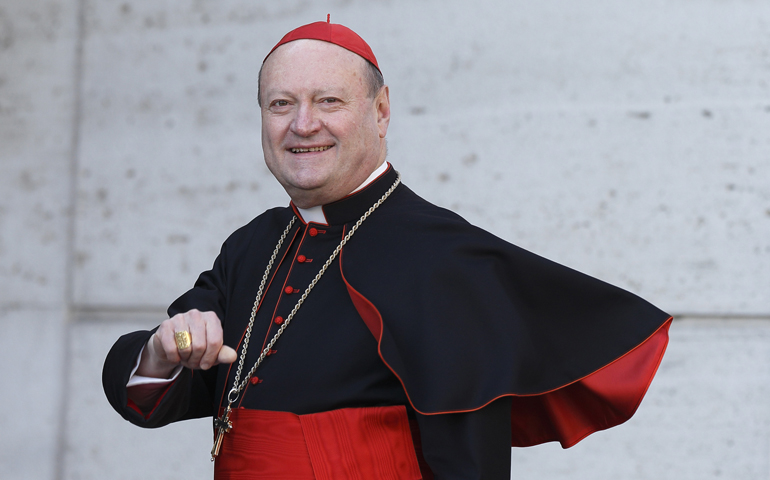
Cardinal Gianfranco Ravasi, who served as president of the Pontifical Council for Culture from 2007 to 2022 and one of the most prominent intellectual figures in the Vatican in recent decades, has given an interview to La Vanguardia that has sparked immediate controversy due to the content of his statements and the openly political tone of many of them.
During the conversation, Ravasi defines himself without mincing words on the ideological plane. When asked about his political position, he responds succinctly and directly: “Politics? Progressive.” From there, the cardinal dives headlong into the migration debate and lashes out at the President of the United States, Donald Trump, with an equally blunt formulation: “Persecuting immigrants, as Trump does, is anti-Christian.”
Ravasi reinforces that idea with a particularly striking historical comparison. “Persecuting people is anti-Christian, just as it was to persecute Christians two thousand years ago in that Rome,” he states in the interview. And he drives home his assessment with another even more explicit phrase: “A racist policy, I would say.”
The interview also includes a reference to Italy’s political past that has also drawn attention. Ravasi asserts: “Personally, I miss the classic Christian democracy, an Italian tradition that was very beneficial.” Along with that, he summarizes his general vision with another significant expression: “I believe in God, and God is a humanist.”
A political vision wrapped in religious language
Ravasi’s words are interesting in themselves, but even more so is the mental framework they reveal. This is not simply a cardinal opining on current events. It is a way of speaking and thinking that has marked a significant part of the European ecclesiastical hierarchy for decades. A way of interpreting reality in which modern political categories end up imposing themselves over the proper language of faith.
In Ravasi, that almost automatic reflex appears clearly, by which a complex political issue is reduced to an immediate moral formula. Everything simplifies into a very recognizable chain: if a migration policy is judged to be harsh, it then comes to be defined as persecution; if it is defined as persecution, it is then presented as anti-Christian; and from there, the discussion disappears because there is no longer room for prudential analysis, but only for condemnation.
That mode of reasoning does not distinguish between the dignity that every person deserves and the right of States to control their borders. It does not differentiate between a concrete moral critique and a total disqualification. And above all, it does not help to think, because it replaces judgment with the label.
The banalization of history
The comparison with the persecutions of ancient Rome says a lot about this intellectual style. Placing the martyrdom of the first Christians and contemporary immigration policies on the same plane does not elevate; it is imprudent and confusing. The Roman persecutions were a systematic religious repression, with blood, coercion, and death. Using them as a rhetorical resource to comment on current government decisions reveals a very widespread tendency in certain progressive Catholicism: to use sacred history as a repository of striking images in the service of present-day political causes.
When everything can be called persecution, persecution ceases to mean something precise. When every strong disagreement becomes an absolute moral drama, language loses rigor and turns into propaganda.
The nostalgia for an old Italian ruin
Another revealing phrase from the interview is the one he dedicates to the old Italian Christian Democracy. Ravasi misses it and presents it as a “very beneficial” tradition. That nostalgia portrays an entire generation. Because the Christian Democracy that some continue to evoke with sentimentality was not only the party that dominated Italy for decades; it was also the Christian democracy of divorce, abortion, and corruption.
It was the Christian democracy incapable of offering real and lasting political resistance to Italy’s moral secularization. It was the Christian democracy that administered power for years while the country slid toward legislation increasingly alien to natural law. It was also the Christian democracy corroded by clientelism, apparatus deals, and a corruption so widespread that it ended up dragging down the entire Italian political system in the 1990s.
Presenting that legacy as a beneficial tradition without adding a single shadow is not an oversight; it is the selective memory of those who continue to identify political moderation with virtue.
A key generation for understanding the crisis
Ravasi’s interview ultimately serves to understand something broader than his own words. It helps to recognize the ideology of a generation of octogenarian cardinals formed in the cultural climate of postwar Europe, fascinated by dialogue with modernity and convinced that the Church had to continually translate itself into the world’s language to remain heard.
From that operation came an unstable synthesis. Instead of converting the world, many of them ended up adopting its categories. Instead of offering a Christian gaze on politics, they ended up offering a politics with Christian vocabulary. Instead of firmly safeguarding their own moral judgment, they assumed many of the premises of European progressivism as obvious, even though that same progressivism has systematically worked against essential pillars of Christian civilization.
That is why these statements matter. They are not an isolated extravagance or a mere slip of the tongue. They are the reflection of a mentality that has had real weight in the Church and that still helps to explain many of its current ambiguities. A mentality that speaks a lot about dignity, humanity, and openness, but that has frequently been unable to recognize the doctrinal, moral, and cultural cost of that continuous adaptation.
Understanding these cardinals is understanding a decisive part of the contemporary ecclesial crisis. Because in them one can clearly see a form of Catholicism that has aged, politically predictable, docile before dominant schemes and surprisingly indulgent with the great historical failures of European Christian democracy. And also because, in hearing them speak, one perceives to what extent a part of the hierarchy has confused the Gospel with the ideological sensitivity of an era for too long.
Ravasi does not improvise. He maintains a line.
In 2016 he did not deny the formal incompatibility between Church and Freemasonry, but he emptied it of practical content. He spoke of “common values,” asked to overcome prejudices, and addressed Freemasons as “dear brothers.” The gesture was not innocuous. It introduced a framework: doctrinal truth takes a backseat to cultural dialogue.
Ten years later, that framework becomes explicit in the language.
First, the phrase: “God is a humanist.” This is not journalistic rhetoric. It is a conceptual inversion. Classical Christianity is theocentric: God is the end, man is ordered to Him. Modern humanism, on the other hand, takes man as the measure. If God is defined as “a humanist,” He ceases to be the absolute transcendent and is interpreted from human categories. It is the theological translation of that “common values” from 2016: if the center is no longer God but man, the distance from systems like Freemasonry—which are explicitly humanistic—reduces until it becomes irrelevant.
Second, the statement about Mary Magdalene: “favorite disciple” and “she knew.” Here the problem is not frontal, but more subtle.
The Gospel does not call Magdalene “favorite.” She is a privileged witness to the Resurrection, yes, but she does not occupy that affective-theological place that tradition has reserved for the beloved disciple. Introducing that category alters the internal hierarchy of the Gospel narrative without textual basis.
The appendage “and she knew” adds another layer. It does not define what she knew. It suggests special knowledge. That language fits gnostic readings where Magdalene possesses a superior revelation compared to the apostles. The Church has systematically rejected those interpretations. Ravasi does not affirm them, but he opens the door.
The connection to 2016 is direct. Then he proposed dialogue with Freemasonry on the basis of “common values.” Today he uses categories—theological humanism, ambiguity about reserved knowledge—that are compatible with that common ground. He does not deny doctrine. He surrounds it, dilutes it, and reinterprets it.
The pattern is stable: displacement of precise language toward open formulas that allow convergences where there was previously incompatibility.