


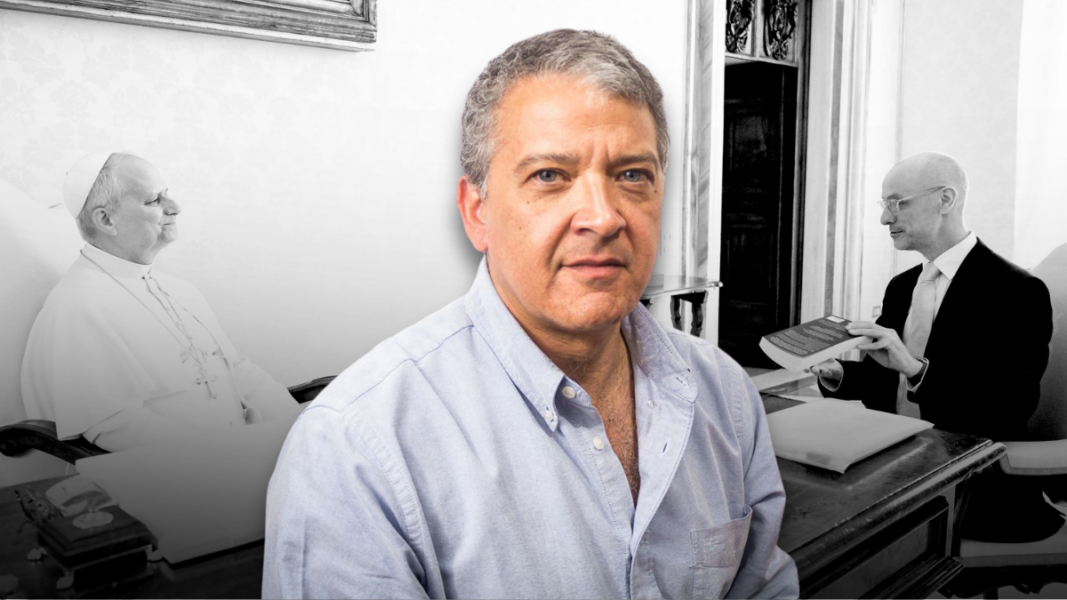
The recent audience granted by León XIV to the British journalist Gareth Gore, author of the book Opus, has provoked evident unease in various ecclesiastical circles. The reason is not difficult to understand. Gore’s work offers an extremely critical view of the Opus Dei, which he goes so far as to describe as a «sect», and compiles a long series of accusations and controversial episodes that the institution itself hastened to publicly reject. In that context, it has been particularly striking that, according to the author himself, the Pope described the book as a «rigorous work».
However, it is advisable to introduce an essential nuance from the outset. That statement has not been confirmed by the Holy See. It comes exclusively from the account provided by Gore in his personal publication, and there is currently no official corroboration regarding the specific content of the conversation held with the Pontiff. Given that this type of private audience is rarely clarified by the Vatican, the prudent course is not to grant that version conclusive value. Even so, the episode has gained public relevance and deserves careful examination, not only for what was presumably said, but above all for the way in which the meeting took place.
And there emerges a fact that has barely been highlighted, but which is particularly significant. According to Gore himself, the first contact to prepare the audience did not come through the ordinary channels of the Holy See or from his publishing circle, but through the Peruvian journalist Pedro Salinas, with whom he had last coincided in December, during a conference held in Argentina. It was Salinas, according to that version, who conveyed that León XIV knew his book and wanted to speak with him alone.
The question arises inevitably. Why was the channel to reach the Pope precisely Pedro Salinas? He is neither the author of the book, nor his editor, nor a habitual Vatican expert, nor a figure with any position in the Roman Curia. His connection to this matter seems to be explained only by the personal relationship he has maintained for years with Robert Prevost, now León XIV, stemming from the period when the latter held pastoral responsibilities in Peru.
That bond would have been forged, to a large extent, in the context of journalistic and media investigations surrounding the Sodalicio de Vida Cristiana, a case in which Salinas played a very visible role. That process ended with severe decisions taken by ecclesiastical authority, including expulsions of members and, finally, the dissolution of the institution by pontifical decree. Salinas followed that trajectory very closely and, according to various accounts, discussed various issues related to the case with Prevost, first in Peru and later in Rome, when he was appointed prefect of the Dicastery for Bishops.
But precisely for that reason, his intervention in this new episode seems even stranger. Because the Opus Dei has no direct relationship with the Sodalicio process, even though some journalists and commentators have attempted to draw parallels between the two realities. The fact that Salinas now appears as an intermediary in a papal audience with the author of a book particularly hostile to the Opus Dei is, at the very least, a striking fact that demands explanation.
It is not a matter of asserting without proof that a concerted maneuver existed. That would be excessive and unserious. But neither does it seem reasonable to ignore the anomaly. If the audience had stemmed from a direct decision by the Pontiff, the normal course would have been for the contact to occur through the ordinary mechanisms of the papal entourage. Instead, the fact that the arrangement appears associated with an external figure, ideologically very marked and actively involved in public controversies with strong political and ecclesiastical overtones, opens a field of suspicion that cannot be dismissed lightly.
The issue becomes even more delicate if one takes into account the stated purpose by Gore himself in making public his version of the meeting. The journalist explained that he decided to publicize the episode to «create a public record» of what the Pope knows about his accusations against the Opus Dei. In other words, the audience was not presented as a simple private conversation, but as a fact with public projection, susceptible to being interpreted as moral or intellectual support from the Pontiff for a particular narrative. That is precisely where the problem lies.
When a private meeting with the Pope is used as an element of legitimation within an ecclesiastical controversy, the risk of media instrumentalization becomes evident. And that risk is aggravated if access to the Pontiff has come through people who are not neutral observers, but active protagonists in very specific informational and ideological battles.
Pedro Salinas is, in that sense, a figure well known in the Peruvian public sphere. Not only for his role in the Sodalicio case, but also for his openly leftist profile, his declared status as a non-Catholic, and his political and media confrontation with the mayor of Lima, Rafael López Aliaga, a conservative leader and member of the Opus Dei. That public enmity does not belong to the realm of speculation: it is part of the Peruvian political debate and has had numerous episodes of great intensity.
One of them occurred in early 2025, when López Aliaga awarded the cardinal Juan Luis Cipriani, emeritus archbishop of Lima and also a member of the Opus Dei, the Medal of the Order of Merit of the city. The distinction provoked an immediate media storm, fueled by the reactivation of old accusations and controversies, and Salinas was among the harshest voices against the recognition granted to both the cardinal and the mayor. All of this contributed to consolidating the impression that certain journalistic and political sectors in Peru have placed the Opus Dei and figures linked to it at the center of a sustained campaign of public wear and tear.
In that context, Salinas’s appearance as a mediator in a papal audience with Gareth Gore inevitably acquires a dimension that transcends the merely anecdotal. Not because it demonstrates, by itself, an improper intention on the part of the Pontiff, but because it feeds an uncomfortable perception: that access to the Holy Father might be being used, even indirectly, to reinforce certain positions within national controversies that mix religion, media, and political struggle.
The heart of the matter, therefore, is not so much in reconstructing word for word a private conversation that no one outside the participants can verify. The decisive issue is another: who really promoted the meeting, why was that channel used, and with what public effects has it been presented afterward. As long as those questions remain unanswered, the episode will continue to be shrouded in shadows.
And they are not minor shadows. Because the Pope’s moral authority cannot become, even involuntarily, a useful piece in media disputes driven by clearly positioned actors. The institutional prudence of the Church exists precisely to prevent a private audience from turning into ammunition for a battle alien to the proper mission of the Pontificate.
For that reason, rather than debating now whether León XIV said exactly this or that phrase, what is truly relevant is to clarify the itinerary of this meeting. Was it a personal initiative of the Pope? Was it suggested by third parties? Why does the name of Pedro Salinas appear at the center of the arrangement? And why has the final outcome been presented publicly in a way so functional to one of the parties in the dispute? They are legitimate, reasonable, and necessary questions.
Answering them would help not only to clear doubts, but also to protect the Pontiff himself from an interested use of his figure. Because when the Pope’s name enters, even unintentionally, into the machinery of media operations marked by ideological affinities, political enmities, and long-running journalistic campaigns, the damage does not limit itself to a specific institution. It affects the very credibility of the pastoral neutrality that must surround the exercise of the Petrine ministry.