


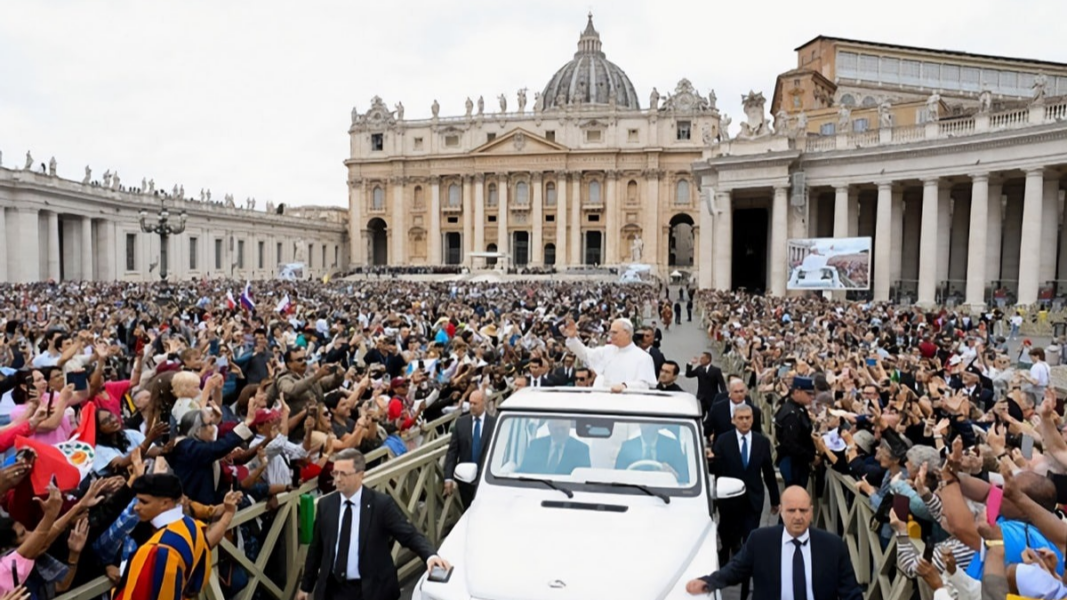
Pope Leo XIV centered this Wednesday’s general audience on the identity of the Church as the «people of God,» resuming his cycle of catechesis dedicated to the documents of the Second Vatican Council and, in particular, to the dogmatic constitution Lumen gentium.
Before thousands of pilgrims gathered in St. Peter’s Square, the Pontiff explained that the Church is born from God’s saving initiative in history and is founded on faith in Christ, who gathers men and women from all nations into a single people.
During the audience, the Pope also issued a call to pray for peace in Iran and throughout the Middle East, especially remembering the numerous civilian victims, including many children.
We leave below the complete message from Leo XIV:
Dear brothers and sisters, good morning and welcome!
Continuing the reflection on the Dogmatic Constitution Lumen gentium (LG), today we pause at the second chapter, dedicated to the People of God.
God, who created the world and humanity and who desires to save every man, carries out his work of salvation in history by choosing a concrete people and dwelling in them. For this reason, he calls Abraham and promises him numerous descendants like the stars in the sky and the sand on the sea (cf. Gen 22:17-18). With Abraham’s children, after freeing them from the condition of slavery, God establishes a covenant, accompanies them, cares for them, and gathers them every time they stray. Therefore, the identity of this people is given by God’s action and by faith in Him. It is called to become a light for the other nations, like a beacon that will attract all peoples, all humanity to itself (cf. Is 2:1-5).
The Council states that «all of this happened in preparation and figure of that new and perfect covenant which was to be concluded in Christ, and of that fuller revelation which was to be made by the same Word of God made man» (LG, 9). It is, in fact, Christ who, in the gift of his Body and his Blood, gathers this people to himself in a definitive way. This people is already formed by persons from any nation; it is unified by faith in Him, by adherence to Him, by living His same life animated by the Spirit of the Risen One. This is the Church: the people of God who obtains its existence from the body of Christ [1] and who is itself the body of Christ; [2] not a people like the others, but the people of God, convened by Him and formed by women and men from all the peoples of the Earth. Its unifying principle is not a language, a culture, or an ethnicity, but faith in Christ: the Church is therefore—according to a beautiful expression of the Council—»the assembly of those who look with faith to Jesus» (LG, 9).
It is a messianic people, precisely because it has Christ, the Messiah, as its head. Those who form part of it do not presume merits or titles, but only the gift of being, in Christ and through Him, daughters and sons of God. Before any task or function, therefore, what really counts in the Church is being grafted onto Christ, being by grace children of God. This is also the only honorary title we should seek as Christians. We are in the Church to receive ceaselessly the life of the Father and to live as His children and as brothers and sisters among ourselves. Consequently, the law that animates relationships in the Church is love, as we receive it and experience it in Jesus; and its goal is the Kingdom of God, toward which it walks together with all humanity.
Unified in Christ, Lord and Savior of every man and woman, the Church can never fold in on itself, but is open to all and for all. If believers in Christ belong to it, the Council reminds us that «all men are called to form the new people of God. Therefore, this people, remaining one and unique, must extend to the whole world and to all ages, so that the design of God’s will may be fulfilled, who at the beginning created human nature as one, and wants to gather His children, who were scattered» (LG, 13). Even those who have not yet received the Gospel are, in some way, oriented toward the people of God and the Church, cooperating with the mission of Christ, which is called to spread the Gospel everywhere and to all (cf. LG, 17), so that each one may come into contact with Christ. This means that in the Church there is and must be room for everyone, and that every Christian is called to proclaim the Gospel and to bear witness in every environment in which he lives and works. This is how this people manifests its catholicity, welcoming the riches and resources of diverse cultures and, at the same time, offering them the newness of the Gospel to purify and elevate them (cf. LG, 13).
____
[1] Cf. J. Ratzinger, El nuevo pueblo de Dios, Brescia 1992, 97.
[2] Cf. Y. M.-J. Congar, Un pueblo mesiánico, Brescia 1976, 75.
[3] Cf. H. de Lubac, Catolicismo. Aspectos sociales del dogma, Milán 1992, 222.