


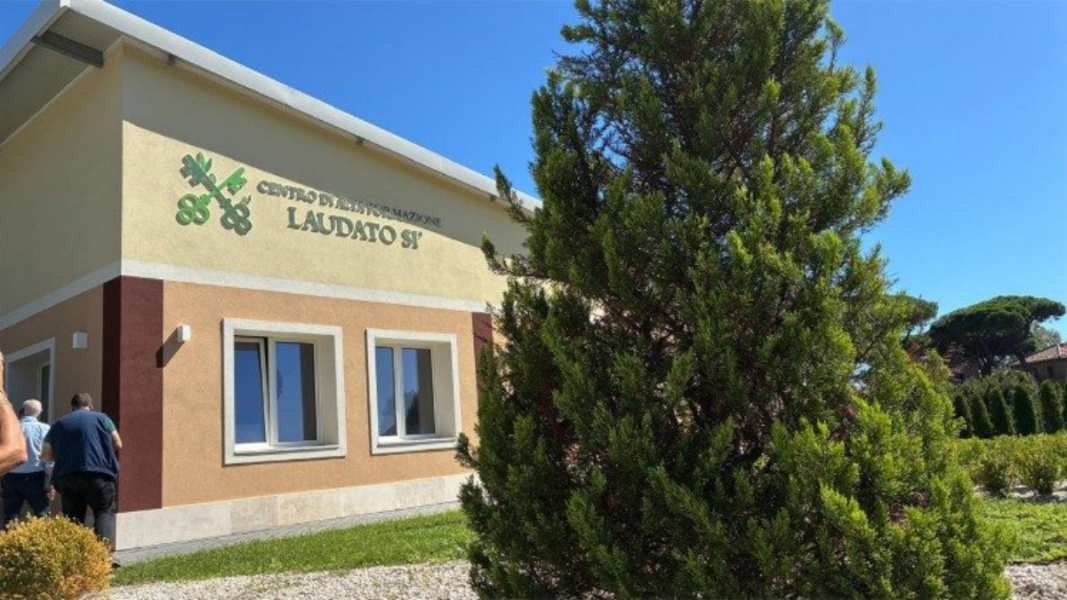
The Borgo Laudato Si’, the Vatican-driven ecological laboratory in the former pontifical villas of Castel Gandolfo, has hosted representatives from more than 60 international universities and various organizations to launch a “global alliance” aimed at promoting integral ecology and coordinating academic initiatives in the face of the climate crisis.
Universities from around the world for a climate network
According to Vatican News, over two days, academic representatives from Europe, Asia, America, and Africa gathered at the Vatican complex to debate and share experiences around sustainability and the development of projects inspired by the encyclical Laudato si’.
The meeting is sponsored by the Laudato Si’ Center for Advanced Studies and the University of Notre Dame and seeks to create an international network connecting universities, research centers, and institutions involved in interdisciplinary studies on the environment.
The initiative aims to coordinate research, education, and community action to expand the global reach of so-called “integral ecology,” a central concept in the Vatican’s ecological program in recent years, promoted by Francis with his encyclical Laudato Si’.
Translating Laudato si’ into academic programs
Cardinal Fabio Baggio, director general of the Laudato Si’ Center for Advanced Studies, explained to the Vatican media that the goal of the network is to transform the content of Pope Francis’s encyclical into practical initiatives within the university world.
According to the prelate, since September, work has been underway to identify Catholic universities and study centers interested in developing interdisciplinary research related to Laudato si’. The meeting held in Castel Gandolfo now brings together around 60 universities that, according to the organizers, represent more than 400 academic institutions that have produced studies in this field.
Baggio acknowledged that the so-called “ecological conversion” promoted by the encyclical is still far from being fully achieved and defended the need for an international alliance that allows coordination of research, academic production, and dissemination of these approaches.
Castel Gandolfo as a showcase for the ecological project
The meeting is taking place at the Borgo Laudato Si’, the environmental complex created on the grounds of the former pontifical villas and presented as an experimental space to apply principles of sustainability, regenerative agriculture, and circular economy.
Read also: Castel Gandolfo: from papal retreat house to eco-gourmet resort
Sister Alessandra Smerilli, secretary of the Dicastery for Promoting Integral Human Development, highlighted the symbolic nature of the place. As she explained, Pope Francis wanted this space to be a “tangible sign” of the possibility of living according to the principles proposed in Laudato si’.
The project, which aims to become a replicable model in other places, combines agriculture, academic training, educational initiatives, and environmental programs with the intention of showing how these elements could be integrated into a development model inspired by so-called integral ecology.
An marked ecological agenda
The growing prominence of climate discourse within ecclesial structures only raises doubts and concerns about pastoral priorities at a time when the Church faces major doctrinal and evangelizing challenges.
The Borgo itself generated controversy in recent months after it was learned that the complex’s restaurant will be run by American chef Art Smith, a well-known LGBT activist, married to another man and adoptive father of several children.
While university alliances, environmental projects, and academic meetings around Laudato si’ multiply, the Borgo Laudato Si’ continues to present itself as one of the main showcases of the current ecological push promoted by the Vatican.