


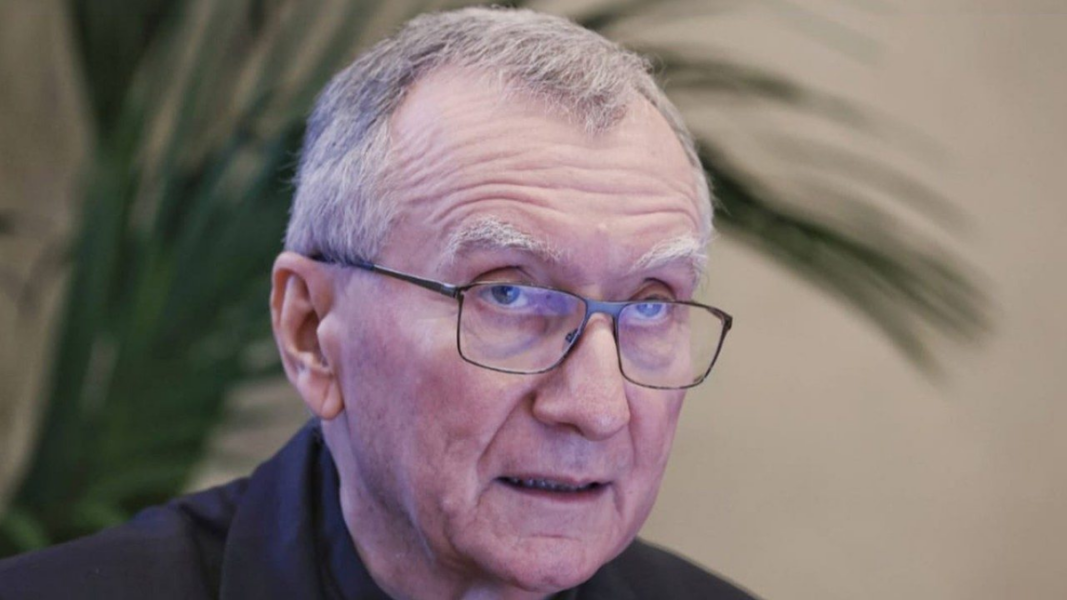
Cardinal Pietro Parolin, Secretary of State of the Holy See, has warned of the risk that the current international context could lead to a multipolarism characterized by the primacy of force, amid the escalation of tensions in the Middle East. In an interview granted to Vatican News, the cardinal expressed his concern over the weakening of international law and defended diplomacy as the only path to avoid a spiral of violence with unpredictable consequences.
Pain in the face of a war that strikes the peoples of the Middle East
In the interview with Vatican media, Parolin acknowledges that he is experiencing these hours with “great pain” in the face of the resumption of war in a region already marked by decades of conflicts. The cardinal emphasizes that violence is once again striking the peoples of the Middle East, including Christian communities, many of which are already fragile and threatened.
Read also: Romanelli denounces the total closure of access to Gaza
The Secretary of State also recalls the words spoken by Pope Leo XIV during Sunday’s Angelus, when he described the situation as a “tragedy of enormous proportions” and warned of the risk of falling into an “irreparable abyss” if the military escalation continues.
Diplomacy, the only way to resolve conflicts
Asked about the US and Israeli attack against Iran, Parolin insists that peace and security must be sought through diplomacy and multilateral organizations. As he explains, after World War II, States created the United Nations precisely to prevent the world from falling back into devastating conflicts.
“History has already taught us that only politics, through the effort of negotiation and attention to the balance of interests, can increase trust among peoples, promote development, and preserve peace”.
In this sense, he recalls that the UN Charter establishes clear principles for the management of conflicts between States. However, he warns that those efforts appear to have weakened in the current context.
The risk of justifying “preventive war”
Another point addressed in the interview is the idea of the so-called “preventive war”, often used to justify military attacks aimed at avoiding future threats. The cardinal recalls that, according to the UN Charter, the use of force must be considered only as a last resort, after exhausting all instruments of political and diplomatic dialogue.
«If States were recognized the right to ‘preventive war’, according to their own criteria and without a supranational legal framework, the entire world would run the risk of being engulfed in flames».
An international order in crisis
For Parolin, the current situation also reflects a deep crisis in the international system based on multilateral cooperation. As he explains, the awareness that the common good benefits everyone has weakened, and that security and prosperity can only be built through cooperation among peoples.
In this context, the cardinal warns that “a multipolarism characterized by the primacy of force and self-referentiality is dangerously asserting itself”.
He also denounces what he considers an unequal application of international law. “There are no first-class and second-class deaths”, emphasizing that all human lives have the same value regardless of the country or continent in which they are found.
Call to resume the path of negotiation
In the face of the current crisis, Parolin expresses his hope that the call to responsibility made by Pope Leo XIV will be heeded by those who make political and military decisions. He states that Christians hope because they trust in Christ, who in the Gospel ordered Peter to sheathe his sword; however, he also adds another consideration:
“[Christians] also hope because, despite the wars, destructions, uncertainties, and a widespread feeling of bewilderment, voices continue to rise from many parts of the world demanding peace and justice”.
Thus, with a humanitarian and political emphasis, the Vatican’s Secretary of State calls for the clamor of arms to cease and for the path of negotiation to be resumed, underscoring that diplomatic processes require time, patience, and political will to achieve concrete results.