


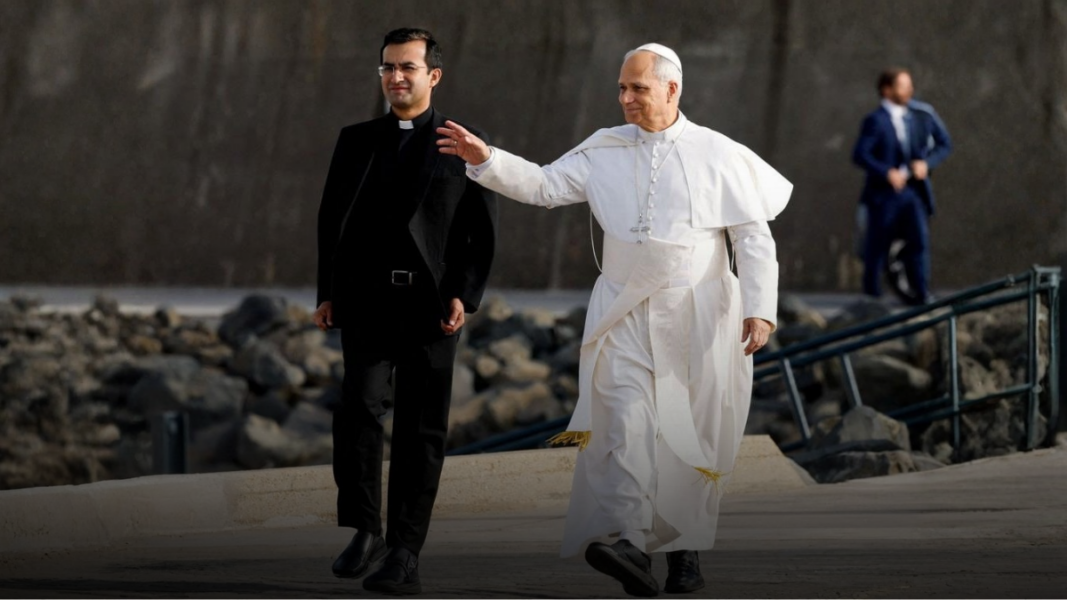
Imagine for a moment the Pope appearing at an audience wearing fitted white pants, a crossed jacket of the same tone, a white shirt with a clerical collar, and shiny shoes. The headlines would write themselves: “The Pope switches to the clergyman.” Doctrinally, it wouldn’t be particularly grave: it’s the usual attire of the contemporary clergy and episcopate. And yet, the image would produce great aesthetic perplexity. More than the successor of Peter, he would look like the magician of a hotel in Las Vegas. The scene wouldn’t be a theological drama, but a visual dissonance that would make history.
The habit is not a historical eccentricity nor a baroque nostalgia. It is a language. And language, when clear, avoids misunderstandings. The cassock is not just a long black garment (or white in the case of the Pope and tropical areas); it is a visible boundary. It affirms without words that the one who wears it has been sacramentally configured for a mission that does not confuse with any other social function.
The clergyman—that dark suit with a minimalist clerical collar—was born as a practical solution in the Anglican sphere, passed through Lutheranism, and ended up incorporated into Catholic use. It was a functional adaptation, comfortable for day-to-day life. No one can deny its success and its role as a counterpoint to the progressive clergy’s tendency to dress in lay clothes. The problem is that its effectiveness is precisely that of any well-cut urban suit. It integrates the priest into the contemporary professional landscape: discreet, correct, interchangeable. A spiritual consultant among lawyers, economists, high officials, and various managers.
The cassock, on the other hand, does not integrate: it bursts in. And that irruption has something healthy about it. It forces the formulation of a silent question: what does this man represent? Have you noticed the respect that a priest in a cassock inspires in a child? The Christian tradition has always understood that the visible educates, forms, reminds. Hence the care for architecture, music, liturgy… and also for attire. The Church has never been naive about the pedagogical power of form.
Moreover, there is in the cassock a personal pedagogy that is not to be despised. It is not designed to optimize performance or facilitate athletic movements. It demands composure, discipline, a certain elegance of gesture. Not because the priest should seem distant, but because the external form helps to recall the interior form. The modern suit is designed for efficiency; the cassock, for meaning. They do not compete on the same plane.
The debate, at bottom, is not textile but anthropological. If the priest is understood first and foremost as a social agent with spiritual competencies, the suit works perfectly. If he is understood as a man ontologically configured to Christ, set apart for God and sent from there to the world, the symbolic logic changes.
The contemporary world suffers more from uniformity. Everything tends to seem interchangeable, modular, functional. In that landscape, the cassock introduces a small visual rupture that reminds us that not everything is equivalent. That there are realities that cannot be reduced to the corporate mold.
Reducing clerical identity to a white collar inserted into the common suit may be comfortable and practical. But the cassock, with its historical and spiritual charge, offers something more: a joyful and visible affirmation that the priesthood is not a profession among others, but a consecration.