


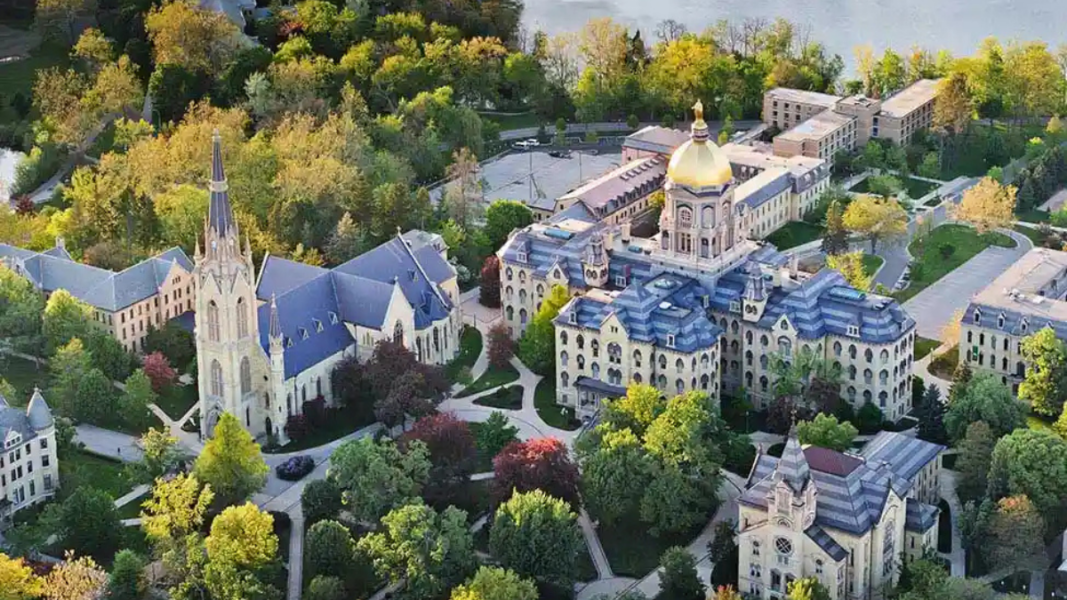
The University of Notre Dame, one of the most prestigious Catholic institutions in the United States, is facing growing controversy following the appointment of Professor Susan Ostermann—identified for her pro-abortion stances—as director of the Liu Institute for Asia and Asian Studies, within the Keough School of Global Affairs. The appointment has sparked reactions from bishops, academics, student groups, and faculty, who question its coherence with the university’s Catholic identity.
Criticism from pro-life student groups
The executive committee of Notre Dame Right to Life, a student group with over 700 members dedicated to promoting the sanctity of human life, publicly asked the university to revoke Ostermann’s appointment. In a statement reported by the student newspaper The Observer, the students argued that the professor’s public stances “contradict the Catholic Church’s teaching on abortion as an intrinsic evil” and that it cannot be assumed that her personal beliefs do not influence her work within the Keough School.
The group’s leader, Anna Kelley—adopted from China and a defender of pro-life causes—stated that her personal testimony compelled her to speak out against an appointment that, according to her, “promotes an ideology that denies the dignity of human life.”
Priests and academics also express rejection
Students are not the only ones who have reacted. Several Notre Dame professors have resigned from their roles at the institute in protest of the appointment. Two of them reported that they stepped down from their academic positions, citing their disagreement with the administration’s decision.
Additionally, Emeritus Professor and priest Wilson Miscamble published an essay in First Things describing the designation as “a tragedy” and pointing to Ostermann’s association with organizations like the Population Council, an entity promoting demographic control policies.
Episcopal support for the criticism
The reaction to the appointment has extended beyond the campus borders. Bishop Kevin Rhoades of Fort Wayne-South Bend—the diocese where Notre Dame is located—issued a statement rejecting Ostermann’s promotion, arguing that it “causes scandal” among the faithful and affects the integrity of the university’s Catholic witness.
In support of Rhoades, several bishops have spoken out, including Michael Olson of Texas and Robert Barron, who urged reconsideration of the decision to align with the educational institution’s Catholic mission. The outgoing Archbishop of Denver, Samuel Aquila, also expressed his support.
Institutional defense and debate on academic freedom
For its part, Notre Dame has defended Ostermann’s appointment. In an official statement, the university described the professor as a highly qualified scholar with experience in interdisciplinary research and maintained that her designation fits the academic mission, even if her personal stances have generated criticism.
The university emphasized its commitment to the dignity of all human life, though it did not directly respond to statements from academics like Miscamble or the demands of pro-life student groups.
Resignations and internal tension
The controversy has also had practical implications: at least two academics have resigned from their roles at the institute in protest of the appointment, stating that they could not support an academic direction they consider incompatible with the university’s Catholic mission.
Debate on campus and demonstrations
In the meantime, the debate on institutional coherence has taken on various nuances on campus. In a gesture of religious identity, students erected an improvised ice chapel after a winter storm, gathering to celebrate Mass in a symbolic act that contrasted with the administrative decision.
Current situation and prospects
To date, the university has not revoked Ostermann’s promotion and maintains its institutional stance. The controversy, however, remains open, with voices inside and outside the academic sphere questioning whether an institution that defines itself as Catholic can appoint leaders with opposing positions on fundamental issues like human life.