


The announcement of possible new episcopal consecrations by the Priestly Fraternity of Saint Pius X (FSSPX)—widely commented on in recent days—has put the traditional world, and the pontificate of Leo XIV, in tension before a reality that—until now—had attempted to carry out in «silence and listening.»
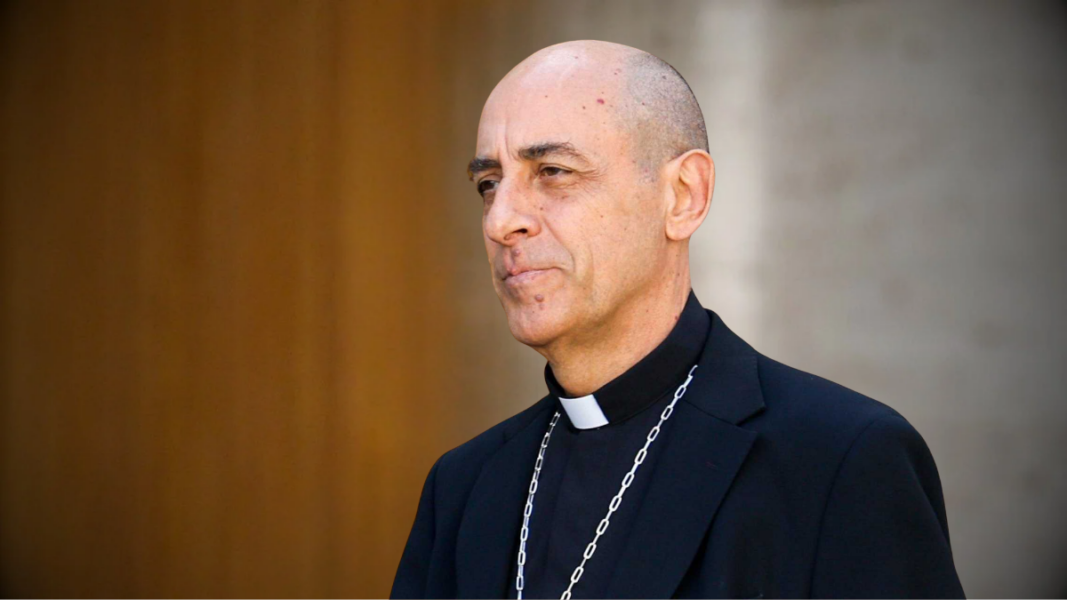
However, the recent interview with the superior general of the FSSPX, Don Davide Pagliarani, shows that the decision is not explained solely by a disciplinary or canonical issue. At the center of the conflict appears the figure of Cardinal Víctor Manuel Fernández—Tucho—and the doctrinal orientation promoted from the Dicastery for the Doctrine of the Faith.
It is not simply a matter of a deteriorated relationship with “Rome” in the abstract, nor even a specific disagreement with the Pope. For the Fraternity, the problem has a concrete face and a precise content: a way of understanding the proclamation of the Gospel, Tradition, and doctrinal authority that they consider incompatible with the Catholic faith received.
Designated mediator and point of doctrinal friction
Since his appointment as prefect of the Dicastery for the Doctrine of the Faith in 2023, Fernández has assumed the management of the Church’s most sensitive doctrinal matters: synodality, sexual morality, liturgy, and Mariology. For the FSSPX, Tucho is the symbol of a doctrinal line that the Fraternity considers decisive in the deterioration of relations.
In explaining why the situation has become unsustainable, Pagliarani does not dwell on administrative problems or the lack of legal recognition. The focus is on concrete documents, speeches, and theological criteria directly associated with the prefect for the Doctrine of the Faith.
The kerygma separated from Tradition
«Cardinal Fernández, in the name of Pope Leo, invited the Church to return to the fundamental intuition of Francis, expressed in Evangelii gaudium, his key encyclical: in a simplified way, it is about reducing the proclamation of the Gospel to its primitive essential expression, in very concise and forceful formulas—the «kerygma»—with a view to an «experience», an immediate encounter with Christ, setting aside everything else, however valuable; specifically, the set of elements of Tradition, considered as accessories and secondary.»
(Don Davide Pagliarani. Interview of February 2)
In his statements, Pagliarani clearly describes what he considers the core of the problem. As he explains, a way of proclaiming the Gospel is being promoted that reduces the Christian message to its most elemental expression—the so-called kerygma—with the intention of provoking an immediate experience of encounter with Christ. The problem, he argues, is that this proclamation is carried out setting aside the whole of doctrinal, moral, and liturgical Tradition, considered secondary or accessory.
This approach, promoted from Evangelii gaudium and taken up by Fernández in the name of the Pope, would have generated what the Fraternity defines as a doctrinal vacuum, the fruit of a Christianity reduced to pastoral impact but disconnected from the organic body of the faith. The centrality of Christ is not questioned, but rather the claim to proclaim him while dispensing with that which the Church has safeguarded for centuries.
Synodality and decisions without doctrinal anchorage
To this method is added the practice of synodality understood not as discernment in continuity, but as the substitution of traditional answers by new decisions, justified pastorally even if they lack a solid doctrinal basis.
«Certainly, in this perspective, one must always worry about offering new and adequate answers to the questions that arise; but this task must be carried out through synodal reform, and not by rediscovering the classic and always valid answers provided by the Tradition of the Church.»
(Don Davide Pagliarani. Interview of February 2)
Pagliarani directly links this way of proceeding with decisions adopted in recent years, such as communion for divorced and remarried persons or the blessing of same-sex couples. For the Fraternity, these are not debatable pastoral developments, but consistent consequences of a method that separates the proclamation of the Gospel from moral and sacramental doctrine.
Mater Populi Fidelis as a symptom
In this context, the document Mater Populi Fidelis, far from being perceived as just another technical text on Mariology, is interpreted as a revealing symptom of a restrictive theological orientation, especially with regard to devotion and traditional Marian titles—a fact that not only drew the attention of the FSSPX.
For the Fraternity, the rejection of certain Marian expressions is not a terminological issue, but the sign of an impoverished Mariology, more concerned with limiting than with safeguarding the received doctrinal richness. In this reading, there is a clear continuity between Mariology and the decision to ensure, through episcopal consecrations, the continuity of what they consider the integral faith.
A criticism that does not stand alone
Cardinal Joseph Zen has also denounced the manipulative character of certain current ecclesial methods and warned of the danger of attributing them to the Holy Spirit. Words echoed by the FSSPX and which also demonstrate that the doctrinal drift is not seen only by the Fraternity. Pagliarani adds in his interview that «it is to be feared; unfortunately, that he is right,» in reference to the words of the Chinese cardinal.
Read also: Cardinal Zen calls to halt the synodal drift and return to apostolic doctrine
Letters to the Pope and the “doctrinal filter”
«Last summer I wrote to the Holy Father to request an audience. Having received no response, I wrote a new letter a few months later; […] A response to this second letter was sent to us from Rome a few days ago, signed by Cardinal Fernández. Unfortunately, this response dismisses our proposition outright, without offering us an alternative solution.»
(Don Davide Pagliarani. Interview of February 2)
Pagliarani states that he attempted direct and filial contact with the Holy Father, requesting an audience and clearly exposing his needs and doctrinal divergences. At the time, the response did not come from the Pope, but was signed by Fernández, and it dismissed the presented proposal without offering an alternative, while evoking the possibility of new sanctions.
«It seems extremely important to me to be able to meet with the Holy Father and there are many things I would be delighted to convey to him that I have not been able to put in writing. Unfortunately, the response received from Cardinal Fernández does not provide for an audience with the Pope. Instead, it evokes the threat of new sanctions.»
(Don Davide Pagliarani. Interview of February 2)
For the Fraternity, this fact confirms that the conflict is not being managed directly at the pontifical level, but through a doctrinal filter perceived as closed to any reasonable pastoral solution.
Tucho as judge and party
Two days after the FSSPX’s announcement about the episcopal appointments, the Holy See appointed Fernández as the sole interlocutor to carry out a dialogue with Pagliarani. A meeting that was scheduled for February 12.
Cardinal Víctor Manuel Fernández, as prefect of the Dicastery for the Doctrine of the Faith, concentrates both the doctrinal orientation that the FSSPX questions and the role of exclusive filter in the dialogue, which makes it truly paradoxical—and in a certain way lamentable—that the figure that the Fraternity identifies as one of the main factors of the problem is, at the same time, the only bridge that Rome offers them.