


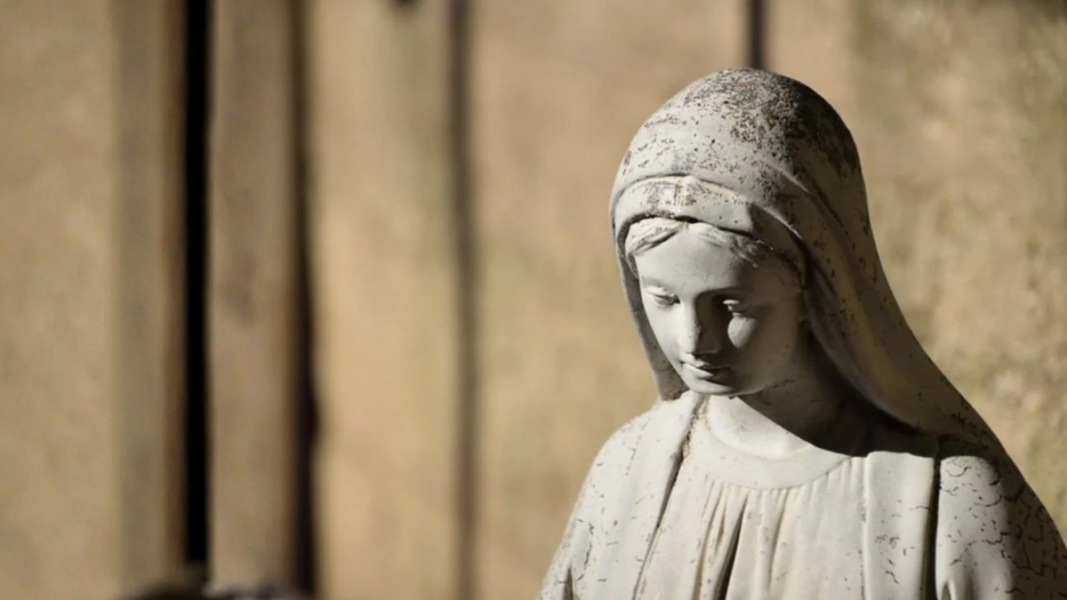
The Holy See published the new statutes of the Pontifical International Marian Academy (PAMI), an official document that clarifies its nature, competencies, and purpose within the institutional framework of the Vatican. The text, disseminated in the Bulletin of the Holy See Press Office, positions the Academy as a direct instrument in the service of Mariological study, closely linked to the Magisterium and the Church’s evangelizing mission.
The statutory update does not respond to a mere administrative adjustment. It entails an explicit reaffirmation of the place that Mariology occupies in the theological and pastoral life of the Church, while precisely delineating the doctrinal and academic framework in which it must develop.
A pontifical institution with a defined mission
The statutes recall that the PAMI was founded in 1946 and elevated to a pontifical institution by St. John XXIII in 1959, through the motu proprio Maiora in dies. Since then, its mission has been to promote the scientific and theological study of the Virgin Mary, always in inseparable relation to the mystery of Christ and of the Church.
The new statutory text insists that Mariology is not a marginal discipline nor a secondary devotion, but a structural dimension of Catholic theology. Therefore, the Academy is called to foster rigorous research, coordinate international academic encounters, and accompany authentic expressions of Marian piety, avoiding both sentimentalism disconnected from doctrine and theological reductions that impoverish the figure of Mary.
Institutional dependence and doctrinal framework
The statutes place the Academy under the dependence of the Dicastery for Culture and Education, in accordance with the apostolic constitution Praedicate Evangelium, and specify its seat in Vatican City, as well as its academic affiliation with the Pontifical Antonianum University. The document regulates its internal structure, the composition of its governing bodies, and the ecclesial service character of those who form part of it.
In this way, the Academy is clearly configured as an institution at the service of the universal Church, not as an autonomous forum nor as a space of reflection detached from the Magisterium, but as an organism that acts in communion with the doctrinal authority of the Church.
Mariology between truth, beauty, and Christian life
One of the most relevant aspects of the statutory text is the insistence that Mariology must develop in balance between doctrinal rigor, ecclesial sense, and attention to popular piety. The Virgin Mary is presented as Mother of Christ and Mother of the Church, an indispensable reference for understanding the mystery of the incarnation, redemption, and Christian vocation.
In this sense, the document underscores that a faithful Mariology does not obscure the centrality of Christ, but leads to Him, and that the serious study of Mary has concrete consequences for spiritual life, evangelization, and the formation of Christian conscience.
A significant silence about Mater Populi Fidelis
In this context, it is striking that the Pontifical International Marian Academy was neither consulted nor considered in the preparation of the doctrinal document Mater Populi Fidelis, published by the Dicastery for the Doctrine of the Faith and approved by the Pope, and that it has not publicly pronounced itself after its publication. It is a text that directly addresses central issues of contemporary Mariology, such as the use of certain Marian titles and the correct formulation of Mary’s cooperation in the work of salvation, matters that fully belong to the specific scope of this pontifical institution.
To date, no communication, official note, or position taken by the Academy on the matter is recorded. This silence is significant, given that it is precisely the pontifical body specialized in Mariology and explicitly charged, by statute, with promoting the rigorous and faithful study of these matters.
Normative clarity, pending questions
With the publication of these statutes, the Holy See orders the institutional role of Mariology in the Church, underscoring its theological and pastoral importance in the current context. At the same time, it raises legitimate questions about how this normative clarification articulates with recent doctrinal debates that directly affect the Academy’s own field.