


The international association Una Voce and the Latin Mass Society (England and Wales) have expressed their concern following the announcement by the Priestly Fraternity of Saint Pius X (FSSPX) in which they consider carrying out new episcopal consecrations on the next July 1. Both associations warn that this decision may further distance the possibility of a canonical regularization of the Fraternity, a desire that they assure is shared by many Catholics of good will.
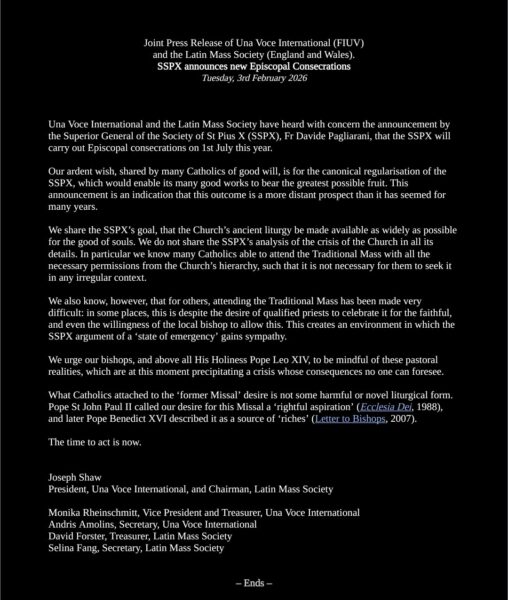
In a joint statement released on Tuesday, February 3, both associations point out that this step represents a serious setback at a particularly delicate moment and make a direct appeal to the bishops and, especially, to Pope Leo XIV, to take into account the current pastoral realities surrounding the traditional Mass, which—they warn—are contributing to a crisis with unpredictable consequences.
The two organizations emphasize that, although they share with the FSSPX the desire for the traditional liturgy to be accessible for the good of souls, they consider episcopal consecrations outside the canonical framework to hinder ecclesial unity and make a stable and fully regular solution more distant.
We provide below the full transcription of the letter:
Una Voce International and the Latin Mass Society have received with concern the announcement made by the Superior General of the Priestly Fraternity of Saint Pius X (FSSPX), Father Davide Pagliarani, that the FSSPX will carry out episcopal consecrations on the next July 1 of this year.
Our ardent desire, shared by many Catholics of good will, is the canonical regularization of the FSSPX, which would allow its numerous and valuable works to bear the greatest possible fruit. This announcement is an indication that this outcome is today a more distant prospect than it has been for many years.
We share the FSSPX’s goal of making the ancient liturgy of the Church available as widely as possible for the good of souls. However, we do not share the FSSPX’s analysis of the crisis in the Church in all its details. In particular, we know that many Catholics can attend the traditional Mass with all the necessary permissions from the Church hierarchy, so they do not need to seek it in any irregular context.
We also know, however, that for others attending the traditional Mass has become very difficult; in some places, this occurs despite the desire of qualified priests to celebrate it for the faithful, and even the willingness of the local bishop to allow it. This creates an environment in which the FSSPX’s argument of a “state of emergency” gains sympathy.
We exhort our bishops and, above all, His Holiness Pope Leo XIV, to keep these pastoral realities in mind, which at this moment are precipitating a crisis whose consequences no one can foresee.
What Catholics attached to the “former Missal” desire is not a harmful or novel liturgical form. Saint John Paul II described our desire for this Missal as a “legitimate aspiration” (Ecclesia Dei, 1988), and subsequently Pope Benedict XVI described it as a source of “riches” (Letter to the Bishops, 2007).
The time to act is now.
Joseph Shaw, President of Una Voce International and President of the Latin Mass Society
Monika Rheinschmitt, Vice President and Treasurer, Una Voce International
Andris Amolins, Secretary, Una Voce International
David Forster, Treasurer, Latin Mass Society
Selina Fang, Secretary, Latin Mass Society