


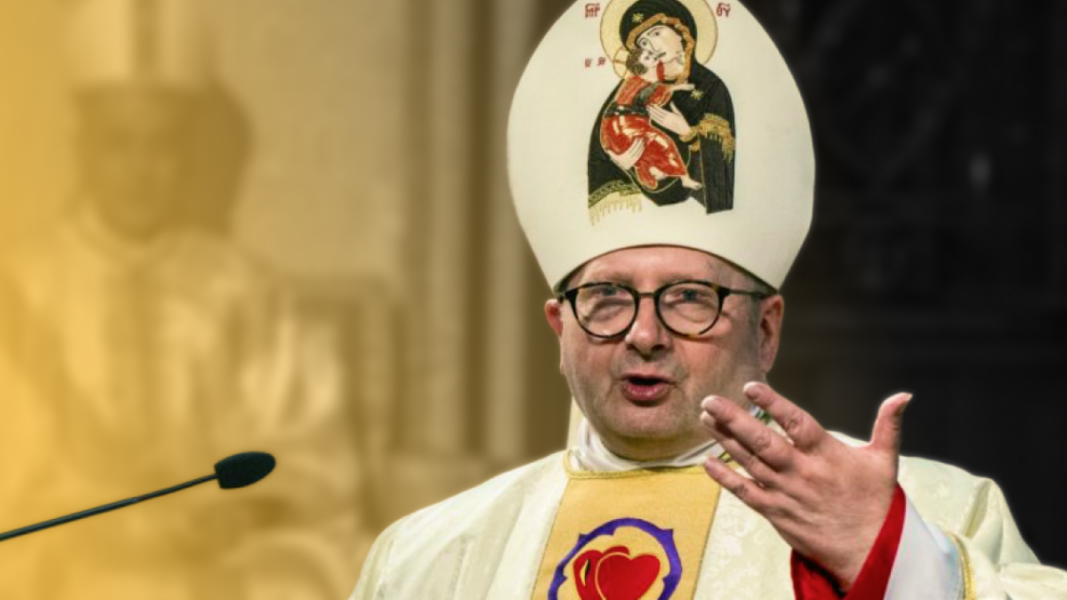
Bishop David Waller, of the Personal Ordinariate of Our Lady of Walsingham—an Anglican-use Latin ordinariate—has described the Priestly Fraternity of Saint Pius X (FSSPX)’s announcement regarding the possible consecration of new bishops without a pontifical mandate as “very serious,” and has warned that the situation reveals a fundamental ecclesiological problem, regardless of whether such consecrations take place or not.
Read also: The FSSPX announces that it will consecrate new bishops on July 1, 2026
The statement was disseminated by journalist Niwa Limbu, of The Catholic Herald, who explained that the prelate’s words must be taken into account amid speculations arising in some circles about the eventual creation of a sort of “ordinariate for the FSSPX,” taking as a model existing canonical structures such as the one presided over by Bishop Waller himself.
Call to prayer and unity with the Pope
In his assessment, Bishop Waller emphasized that the first response to the announcement must be prayer for the Holy Father and for the Fraternity itself, recalling that the Pope is the visible principle of unity in the Church. In this regard, he expressed his confidence that the Pontiff “will be eager to avoid new divisions or schisms.”
At the same time, the ordinary of Walsingham acknowledged the difficulty of finding a solution that would allow the canonical integration of bishops in an irregular situation with the See of Peter, which, in his view, constitutes one of the main obstacles in the current scenario.
A problem that goes beyond the consecrations
Waller pointed out that the fact that the FSSPX considers itself to have the authority to consecrate bishops without a papal mandate is, in itself, an indication of a serious ecclesiological problem, regardless of whether the consecrations are ultimately carried out. This assertion focuses not only on the specific act, but on the understanding of authority, communion, and the hierarchical structure of the Church.
The prelate concluded by expressing his hope that the conversations will continue and that a solution can be found that avoids a greater rupture, reiterating that, in the face of a situation of this gravity, one must persevere in prayer and in the patient search for an outcome in accordance with ecclesial communion.
The Personal Ordinariate of Our Lady of Walsingham
The Personal Ordinariate of Our Lady of Walsingham was erected by the Holy See in 2011, by virtue of the apostolic constitution Anglicanorum coetibus promulgated by Benedict XVI, with the aim of welcoming former Anglicans who sought full communion with the Catholic Church while preserving legitimate elements of their liturgical, spiritual, and pastoral heritage.
The ordinariate, with personal and not territorial jurisdiction, groups faithful mainly from England, Wales, and Scotland, and allows the celebration of the liturgy according to its own use approved by the Holy See, fully integrated into Catholic discipline and doctrine. Its ordinary exercises functions equivalent to those of a diocesan bishop, in full communion with the Roman Pontiff.
A significant ecclesiological contrast
The reference to the Personal Ordinariate of Our Lady of Walsingham is relevant in the context of the debate about the FSSPX, as it highlights two clearly distinct paths of relationship with the Church’s authority. The ordinariate was erected following an explicit process of dialogue and discernment with the Holy See, and constitutes a full canonical solution approved by the Roman Pontiff, which allowed entire communities to be integrated into ecclesial communion without acting outside the hierarchy.