


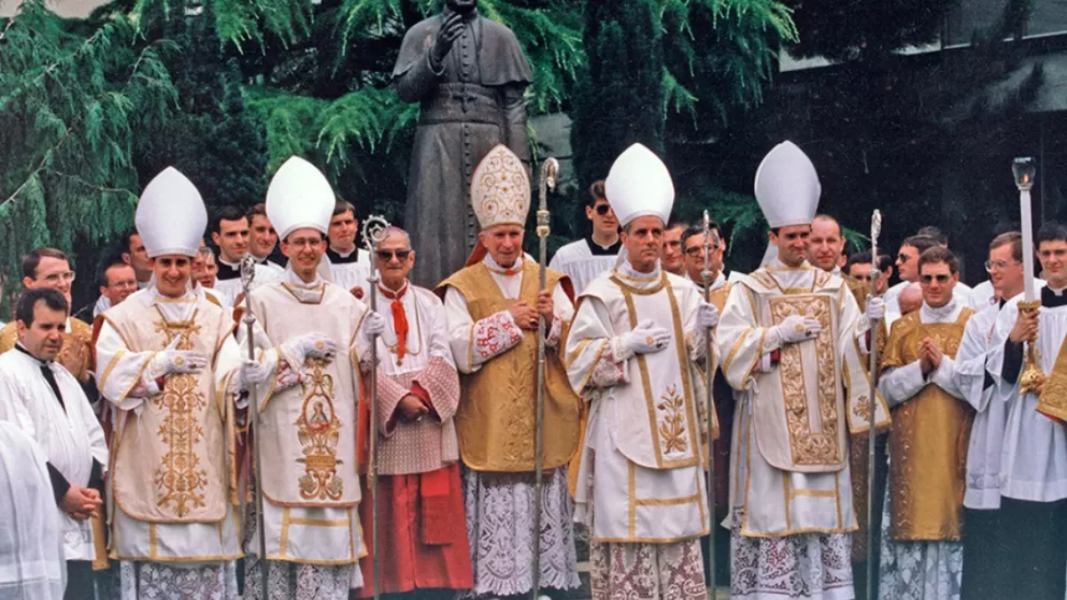
It’s best to stop with the pious pretenses. What has happened with the Society of Saint Pius X is not an accident, nor a sudden outburst, nor a “flight forward”. It is the logical outcome of a perfectly recognizable Roman strategy: buy time, stretch out conversations, postpone decisions, and trust that biology would do the dirty work. Four bishops consecrated by Lefebvre, increasingly elderly. A simple calculation: wait for them to die and, once the dog is dead, the rabies is gone.
For thirty years, negotiations have taken place without actually negotiating. Meetings, letters, commissions, amiable gestures, ambiguous statements, prolonged silences. A lot of movement, no structural progress. No stable canonical solution. No solid sacramental guarantee. No legal framework that couldn’t be reversed by the next bureaucrat with delegated signature. Everything provisional, everything conditional, everything reversible. The house specialty.
Rome didn’t want to resolve the “FSSPX problem”; it wanted to manage it until its natural extinction. And that explains the infinite patience, the cordiality without fruits, and the systematic refusal to address the real core of the matter: the objective continuity of the episcopal and sacramental ministry for a living, growing reality with real vocations. Meanwhile, the same old mantra was repeated: wait, trust, we’ll see, now is not the time.
The problem with dilatory tricks is that they only work as long as the other side doesn’t detect them. And the Society, rightly or wrongly, has finally seen the trap. It has understood that there was no horizon, only postponement. That there was no will for real integration, but bureaucratic management of wear and tear. That the dialogue table was a treadmill: a lot of effort, no displacement.
Having reached that point, the decision to go “down the middle street” is neither heroic nor exemplary, but understandable. When you’ve spent three decades waiting for a solution that never arrives, when you see channels closing, sacraments blocked, and everything depending on revocable permissions, the abstract appeal to patience starts to sound like mockery. No one is obligated to collaborate indefinitely in their own asphyxiation.
I don’t like the decision. It has objective risks and serious consequences. But I also don’t feel morally authorized to judge those who have negotiated for thirty years without obtaining anything substantial in return. On the other side, there were no pastors with vision, but administrative shell-game players: move the cup, distract the gaze, promise that the ball is still there while it never appears.
The Society has stopped believing in the game. And when someone abandons a rigged game, the problem is not that they get up from the table, but that the table had been set up for decades so that no one would ever win.