


By Robert Royal
Several friends have recently asked me for prayers, as mothers, friends, and even distant acquaintances are seriously ill or lying on their deathbeds. News also arrives, for those of us who cherish memories of memorable sports moments, that the great Notre Dame football coach, Lou Holtz (undefeated in 1988 and national champion), has entered palliative care. We talk a lot nowadays about the loss of «Christian anthropology,» that is, the deeper meaning of being human in this world. But a reason for that loss, undoubtedly, is that we have also lost the main part of the story: the truth that there is life after this one, in the world to come. And that, therefore, what we do here has meaning and eternal consequences.
The recent prayer requests coincided, for me, with the chance discovery, on an overloaded shelf, of Seamus Heaney’s vivid translation of Book VI of Virgil’s Aeneid. And upon taking it out for a new reading. It is the passage in which Aeneas enters the underworld and learns things about souls in the afterlife and about the future of Rome.
I have loved Virgil since I first read him at fifteen, and when I discovered Dante a few years later, it was easy to appreciate his deep natural affinity. Dante is probably the only poet whose representation of the afterlife surpasses Virgil’s. But that is because «Christian anthropology» tells a broader story about life after death than even the best pagan speculations (for example, Plato and Cicero).
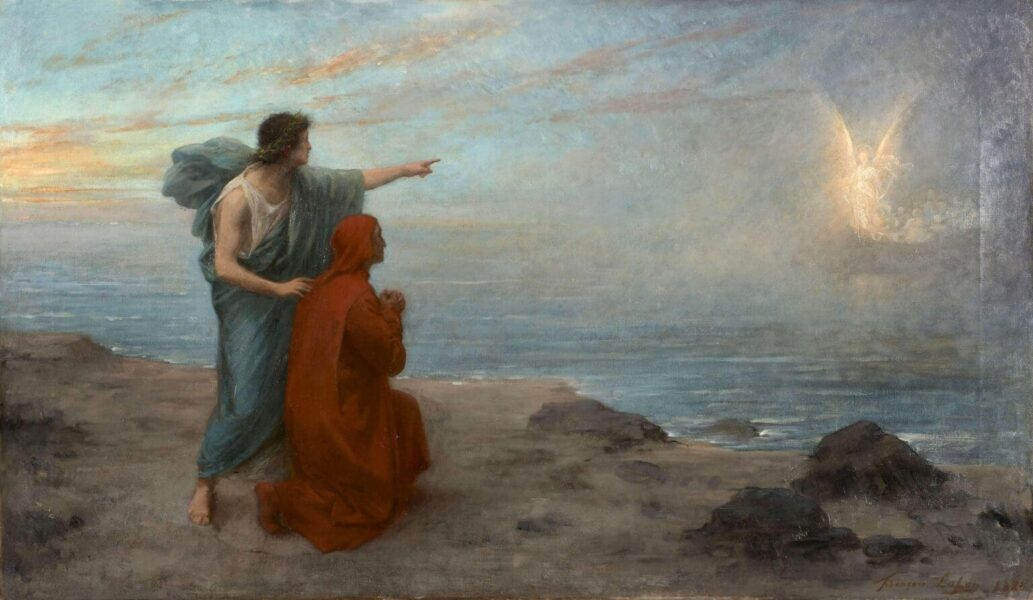
St. Augustine also loved the Aeneid and felt guilty, as a Christian, for his attachment to a pagan poem. But perhaps he was overly scrupulous. The expression anima naturaliter christiana («soul naturally Christian») was soon applied to Virgil. That was just one of the many reasons why Dante (in the Divine Comedy) could take Virgil as his guide through Hell and Purgatory (though, out of respect for Virgil’s paganism, he has him withdraw before Paradise).
In fact, before Dante and Virgil enter the underworld, Dante wants to excuse himself. He tells Virgil that it is understandable that St. Paul, the apostle to the Gentiles, went to Heaven and returned. As St. Paul himself had said:
I know a man in Christ who fourteen years ago was caught up to the third heaven—whether in the body or out of the body I do not know, God knows. And I know that this man… heard inexpressible words, which a man is not permitted to speak. (2 Corinthians 12:2-4)
And Aeneas, says Dante, was also worthy to go there, since his journeys (at least according to Virgil’s account) led to the founding of Rome, which was to become the capital of an Empire and the seat of the Catholic Church.
However, Dante, understandably, stammers:
But me? To travel there? Who grants it?
I am not Aeneas, I am not Paul.
For that, neither I nor anyone else thinks me worthy. (trans. Baxter)
Virgil explains: this is desired in Heaven, and a whole series of saints—including the woman Dante knew on earth as Beatrice—has set everything in motion.
And as other hints in that supreme Christian poem by the greatest of Christian poets suggest, this is a journey we all must make. Dignity or unworthiness is not the main point. How we live here in the brief time granted to us has profound historical meaning and an eternal destiny: for some, as the pagan vision of the underworld in Virgil already made clear, eternal punishments; for others, perpetual joy.
Indeed, the expression anima naturaliter christiana, which was said especially of Virgil for his inclinations, even as a pagan, toward Christian truths, was used even more broadly in the early Church.
I only discovered this recently, but it was the first Christian theologian Tertullian who coined the expression, and he applied it universally, in the sense that all souls are, in some way, naturally Christian. Because they are created by God and, therefore, created for Him, whether they recognize it or not. Tertullian is also the author of the irascible phrase: «What has Athens to do with Jerusalem?», with which he scorned pagan knowledge for having little to do with faith. But he knew how to pierce through his own irritation to a deeper truth about the soul.
It is not easy to imagine what the afterlife will be like. St. John says: «Beloved, we are God’s children now, and what we will be has not yet appeared; but we know that when he appears we shall be like him, because we shall see him as he is.» (1 John 3:2) But the little we conjecture goes far beyond the vague notions we have come to have about being «with God,» as is heard today at almost every funeral.
Because that is not what we hear from the mouth of Jesus himself, nor in other places in Scripture. He speaks of sheep and goats, of eternal fire, and other realities that cannot be ignored. Msgr. Charles Pope, of the Archdiocese of Washington, recently wrote a good book, The Hell There Is, which expounds Jesus’ words on the subject. He was not an alarmist, but simply a transmitter of the truth. Naturally, after a lecture he gave on the book, a woman catechized in the warm and fuzzy Jesus church reproached him: «That’s not the Jesus I know.»
Which is precisely the problem, and very widespread.
George Orwell, a non-believer, mocked the Christian vision of Heaven as a «choir practice in a jewelry store.» There are biblical precedents for some of that. And perhaps the joke, in the end, was on Orwell for thinking that gold, silver, jewels, and music—all divine creations—are beneath the dignity of a modern skeptic.
In any case, we have much at our disposal in Scripture, Tradition, Catholic culture, and even in the great premodern pagans to reflect on, as we see people around us on the threshold of eternal life and prepare ourselves for that singular day when we pass from this world to the next.
Mors certa, hora incerta («Death is certain, the hour uncertain»). So there is no time like the present.
About the author
Robert Royal is editor-in-chief of The Catholic Thing and president of the Faith & Reason Institute in Washington, D.C. His most recent books are The Martyrs of the New Millennium: The Global Persecution of Christians in the Twenty-First Century, Columbus and the Crisis of the West y A Deeper Vision: The Catholic Intellectual Tradition in the Twentieth Century.