


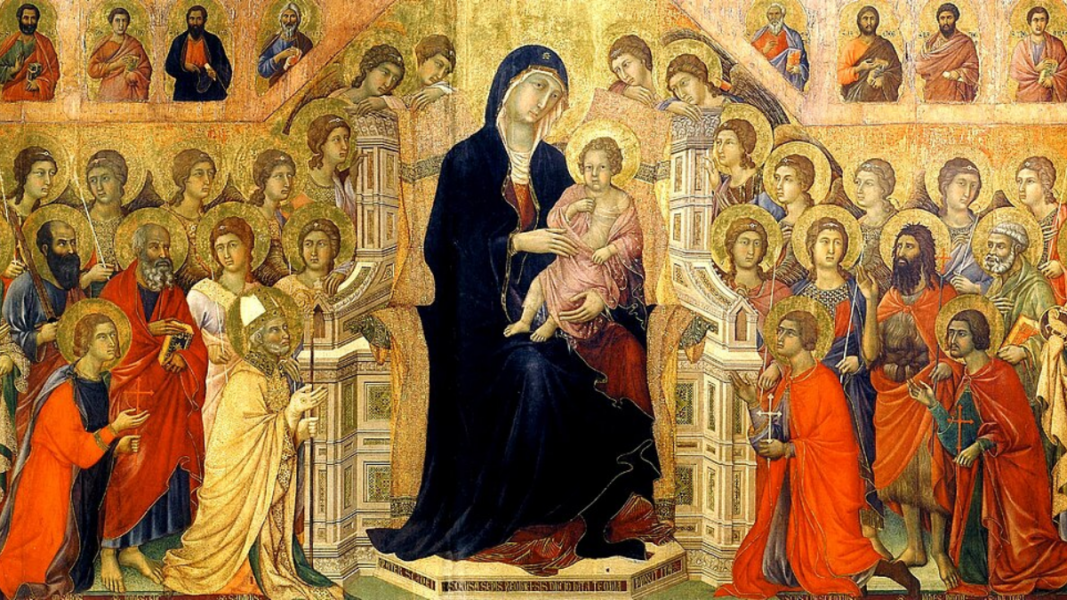
In contemporary language, a way of speaking about the Virgin Mary has taken hold that, although well-intentioned, is theologically imprecise. She is often presented as an exceptional woman who, due to her personal holiness, was “chosen” by God for an extraordinary mission. Catholic tradition, however, teaches exactly the opposite: Mary was not chosen because she was holy; she was made holy because she was chosen.
This nuance is not secondary. It affects the very way in which grace, human freedom, and God’s sovereign action in the history of salvation are understood. In Mary, there is no prior merit that obliges God to act. Rather, there is a free, eternal, loving choice that shapes her entire existence from the first instant.
God Does Not Improvise the Incarnation
The faith of the Church affirms that the Incarnation is not a divine reaction to sin, nor an emergency plan. It is the center of God’s eternal design. And if the Son was to become flesh, that flesh had to come from a mother prepared by God Himself.
From this perspective, Mary’s figure does not appear as a later addition, but as a constitutive part of the plan. God did not “search” for a suitable mother when the fullness of time arrived; He prepared her from eternity. Mary’s choice belongs to the same decree by which the Word became flesh.
This explains why classical theology insists on Mary’s predestination to divine maternity. It is not a marginal speculation, but a logical consequence of the Christian mystery. If Christ is the center of creation, the woman from whom He receives His humanity occupies a unique place in that order.
Grace as Principle, Not as Reward
One of the most persistent errors in modern theology is to conceive of grace as a kind of spiritual salary: God grants more to those who are already better. Mary’s life radically disproves this scheme.
The Virgin’s fullness of grace is not the result of an accumulation of human virtues, but the starting point of her existence. From the first instant, her soul was filled with divine life because her mission demanded a holiness proportionate to her dignity.
This principle protects Catholic doctrine from two opposing deviations: Pelagianism, which absolutizes human effort, and fatalism, which eliminates freedom. In Mary, a perfect synthesis occurs: all her holiness comes from God, and all her response is free.
Mary’s “Yes” and the False Image of Risk
There are not a few contemporary discourses that present the Annunciation as a moment of uncertainty for God, as if the plan of salvation had been suspended on the response of a young woman from Nazareth. This reading, although emotionally attractive, is theologically untenable.
To accept that Mary’s fiat might not have happened is equivalent to admitting that God’s plan was fallible. Catholic faith does not affirm that. It affirms, instead, that God wanted Mary’s free cooperation and, precisely for that reason, granted her an efficacious grace that did not annul her freedom, but led it to its perfection.
Mary said “yes” because she was fully free; and she was fully free because she was fully graced. Separating these elements leads to a deformed understanding of both God and man.
A Holiness That Does Not Flee from Suffering
Mary’s choice did not place her on the margins of human drama. On the contrary: it placed her at its center. Her union with Christ also implied a singular participation in His cross. The fullness of grace did not make her insensitive, but more vulnerable to pain.
This point is especially uncomfortable for a superficial spirituality that identifies holiness with well-being. Mary demonstrates the opposite: the greater the union with God, the more radical the surrender can be, even when it passes through suffering.
Her pain was not the fruit of disorder, but of love. And precisely for that reason, it has redemptive value in communion with her Son’s sacrifice.
Recovering Order in Mariology
In an ecclesial context marked by sociological and symbolic readings of the faith, it is urgent to recover a mariology anchored in doctrine, not in emotivity. Mary is not an interchangeable icon nor a figure functional to the discourse of the moment. She is the Mother of God. And everything in her is explained from there.
When this center is lost, devotion is emptied and theology is disordered. When it is maintained, Mary’s figure appears with all its force: humble, obedient, free, fully graced, and totally oriented toward Christ.
It was not a prize. It was a mission. And to fulfill it, God did not stint on grace.
Source: Taylor Patrick O’Neill, Mater Dei Ergo Gratia Plena: On the Predestination of Mary to Divine Maternity as the Reason for Her Radical Plenitude of Grace, theological study on the predestination of the Virgin Mary and the fullness of grace.