


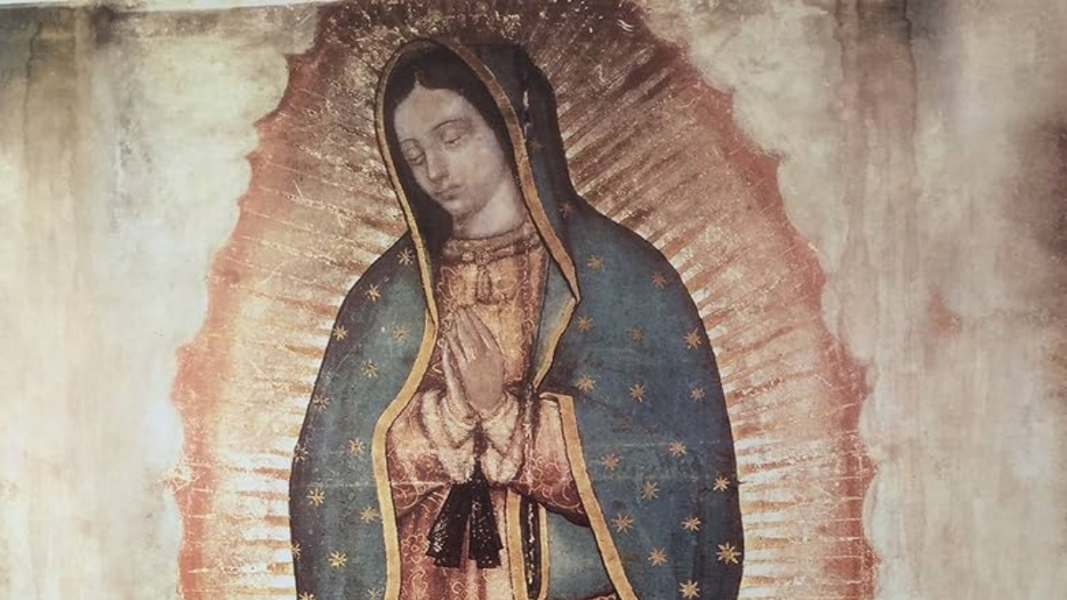
Mexico City, December 1531. A cold morning on the shores of the ancient Lake Texcoco, a humble indigenous man walks to his catechism classes without imagining that he is about to witness an event that will transform the spiritual history of a continent. Juan Diego Cuauhtlatoatzin, a recently baptized Chichimec, climbs the hill of Tepeyac as dawn was breaking. Suddenly he hears a celestial song and a sweet voice calling him by name. At the top of the hill, he encounters a Lady of superhuman beauty, radiant like the sun, who presents herself with kind words: “I am the ever Virgin Mary, Mother of the true God, by whom one lives”. Thus begins the story of the Virgin of Guadalupe, the Marian devotion that over time would be acclaimed as spiritual Mother of an entire civilization and proclaimed Patroness of America by the Catholic Church.
The apparitions of 1531: the miracle at Tepeyac
The traditional account—preserved in documents such as the Nican Mopohua in Nahuatl and the chronicles of the time—narrates in detail four apparitions between December 9 and 12, 1531. In the first, the “perfect Heavenly Maiden” entrusts Juan Diego with requesting the bishop of Mexico to build a temple in that place, “so that in it I may show and lavish all my love, compassion, help, and defense to all the inhabitants of this land”, in the words of the Virgin herself. With simple obedience, Juan Diego goes to the city and after arduous efforts manages to meet with the Franciscan friar Juan de Zumárraga, the first bishop of Mexico. The prelate, though pious, is skeptical about the unusual request from the peasant and asks for tangible proof of the apparitions before proceeding.
Discouraged but firm in fulfilling the heavenly command, Juan Diego returns to Tepeyac the next day. The Virgin appears to him again and promises to grant him a “sign” to convince the bishop. However, on Monday, December 11, Juan Diego misses the appointment: his uncle Juan Bernardino has fallen gravely ill, and he hurries to find a priest. In the early hours of Tuesday, December 12, anguished by his uncle’s health and fearful of delaying his filial duty, Juan Diego tries to go around the hill to avoid encountering the Lady. But Mary comes to meet him on the path: in this fourth apparition, the Mother of God listens to him compassionately and pronounces immortal words of consolation: “Am I not here, who am your mother? Are you not under my shadow and protection? (…) Does this illness not afflict you? Be assured that he is already healed”. The sweet maternal voice of Guadalupe dispels Juan Diego’s fear, assuring him that his uncle will not die of that illness. Indeed, tradition reports that at that very moment the Virgin also appeared to Juan Bernardino to heal him miraculously and reveal the name by which she wished to be invoked: Saint Mary of Guadalupe.
Convinced and filled with faith, Juan Diego then requests the promised sign. The Virgin instructs him to climb the arid summit of Tepeyac and gather the flowers he will find there. Juan Diego obeys and discovers, to his astonishment, fresh Castilian roses blooming in the middle of winter—something impossible in the cold Mexican December. He cuts as many roses as he can and keeps them in his tilma (a humble ayate or maguey fiber cloak). The Virgin arranges those roses in Juan Diego’s lap with her own hands and orders him not to open his tilma until he is before the bishop.
Hours later, in the episcopal palace, the central prodigy occurs. Juan Diego unfolds his tilma before Fray Zumárraga and the attendants: the roses fall to the ground, and at the same time the beautiful image of the Virgin Mary appears imprinted on the fabric, just as she had manifested herself at Tepeyac. Everyone is overwhelmed: the Little Dark-Skinned One of Tepeyac reveals herself with a serene face and hands joined in prayer, dressed in a pink tunic adorned with indigenous motifs and a bluish-green mantle studded with stars. Bishop Zumárraga, moved to tears, kneels before that tangible miracle. He immediately takes the sacred tilma and enshrines it in his private chapel. Days later, the prelate, now convinced of the veracity of the apparitions, orders the immediate construction of a hermitage on the top of Tepeyac hill, just as the Virgin had requested. For his part, Juan Diego left everything to live next to the new sanctuary, where for the rest of his days he was a humble custodian of the sacred image and guide for the pilgrims who began to flock to the holy place.
The impact of the Guadalupan phenomenon was immediate. The simple initial hermitage soon became too small for the multitude of faithful who came to venerate the image; by 1556 there are historical records of the devotion spreading among various strata of New Spain. Over the years, the sanctuary was expanded and beautified until a great Baroque temple was erected. Already in the 17th century, in 1709, the first Basilica of Guadalupe was consecrated, a symbol of the permanent rooting of this devotion in the heart of the Mexican people.
Evangelization and spiritual mestizaje: the legacy of Guadalupe
The apparitions of Guadalupe occurred just a decade after the fall of Tenochtitlan (1521). The Virgin of Tepeyac acted—in the words of Pope Pius XII—as a “providential instrument” chosen by God to draw the indigenous people toward Christ. The miracle of the ayate meant a powerful confirmation of the faith: “From that historical moment, total evangelization was accomplished”, affirmed Pius XII, highlighting that Guadalupe marked the turning point that consolidated the conversion of Mexico and, by extension, of Hispanic America. In fact, after 1531, an astonishing surge of baptisms and conversions was recorded in New Spain—millions of indigenous people are said to have embraced the Catholic faith in the following two decades—, a phenomenon that many have interpreted as a providential response to the loss of faithful in Europe during the Protestant Reformation. The Virgin “raised a banner, raised a fortress (…) fundamental pillar of the faith in Mexico and throughout America”, adds Pope Pacelli, describing how Guadalupe established a spiritual bulwark that would withstand all the storms of history.
Patroness of New Spain and Empress of America
The veneration of Our Lady of Guadalupe soon received official recognition in the Church. In 1754, Pope Benedict XIV approved the proper Mass and Office of Saint Mary of Guadalupe for December 12, granting liturgical rank to the feast in New Spain. It is said that, upon learning of the prodigies of Tepeyac and seeing a copy of the sacred image, the pontiff exclaimed in admiration in Latin: “Non fecit taliter omni nationi” –“He has not done such a thing for any other nation”–, thus recognizing that God had worked a unique portent in Mexico for the world. From then on, the Virgin of Tepeyac was proclaimed Patroness of the Viceroyalty of New Spain, protector of Mexico City and advocate of its natives.
Over time, her patronage extended to all of Hispanic America. Pope Saint Pius X declared her in 1910 “Patroness of all Latin America”, and his successor Pius XI named her Patroness of all the “Americas” without distinction between north and south. During the turbulent years of the 20th century, Mary of Guadalupe continued to be a beacon of hope. In the postwar period, Pope Pius XII addressed a radio message to the Mexican people in 1945 on the occasion of the fiftieth anniversary of the pontifical coronation of the image. In that historic speech, he called the Guadalupana “Empress of America and Queen of Mexico”, recalling how the faithful had crowned her with filial love in 1895. Pius XII praised the “most just homage” that Mexico rendered to its “Noble Indian Woman, Mother of God and our Mother”, recognizing the gratitude of an entire people toward the Virgin who “had the principal part in its vocation to the true Church” and in “the preservation of the purity of the faith” of a young nation that in Her forged its identity. With vibrant eloquence, the Pope described Mary of Guadalupe taking the Cross brought by the fragile Spanish caravels and “triumphantly parading it through all these lands, planting it everywhere” from her sanctuary on the rocky hill of Tepeyac, “to reign from there over the entire New World and watch over its faith”. Thus, from Rome, what Mexicans had felt for centuries was confirmed: that Guadalupe is queen and mother of the Americas under whose mantle the Christianity of this continent was gestated.
Identity, faith, and unity under the mantle of the Virgin
Today, almost half a millennium after that miraculous dawn, the Virgin of Guadalupe remains the spiritual heart of millions of Americans. Her sanctuary at Tepeyac is the destination of massive pilgrimages: it is estimated that more than ten million faithful visit it each year, especially around December 12, making it the most visited Marian shrine in the Catholic world. The original image, intact and incorrupt against all scientific prognosis, presides over the Basilica and lovingly contemplates her children day and night.
Contrary to reductive visions or the so-called black legend that paints the conquest as a mere destructive clash, the Guadalupan event offers a truthful perspective: in it, indigenous and Spanish heritages merge under Mary’s loving gaze, giving rise to something new and fruitful. The Virgin of Guadalupe, by choosing Juan Diego and speaking to him in his language, dignified the indigenous people, showing that the Christian message did not come to annihilate their longings, but to fulfill them. Under her mantle, the Indian and the Spaniard found brotherhood as children of the same God and the same Mother. Thus was born that “mestizo unity” of which Saint John Paul II spoke, for whom Guadalupe is “queen of all America” and authentic forger of communion among the diverse peoples of the continent.