


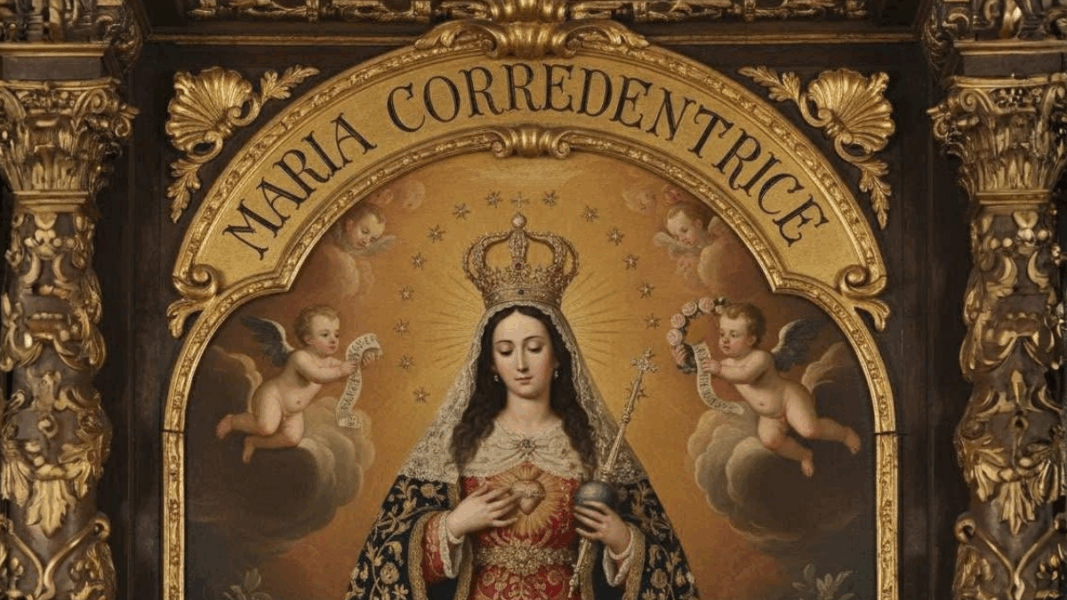
On November 4, 2025, Mater Populi Fidelis was published, the doctrinal note with which the Dicastery for the Doctrine of the Faith attempted to clarify the meaning and limits of certain Marian titles linked to the cooperation of the Virgin Mary in the work of salvation. Far from being a clarifying document, its appearance caused deep consternation among the faithful and scholars, who interpreted its statements as a reduction of the privileges that the Tradition of the Church has unanimously recognized to Our Lady. The reaction was immediate and, in many cases, one of bewilderment.
In the midst of this climate, the publication made on November 27 by journalist Diane Montagna proved especially timely, as she revealed a dialogue held with the prefect of the Dicastery, Cardinal Víctor Manuel Fernández. His responses, although generating new questions, help to illuminate the real scope of the document and to understand the internal logic underlying its drafting.
The restricted meaning of “always inappropriate”
One of the most controversial expressions in the note is found in number 22, where it is stated that it is “always inappropriate” to use the title of Co-Redemptrix to define Mary’s cooperation in Christ’s redemptive work. This statement raised legitimate concerns, as the title has been used for centuries by saints, doctors, and documents of the ordinary magisterium.
When asked whether this prohibition also extended to the past, Cardinal Fernández responded with a triple negation, specifying that the “always” used in the note does not refer to all eras, but only “to the present moment.” When Montagna asked for confirmation that the adverb should be understood as “from now on,” the prefect replied without qualification: “From now on, without a doubt.”
This clarification reveals a decisive point. The term “always,” which in common language indicates continuous validity over time, is redefined in the document with a meaning restricted exclusively to the present and the official sphere. Consequently, the doctrinal evaluation of Marian titles is not presented as definitive or absolute, but as a pastoral measure subject to current circumstances.
A prohibition limited to the official sphere
In his explanations, Cardinal Fernández insisted that the expression Co-Redemptrix will not be used either in the liturgy or in documents of the Holy See, but he emphasized that its use is not prohibited in private devotion, prayer groups, or the theological sphere among the faithful. According to his own approach, those who understand “the true meaning” of the term and have read the note carefully may use it freely in non-official contexts.
This means that the prohibition has a strictly institutional scope, without denying the potential dogmatic validity of the concept itself. Therefore, although the note avoids the term in official documents, it does not question the doctrine of Mary’s subordinate cooperation in Christ’s redemptive work. At the same time, the reduction of the term to the pastoral sphere indicates that the consideration given to Marian titles in Mater Populi Fidelis is not presented as definitive or immutable, but circumscribed to this specific historical moment.
A doctrinal truth that remains open to dogmatic development
Professor Roberto de Mattei, author of the analysis published by Corrispondenza Romana, recalls that the truth of Marian Co-Redemption belongs to the doctrinal heritage of the Church, although it has not yet been proclaimed as a dogma of faith. The note itself implicitly recognizes this future possibility by limiting its prohibition to the present and official use, without excluding what may happen tomorrow.
On this point, historical experience is eloquent. The Immaculate Conception was defined in 1854 and the Assumption in 1950, but these truths had always been authentic, regardless of their solemn definition. In a similar way, Catholics can continue to believe, teach, and promote that the Virgin has always been Co-Redemptrix and Mediatrix of All Graces. There is no doctrinal impediment that obliges them otherwise.
The note, therefore, does not close the door to a future dogmatic recognition. It could even be said that, by restricting “always” to the present and presenting the measure as pastoral and transitory, the text leaves open a path for the Church, at a later moment, to address this Marian title with greater depth and freedom.
Division among specialists and absence of mariological consensus
The interview with Montagna also revealed a point that has generated bewilderment. To the question of whether mariologists were consulted for the preparation of the document, Cardinal Fernández assured that yes, and that there were “many.” However, this statement seems to contradict the testimony of Father Maurizio Gronchi, a consultant to the Dicastery, who told ACI Prensa that “it was not possible to find mariologists willing to collaborate.”
Gronchi added that neither the Pontifical Marianum Faculty—the world’s most recognized mariological institution—nor the Pontifical International Marian Academy participated in the presentation of the document. The silence of both entities, according to the priest, can be interpreted as a form of dissent. To this criticism was added the prestigious mariologist Salvatore M. Perrella, who stated that the document “should have been prepared by competent persons,” thus suggesting a lack of doctrinal rigor in its drafting.
A doctrinal debate that remains alive
If, as the prefect now explains, Mater Populi Fidelis does not intend to deny Marian truths or limit the devotion of the faithful people, but only to regulate the official use of certain terms in institutional documents, the doctrinal debate remains far from closed. On the contrary, many faithful and scholars consider that the current historical moment constitutes a propitious occasion to deepen the privileges of the Virgin and defend her singular role in the history of salvation.
De Mattei concludes that attempts to dim the light of truth, far from extinguishing it, usually provoke its radiance to become even more evident. What happened with this note, he states, could become precisely one of those moments in which Mary’s greatness shines more brightly, urging priests and laity to proclaim her privileges with renewed fervor.