


By Joseph R. Wood
My colleague Francis Maier gladdened my heart last September by mentioning favorably Dependent Rational Animals by Alasdair MacIntyre. This work is one of the most important contributions from one of our most influential contemporary philosophers. I have taught it several times in a course on human nature.
As with all great books, it reveals more truth with each reading. This semester I finally understood that the work as a whole is a brilliant example of how philosophy, as human reason, can grasp a truth given by revelation and faith.
MacIntyre, who died this year, began his career as a Marxist before “seeing the light” of Aristotle and St. Thomas Aquinas. He eventually entered the Church. He understood well the complementarity of faith and reason that permeates all of Thomas’s work. But MacIntyre relied on human reason, not revelation, as the foundation, knowing where reason should lead.
MacIntyre begins by affirming that human beings are animals, and that the difference between humans and non-humans is narrower than many philosophers had supposed. He cites scientific studies on the behavior of higher animals, especially dolphins.
These animals, according to MacIntyre, show something like reasons for acting, something that many philosophers have attributed only to human beings. They exhibit a pre-linguistic form of rationality.
This reminds us that we are always animals with bodies, in which the human soul is infused and to which it remains united. We never escape our animal nature, no matter how intellectual or spiritual we become. We must control the body and choose our reactions to fear, desire, pain, and pleasure. That is what the habits of moral virtues allow.
The great contemplatives, through prayer and reasoned discipline, can subdue the body’s inclinations and open themselves to non-physical realities and to God himself. But their animal body will die all the same, just as Christ in his human nature suffered bodily on the Cross.
Aristotle observed, and St. Thomas deepened, that some animals seem to show a type of practical wisdom or prudence in choosing. Our specifically human rationality consists in being able to reflect and review our reasons for acting—something animals cannot do—and in considering alternative futures and different courses of action. This requires full language, which pre-linguistic animals lack.
We ourselves are born pre-linguistic, and many of our moral concerns derive from our early experiences.
MacIntyre argues that, at different moments in life—the pre-linguistic childhood, illnesses, injuries, old age—we all depend on others for life itself. During those periods, we incur an incalculable debt, because it comes from having received life.
We pay that debt when we become “independent moral reasoners,” capable of evaluating our own reasons for acting, independently of those in the family and community who helped us achieve that state of excellence or virtue. We arrive at it through shared activities: family life, practices like chess or sports, work for a common good. These practices possess internal goods, which we learn to seek together with others.
To settle the debt acquired in times of dependence, those of us who are already independent reasoners need people who depend on us. We cannot be fully human without depending on others and without others depending on us.
This leads MacIntyre to expand on the work of Aristotle and Thomas. He explains that we need virtues of “acknowledged dependence”, through which we accept our dependence and that of others. They are virtues of giving and receiving, and they should guide the family, political, and social life that allows—or should allow—our human flourishing.
No traditional word in ethics fully captures what MacIntyre wants to express. The closest example he finds is in a Lakota expression: “wancantognaka”, the virtue of those who “recognize their responsibilities toward the immediate family, the extended family, and the tribe, and express that recognition. . . in ceremonies of uncalculated giving, of thanksgiving, of remembrance, and of conferring honor.”
As Aristotle and St. Thomas knew, virtue must be cultivated. It is not enough to be born human. Education and community life must equip us to perform:
actions that are at once just, generous, beneficent, and moved by mercy —says MacIntyre, for this word better captures what we today call “pity”—. The education to perform this type of acts is the one that sustains relationships of uncalculated giving and grateful receiving. That education must include. . . the formation of affections, sympathies, and inclinations.
MacIntyre calls this virtue, in short, “just generosity”. But in my last reading, what caught my attention was his emphasis on mercy. He quotes St. Thomas, who defines mercy as “sorrow or grief for another’s affliction. . . insofar as one considers the affliction of the other as one’s own. . . .To understand another’s affliction in this way is to recognize the other as neighbor.”
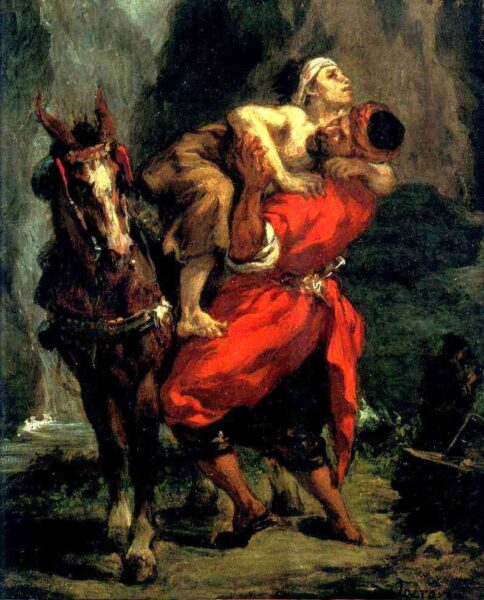
I then understood that, consciously or not, MacIntyre presents a philosophical account of the Good Samaritan, where Christ responds: “Who is my neighbor?”
The final chapter explains the importance of this reasoned moral inquiry.
Our neighbors are those with whom we share the virtues of rational animals—independent and always dependent—, the virtues of giving and receiving in community, including strangers who arouse our mercy.
It is no surprise: reason confirms faith.
About the author
Joseph Wood is an assistant professor at the School of Philosophy of The Catholic University of America. He is a pilgrim philosopher and an easily accessible hermit.