


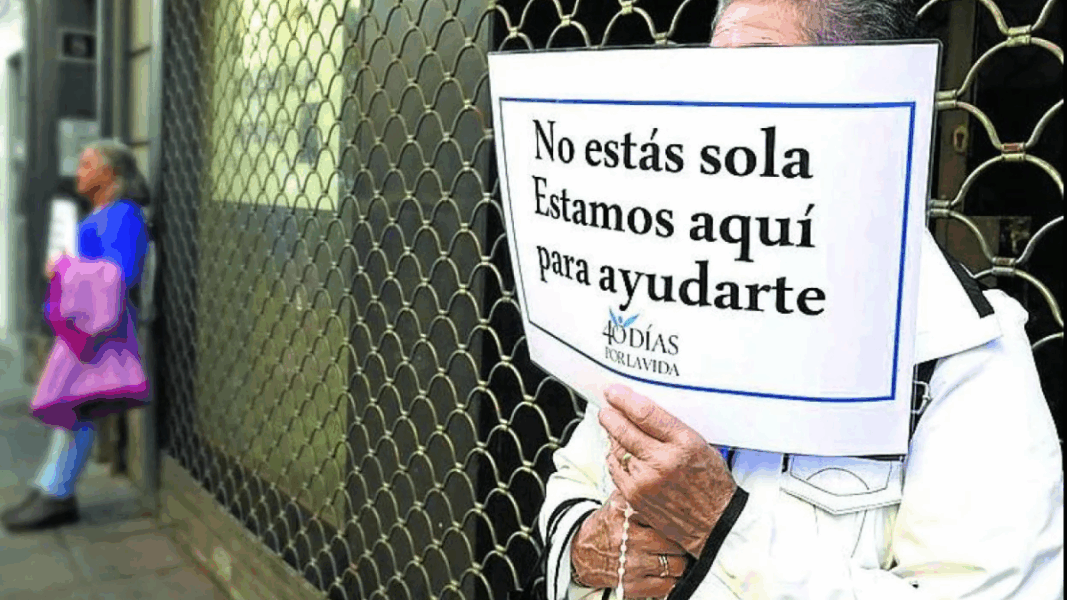
This Monday marked the start of the first trial in Spain against 21 pro-life individuals whose only “crime” would have been praying silently in front of the Askabide clinic, a center where abortions are performed. The events took place between September and November 2022, when several volunteers gathered peacefully at the doors of the facility to pray—or in Planellas’s words: «banalizing prayer»—and offer support to women in difficult situations.
Despite there being no incidents or altercations, some clinic patients have reported alleged “coercions, intimidations, and pointings.” The Public Prosecutor’s Office considers that the mere presence of the pro-life individuals may have “obstructed” the exercise of abortion and requests five months in prison—or 100 days of community service—for each of the accused. The clinic, as a private prosecution, also demands 20,000 euros for an alleged “damage” derived from those prayers in the public street.
Where does freedom of expression stand
The defense categorically rejects these accusations and reminds that the accused were exercising fundamental rights recognized by the Constitution: freedom of expression, freedom of assembly, and freedom of conscience. The lawyers emphasize that the volunteers did not block access, did not confront anyone, and did not engage in any aggressive action. Their behavior was limited to praying in a low voice and holding signs with messages like “40 days for life,” “you are not alone,” or “we pray for you.”
According to various media reports, during the first hearing, 17 witnesses testified, including two women who went to the clinic. One of them said she felt intimidated by the expression “forgive her,” although the defense recalled that that phrase is part of the prayer and was not directed at any woman in particular. The other witness acknowledged that no one approached her, although she assured she felt “uncomfortable” seeing people praying on the sidewalk.
An uncomfortable presence
The manager of Askabide described the presence of the pray-ers as a “constant coercion,” despite the fact that the signs themselves contained messages of help, not insults. He also stated that some women canceled their appointments because they felt “pointed out.” However, several Local Police and Ertzaintza agents, present at the gatherings, testified exactly the opposite.
The police confirmed to the judge that the participants never blocked the street, never insulted, never prevented access to the center, and never caused altercations. They described all the gatherings as “peaceful” and even mentioned the collaboration of the attendees when asked to identify themselves. Some agents admitted that, in their personal opinion, the presence could “be coercive,” but others insisted that the messages were not intimidating and that public order was never violated.
It is a rejection of reasoning and wanting to know the truth
During the opening speech of the Plenary Assembly of the Spanish Episcopal Conference (CEE) this Tuesday, Mons. Luis Argüello expressed clearly:
“Offering information to pregnant women is considered abuse and praying in front of an abortuary a threat. Why this rejection of reasoning and letting science—DNA, genome, ultrasound, etc.—speak, inform, and allow knowing the truth?”
It is a pertinent reflection. Because at the core of the debate is not only prayer, but the possibility that a woman, upon hearing a word of support or seeing an ultrasound, may change her mind. And that, for some, is not only unforgivable, but a crime.
Prayer in the public street has been criminalized
The trial against the 21 pro-life individuals cannot be understood without the reform of the Criminal Code approved in 2022, a legislative modification promoted by the Government of Pedro Sánchez and voted in favor by the coalition partners, which introduced a new article specifically aimed at prosecuting those who gather in front of abortion clinics.
It is article 172 quater of the Criminal Code, added by the Organic Law 4/2022, which punishes those who, “through annoying, offensive, intimidating, or coercive acts,” attempt to obstruct the exercise of abortion. The deliberately broad wording allows the mere peaceful presence, without insults or blockades, to be interpreted as “coercion,” leaving a huge subjective margin in the hands of the complainant or the judge.
The reform was presented as necessary to stop “harassment” of women, but in practice it has turned such basic demonstrations as praying silently, offering help, or showing supportive posters to pregnant women into potentially criminal conduct. Even not addressing anyone, but being present, can be considered intimidating according to the most expansive interpretation of the law.
A trial that exemplifies the legislative drift
The Vitoria case is the first major judicial test for article 172 quater. The Prosecutor’s Office argues that the subjective “discomfort” a woman may feel is enough to constitute coercion; the defense reminds that such an interpretation empties the fundamental rights of expression, assembly, and conscience of content.
The most significant detail is that the police officers themselves acknowledge that there was no blockade, insults, or intimidating approaches, and yet the criminal accusation is maintained. This illustrates to what extent the 2022 law turns prayer and public presence into potential crimes, depending solely on the subjective perception of the observer.
What is at stake is not only a judicial proceeding, but a model of society: one in which abortion is allowed with all facilities, but those who offer support to motherhood and pray for life are criminalized.