


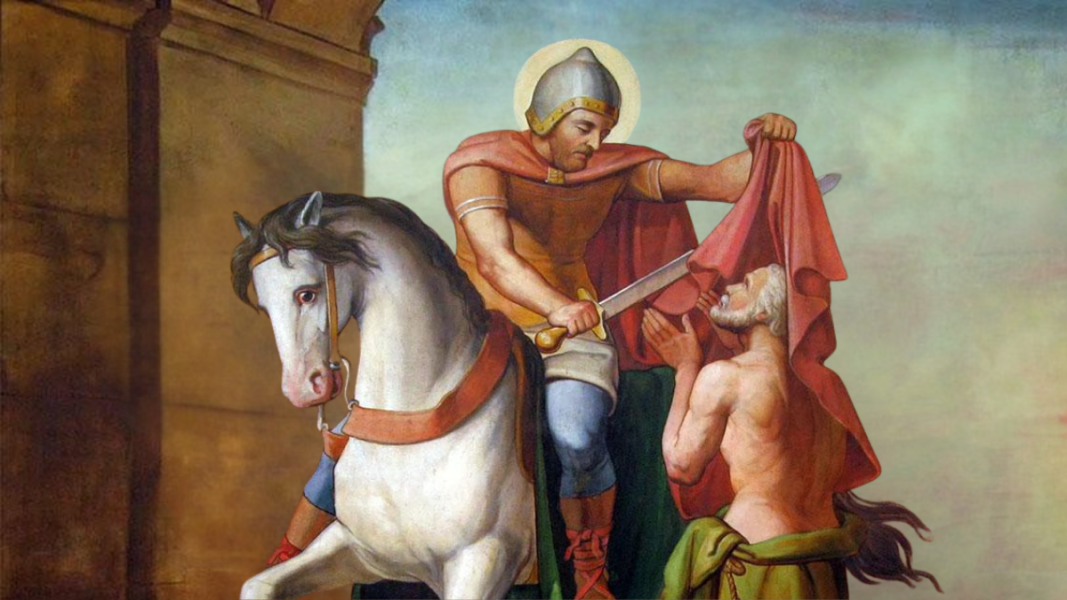
In that gesture, which seemed insignificant, the central truth of Christianity was revealed: Christ identifies with the poor, the sick, and the forgotten. Charity is not a social duty nor an act of goodwill, but an encounter with God Himself. The theology of that gesture summarizes an entire Christian anthropology: man is saved when he loves his neighbor in God’s name, not when he instrumentalizes him for a political or moral ideal.
From the militia of Caesar to the militia of Christ
Shortly after that event, Martin requested baptism and left the army. His decision caused scandal among the military and the authorities. Accused of cowardice, he responded serenely: “Until now I have served the emperor. From now on I will serve Christ.” This phrase synthesizes his entire life: a transition from human power to obedience to God, from pride to humility.
Ordained a priest and then elected bishop of Tours, Martin devoted himself completely to the evangelization of the rural regions of Gaul, where superstitions and pagan cults persisted. He destroyed idolatrous temples, founded monasteries, and trained disciples. However, his zeal was neither authoritarian nor violent: he preached by example, attracted with meekness, and corrected with love. His life was an admirable balance between doctrinal firmness and pastoral tenderness.
In an era when the Church was beginning to confuse itself with political power, Martin was a prophetic voice. He accepted no privileges or honors, rejected episcopal luxuries, and lived with monastic austerity. He loved truth more than convenience and obedience more than fame. For this reason, his figure has transcended the centuries: he was the first non-martyr saint to be officially canonized, a symbol that holiness is not limited to the martyrdom of blood, but also to the daily martyrdom of love.
Christian charity versus secular philanthropy
The charity that moved Saint Martin has nothing to do with modern philanthropy. Today, the world exalts “solidarity” as the supreme virtue, but separates it from faith and truth. Secular philanthropy, stripped of its transcendent dimension, becomes an empty gesture or even a form of vanity. The poor are loved as one cares for a cause, not as one loves a brother.
Saint Martin, on the other hand, did not help the poor to feel better or to demonstrate virtue, but because he saw Christ in him. In Christian charity there is no calculation or reward. It is the love that springs from grace and imitates Christ’s sacrifice on the cross. The gesture of dividing his cloak is, therefore, an eucharistic gesture: a giving that participates in the mystery of redemption.
The example of a bishop faithful to the truth
Saint Martin was also an example of doctrinal courage. In a time marked by Arian heresies and internal divisions, he maintained the unity of the Church without renouncing the truth. He was firm with errors, but merciful with those who erred. His life demonstrates that true charity does not contradict justice or truth; on the contrary, charity without truth degrades into sentimentalism, and truth without charity becomes cruelty.
This teaching has a special echo today, when within the Church itself an attempt is made to oppose mercy to doctrine, pastoral care to morality. Saint Martin would not have understood this false dichotomy. In his life, charity was demanding, because he loved too much to leave the other in his error. His example reminds us that correcting with love is also a form of mercy.
The saint of Christian Europe
Saint Martin is, moreover, a pillar of Christian European civilization. For centuries, his name was synonymous with hospitality, compassion, and justice. More than four thousand parishes in Europe bear his name, and his feast day, November 11, traditionally marked the end of the harvest and the beginning of Advent, a time of spiritual preparation.
His cult spread rapidly throughout Christendom, and his tomb in Tours became one of the great centers of pilgrimage in the Middle Ages. Kings and peasants, monks and soldiers, sought his intercession. The example of a man who changed the world without sword or throne, only with the power of the Gospel, is a reminder for Europe: the roots of its identity are not in the economy or politics, but in faith.
The lesson of Saint Martin for today’s Church
In a Church tempted to dilute its message to appear “close” to the world, Saint Martin reminds us that authentic closeness does not consist in accommodating oneself, but in offering what the world most needs: the truth of the Gospel. His life invites us to recover the supernatural sense of charity, to evangelize with works, but without renouncing doctrine.
Martin was not a social reformer, but a witness to Christ. He did not change structures, he changed hearts. His charity was not a pastoral strategy, but an expression of holiness. In times of confusion, his example illuminates the mission of the Church: to teach, sanctify, and guide, not under the applause of the world, but under the gaze of God.