


By a perplexed (ex) Catholic
On the occasion of the proclamation of Saint John Henry Newman as a Doctor of the Church by Leo XIV, let us recall this most important contribution of his to the correct understanding of doctrinal development, in order to overcome modernist confusion.
Our context is that of the development of the “synodal church.” In this framework, on Sunday, October 27, 2024, the second session of the XVI General Assembly of the Synod of Bishops concluded. Infovaticana offered an interesting analysis regarding the final document of the Synod, which replaced the usual post-synodal apostolic exhortation.
As the YouTube channel La fe de la Iglesia aptly pointed out in analyzing the aforementioned InfoVaticana article, the document seems to point to an ecclesial foundation when it states that “a true conversion toward a synodal Church is indispensable to respond to current needs.” Answering the recurring question about what synodality is seems like a futile endeavor: since a synod is a meeting, synodality would be “the fact of meeting”; therefore, it would be a meeting about the fact of meeting. What is clear is that, being “synodality” an empty concept in itself, it is necessary to fill it with content. And that is what the ecclesiastical hierarchy is doing: endowing this synodal church with new dogmas (ecologism, Masonic universal fraternity, promotion of Islamic invasion and population replacement) and sins (against synodality, against ecology, etc.).
A phrase from the document even states, in reference to leadership roles that it considers women should play in the Church, that “what comes from the Holy Spirit cannot be stopped.” From the Spirit of God, however, from the Holy Spirit, can something contrary to what the sources of Revelation contain originate, that is, Sacred Scripture and Tradition? In addition to a miserable appeal to a spirit that is not God’s, because He does not contradict Himself, let these Vatican innovators beware of incurring sin against the same Spirit, which has no forgiveness, as Our Lord said. Because it turns out that the modernists perched at the highest levels of the ecclesiastical hierarchy commit an error typical of the heresy they have fallen into, which is the confusion of evolution with development.
They have forgotten the principle of non-contradiction of Catholicism: the Church cannot contradict itself. And they have fallen into the worship of progress as something positive per se, continually referring to “the needs of the current times” (do you remember the “aggiornamento” of the Second Vatican Council?), thinking that Catholic doctrine can “evolve” (change) according to the signs of the times, even if that implies contradicting what the Church said previously.
It is dramatic that Pope Francis fell into the nefarious error of thinking that doctrine does not develop without contradiction, but evolves with changes, as a result of all this. It is the consequence of the modernist thinking that dominates the current ecclesial reasoning. In the indistinct consideration by the previous Pope of the concepts of progress, evolution, and development lies the origin of the problem. That is why he believed he could invent new sins and change the Catechism. In this sense, let us think about the change made in the Catechism regarding the death penalty: since Francis considered that the Church has had an erroneous vision until now of the deposit of faith as something static (as was customary for him, he created a problem that did not exist—in this case, the consideration of doctrine as something static—to then resolve it in a confused and heterodox manner), he argued that “the Word of God cannot be kept in mothballs as if it were an old blanket that must be protected from parasites. No. The Word of God is a dynamic and living reality that progresses and grows because it tends toward a fulfillment that men cannot stop.” Therefore—he said—“doctrine cannot be preserved without progress, nor can it be tied to a rigid and immutable reading without humiliating the action of the Holy Spirit.”
This error in Francis’s thinking—and it seems that in Leo XIV’s as well: first, change of mentalities; then, change of doctrine—is not new. Alfred Loisy (1857–1940), the main representative of modernism in the time of Saint Pius X, judged it necessary to “adapt the Gospel to the changing condition of humanity,” and sought “the agreement of dogma and science, of reason and faith, of the Church and society.” This “adaptation” and this “agreement” necessarily led, according to Loisy—as Yves Chiron indicates in his work “History of the Traditionalists”—to the questioning of certain dogmas and to new interpretations of the Sacred Scriptures (p. 15).
The error is clearly observed when Francis refers to the “progress” of Doctrine, and not to its development. In this line, his discourse was one of continuous confrontation between what was done and said, which is no longer valid today, and the contrary positions developed, necessary for the Church to live at the pace of the world and its fashions, even if that contradicts what it always said. In short, a hermeneutic of discontinuity or rupture against which Benedict XVI fought so much: an interpretation of the Second Vatican Council and its faithful or abusive implementation as a new beginning of the Church. A discontinuity that Francis seemed to have set out to turn into rupture and restart with this kind of camouflaged Council that is the synod on synodality.
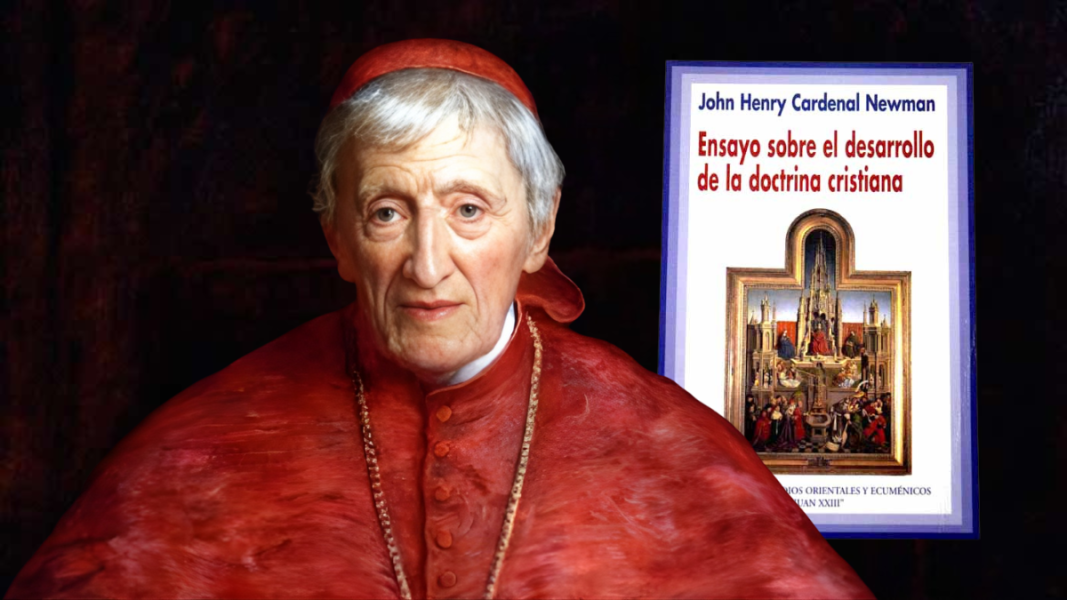
However, it is necessary to insist that the doctrine of the Church does not evolve in the way that modernists propose, but rather develops, in the way that a tree can develop from a seed: the entire tree that it would become was already contained in the seed, as Cardinal John Henry Newman brilliantly explained. In his 1845 work “An Essay on the Development of Christian Doctrine,” Newman expounds how the problem is not the fact that the doctrine had developed over the centuries—which seemed undeniable—but the criteria for development. How can authentic developments be distinguished from false ones? In more explicit terms, how can genuine doctrine be distinguished from heresy?
In this regard, John Senior brilliantly summarized Newman’s exposition in “The Death of Christian Culture,” for the author, “religious evolutionism is frequently confused with Newman’s exactly opposite idea about the development of doctrine—in which the entire creation is forever contained in its own blueprint. Evolution, Newman says, is not development: in development, what is given once and for all at the beginning is merely explicated. What was given once and for all in Scripture and Tradition has been clarified in successive generations, but only by addition, never by contradiction; on the contrary, evolution works through negation. Newman devotes an entire chapter of his ‘Essay on the Development of Christian Doctrine’ to refuting the idea that anything contrary to dogma or not found in the consensus of the dogmas of the Fathers can ever be appropriately developed. Conceived positively, development is radically conservative, allowing only that change which helps the doctrine to remain true by defining the errors that appear in each age.”
What happens is that, as usual, Francis invented that the Church has believed that doctrine was static, when it turns out that Christ Himself said to the Apostles that the Holy Spirit would help them over time to understand the full truth. He would help them, and in fact He did help them, with the development of doctrine, which has nothing to do with a supposed “progress” or “evolution.” In a very interesting article on InfoCatólica, Jorge Soley highlighted the seven notes that authentic developments of doctrine must possess according to Cardinal Newman, in his cited work, which the latter lack, even if presented as mere development, are nothing more than corruptions of doctrine. Of these seven notes, I would like to highlight four here:
1) the continuity of principles: principles are general and permanent, while doctrines relate to facts and grow. Newman writes, “the continuity or alteration of the principles on which an idea has developed is a second mark of distinction between a faithful development and a corruption.”
2) the logical succession: An authentic development process follows the rules of logic: “analogy, the nature of the case, antecedent probability, the application of principles, congruence, timeliness, are some of the methods of proof by which development is transmitted from mind to mind and established in the faith of the community.” What leads Newman to say that a doctrine will be a true development and not a corruption, in proportion to how it seems to be the logical result of its original teaching.
3) the conservative action on its past: Newman writes that, “just as developments that are preceded by clear indications have a fair presumption in their favor, so also those that contradict and reverse the course of doctrine that has developed before them and in which they had their origin are certainly corruptions.” If a development contradicts previous doctrine, it is clear that it is not development, but corruption. On this important point, Newman clarifies that “a true development can be described as the one that preserves the trajectory of antecedent developments… it is an addition that illustrates and does not obscure, that corroborates and does not correct the body of thought from which it proceeds.”
4) The “perennial vigor”: “corruption cannot last long and duration constitutes further proof of a true development.” It is interesting to note another comment that Newman slips in here and in which he shows himself as a fine observer: “the trajectory of heresies is always short, it is an intermediate state between life and death, or what is like death. Or if it does not end in death, it divides into some new and perhaps opposite trajectory that extends without claiming to be united to it… while corruption is distinguished from decay by its energetic action, it is distinguished from development by its transitory character.”
Development, therefore, is conservative; it is neither rupturist nor innovative. The Church affirms that Revelation ended in the apostolic era, with the death of the last apostle. What has developed—organically and without contradictions—is the understanding and exposition of it. However, if Christian or Catholic doctrine progressed as Francis understood it, in contradiction with postulates from times prior to ours, that would mean that the Church erred in preaching that Revelation had ended with the death of the last apostle and that, in reality, the doctrine would be incomplete and need to be completed. The catastrophic epistemological error, the ignorance of Catholic logic, and the modernist intoxication are perfectly observed. If we speak of development, it means that the entire doctrine is there, and what is done is to unroll it, discover it, know it, open it. Development does not add anything new, but discovers what is hidden; while progress is the opposite: a leap and, therefore, something new. In other words: progress is discontinuity and development is continuity. The doctrine of the Church develops; it does not evolve. Therefore, let us be attentive: where there are contradictions, there is no healthy doctrinal development, but corruption and error.
Due to the manipulated use that progressivism in the Second Vatican Council made of the figure of Cardinal Newman, Peter Kwasniewski has made very necessary clarifications about him following Leo XIV’s announcement of his proclamation as a Doctor of the Church. Clarifications that the blogger Wanderer translated into Spanish in an extensive article presented in three parts that I recommend reading, in which Kwasniewski comments how “it is ironic that Newman is mentioned alongside the defenders of the reformist tendencies of the modern Church, when—at least in matters related to fundamental theology, Christian morality, and sacred liturgy—he argued vigorously and consistently throughout his career against rationalism, emotionalism, liberalism, and liturgical ‘tinkeritis,’ that is, the belief that we can build a better worship if we modify enough of what we have inherited.
In the field of liturgy in particular, he firmly opposed ritual modifications and modernizations intended to “meet people where they are” or to “adapt to the current mentality” (as Paul VI said in his Apostolic Constitution of April 3, 1969, which promulgated the Novus Ordo).
Newman was not only antiliberal (he says so expressly of himself, and more than once); he was not only a conservative who detested revolutionary plans. He was what is today called a traditionalist in dogmatic and liturgical matters, someone who would have harshly criticized the entire conciliar project, and undoubtedly the liturgical reform carried out in its name, as erroneous and doomed to failure.”