


A (ex)perplexed Catholic
A few days ago, I had the opportunity to listen to a very interesting lecture on patristics. It was clear that the priest who gave it loved the Church and found it wonderful how the Fathers in the early centuries came to understand the truths that Christ had promised they would understand with the help of the Holy Spirit.
When it came time for questions, however, the rupture and contradictions «that some claim» exist between the Second Vatican Council and the entire previous Church were brought up. The speaker priest affirmed that it was impossible for the Church to contradict itself; that Nicaea and Vatican II were the same; the same Church. It is the same juggling act that Benedict XVI performed to ensure the hermeneutic of continuity in which practically no one believes anymore: that the continuity occurs in the subject Church, as Fr. Gabriel Calvo Zarraute affirms, turning a blind eye to the immensity of transformations and contradictions in the «content.» In fact, Paul VI went even further by telling Archbishop Marcel Lefebvre that Vatican II was «more than Nicaea.» And that is what it seems today, because citations from pre-Vatican II magisterial documents are rarely seen.
After the Council, the Church hierarchy launched an immense propaganda campaign from the pulpits and documents, arguing that everything was changing, that it was necessary to adapt to the times and to modern man, and that all of that was good. That the previous way was no longer possible, nor viable nor desirable: that the rigidity of the «traditional» Church made communication with «modern man» impossible. And that a new «spring» and a new era were opening after the Second Vatican Council.
The propaganda campaign included silencing and minimizing the painful laments and resistance of so many faithful, priests, religious, and laity who saw in the innovations a new church, without correspondence to the previous doctrine, morality, and liturgy. For those of us born at a time of consolidation of the Spirit of the Council, what we were made to understand is that «there had been a change» at some recent moment, as if it had not been traumatic, and that now everything was better, there was an ecclesial spring, with guitars, which would create a fruitful dialogue between the Church and the world and make the Church relevant again in society.
It is however shocking to discover the concrete cases in which history did not happen exactly like that. The painful cases, as I said, and of resistance to safeguard and transmit intact the deposit of faith and the liturgy of always, whose best-known case is Archbishop Marcel Lefebvre, but who was far from the only one. If one reads the documents from the 1960s, in which the dizzying changes that were happening are described in real time, the absolute chaos, the feeling of rupture, of tabula rasa, one is left with a heavy heart. That is why I would like, in some of these texts, to present some cases of concrete people who fought for the defense and restoration of the Church’s tradition in turbulent decades; against the current and being a minority.
And we will begin today with the fascinating story of Sister Wilhelmina Lancaster, founder of the Benedictines of Mary, Queen of the Apostles, in the United States of America.
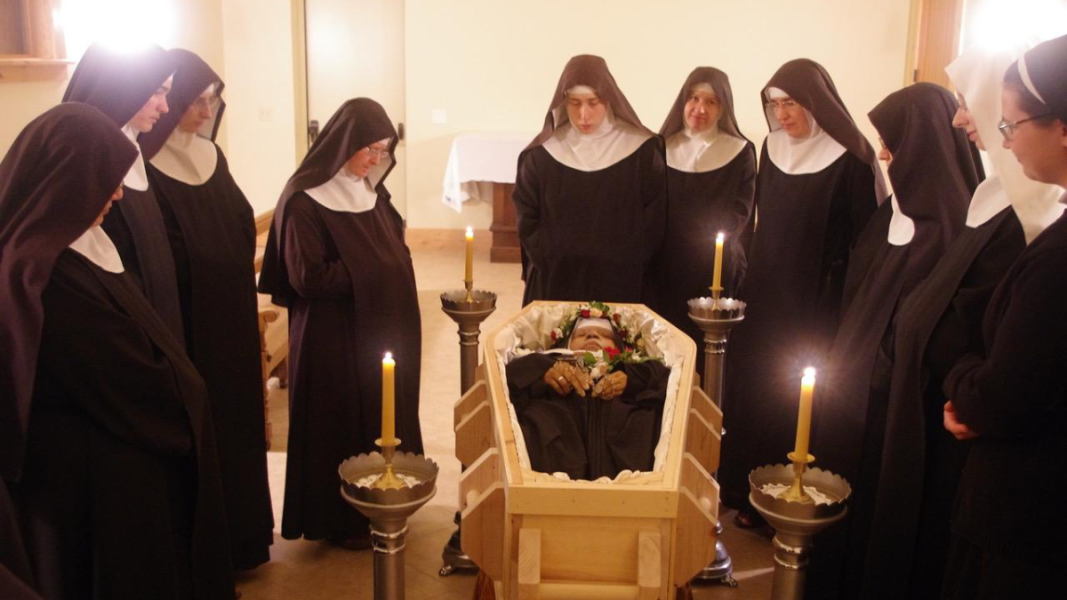
Sister Wilhelmina became very popular when, in April 2023, her body was found incorrupt four years after her death, as reported, among others, by InfoVaticana. After her death in 2019, Sister Wilhelmina was buried without any embalming by the nuns of her community, who testify how they simply, with a priest from the Priestly Fraternity of Saint Peter, washed her, put a clean habit on her, and placed her in a very simple wooden coffin. The coffin was lined with a synthetic material, similar to satin, the coffin was closed, and she was buried directly in the ground. There was no protection against the elements or the high humidity of the soil in which she was buried. That is why what happened almost four years later was even more surprising, when the sisters were giving the final touches to the church of their abbey and building a shrine dedicated to Saint Joseph in a side altar, and thought it would be a suitable place to preserve the remains of Sister Wilhelmina. So the mother abbess initiated the exhumation process. There were sisters digging the grave and they did not expect to find anything extraordinary. Some people told them that they would probably only find bones. But when they opened the coffin, the first thing the mother abbess saw was a very intact foot, just as it was when they originally placed her in the coffin.
The lining of the coffin had completely disintegrated, but Sister Wilhelmina’s body, remarkably intact, still had the complete habit, and showed no wear or signs of moss or disintegration of the natural fibers. Everything was perfectly there, having been buried for four years in very humid ground.
That is how, in April 2023, Sister Wilhelmina became known worldwide and since then thousands of people flock to her abbey to venerate her incorrupt body, which the sisters placed in the side altar dedicated to Saint Joseph, with a transparent cover, so that visitors entering the church can see Sister Wilhelmina intact.
The incorruptibility of her body drew attention to the life of this African-American religious, a life of brave combat for the Church’s liturgical tradition that is worth knowing.
Eric Sammons interviewed Sister Mary Josefa, a sister from Sister Wilhelmina’s community, in September 2023; an interview whose link I leave here, and from which I offer excerpts that I have found fundamental to know this extraordinary woman, a current traditional saint, as Sammons defines her.
In the interview, a review is made of Sister Wilhelmina’s family life and vocation. We read that she was born in St. Louis in 1924, in a time of great racial conflicts, and in the bosom of a very poor family, but with a very living Catholic faith. One of Sister Wilhelmina’s great-grandmothers had been a slave and was freed by her master after she and her son were baptized.
Sister Mary Josefa recounts that «Sister Wilhelmina received her vocation very early, after making her First Communion. While praying, she heard our Lord say to her in her heart: ‘Do you want to be all mine?’ And she responded: ‘Of course I want to be all yours.’ But she still didn’t know what that meant. Only later, when she began to hear about nuns, did she realize that the religious vocation is the way a soul can belong completely to Christ as a spouse.» She entered religious life very young, at 17 years old, right after finishing high school (a Catholic high school for black children that her parents helped found in St. Louis and in which Wilhelmina was the best student of the first graduating class). «So Sister Wilhelmina – explains Sister Mary Josefa – left a very beautiful family life and embarked on religious life at 17, and served with great faith and devotion for more than 50 years.»
In the context of racial segregation in the United States, it was not easy for any religious order to accept a black vocation, so she didn’t have many options to choose from. She joined the Oblate Sisters of Providence, founded in the 19th century by a black woman, Mother Mary Lange, for the Christian education of young children, especially black or mixed-race ones, who had no opportunities to receive education. This first order to which Sister Wilhelmina belonged had Benedictine roots: the foundress was inspired by the tertiary / oblate Benedictine branch that St. Frances of Rome had founded many centuries earlier. Therefore, the order had a very Benedictine spirituality.
In the 1960s, Sister Wilhelmina was a religious and teacher of the Oblate Sisters of Providence in a congregation school in Baltimore. Over twenty years, she had been a teacher in various schools in marginalized neighborhoods. It was in those years that things began to change radically in the Church. Sister Mary Josefa does not hesitate to comment that «it was a source of pain for her when the experimentation of the 1960s and 1970s began to affect her order» (…). It is not that she viewed the experimentation with nostalgia, as if we should always do what we have always done, but rather that she recognized that the experimentation was touching very vital points of religious life. The sisters began to set aside the traditional habit and started dressing like lay women; they abandoned community prayer or silence in the cloister and became very involved in lay activities, more social work activities, and since they were a black order, even in racial pride movements. And then Sister Wilhelmina realized that they were beginning to lose their roots. They were setting aside the things that had safeguarded their identity as spouses of Christ.»
Faced with these circumstances, Eric Sammons wonders why Sister Wilhelmina remained in the Congregation amid these changes that caused her so much suffering. To this question, Sister Mary Josefa responds that Sister Wilhelmina «suffered and prayed for many years to try to get her sisters to return to the traditions they had abandoned. She even tried to form a traditional branch of her order that would preserve those things.
In an article published in Catholic World Report, we can read how «during her 50 years of religious life, Sister Wilhelmina witnessed the changes brought by the Second Vatican Council and tried to preserve the habit. ‘She spent many years fighting for the habit,’ said Mother Cecilia, who stated that Sister Wilhelmina took very seriously the idea that the habit symbolizes the one who wears it as a spouse of Christ. According to her biography (‘The life of Sr. Mary Wilhelmina,’ written by nuns of her order), she made a habit for herself when her sisters had already abandoned it, creating parts of the headpiece with a plastic bleach bottle.»
Sister Wilhelmina had a great sense of loyalty, so she hoped that, instead of starting over, she could reform the community she loved. And she appealed to different sisters in that community. She even wrote to the hierarchy in Rome asking for help and guidance in that situation. So she tried many avenues before reaching the extreme of leaving the community.
A decisive issue was the liturgy. It was not only that her sisters had taken off the religious habit and dressed as lay people and dedicated themselves to activism that lay people could well perform; but she deeply grieved the loss of the traditional liturgy; but she was bound to what she was: that is, she was an oblate sister of Providence, she had to do what the sisters did and pray as her congregation did, with the new breviaries and the Missal of Paul VI.
Sister Mary Josefa explains how, over the years, Sister Wilhelmina appealed to Rome on several occasions about the liturgy. Very emphatically, in a letter she said: «We don’t need an African rite. We don’t need an American rite. We don’t need an African-American rite. We need the Roman Catholic Latin rite». Unfortunately, she had to suffer and wait many, many years to achieve it.
But things changed for the traditional liturgy in 1988 with the indults granted by Pope John Paul II and thus, Sister Wilhelmina rediscovered the Latin Mass in an indult parish in Washington D.C. and remembered all the graces that the ancient liturgy had brought her and how suitable it was for religious life, so she decided to attend that Mass whenever she could. Meanwhile, she continued trying to get her sisters to return to the way of life they had abandoned, but finally she realized that it was very difficult to reform; that in a certain way it was easier to start from scratch. So, after more than 50 years of religious vows and over 70 years old, she decided to leave her community, which had been her religious family, and start a new one, recognizing the value of the religious traditions that had been lost and which she intended to recover.»
The Priestly Fraternity of Saint Peter providentially crossed paths with Sister Wilhelmina’s desire for traditional religious life: she learned that the FSSP was creating a group of sisters, which was the definitive impetus to leave her community since, moreover, she had come into contact with two other nuns who also sought to return to traditional religious observance. The Priestly Fraternity of Saint Peter proposed that they create a community of active sisters who would help the priests in their parish work and catechesis. They had the Mass of all time in Latin, they had the possibility of traditional religious observance, and they were a small community of three members. The priest who welcomed them under his protection was Father Arnaud Devillers, a French priest of the Priestly Fraternity of Saint Peter, who recognized Sister Wilhelmina’s fidelity and devotion to religious life, so he appointed her superior of this small community, entrusting her with its guidance and spiritual direction.
Sister Wilhelmina, however, only held the position of superior for one year, as by then she was of advanced age, and ended up asking one of the younger sisters to assume the responsibility of leadership. But in that first year, the foundations of the young community were laid: they had decided that their spirituality would be Benedictine. They decided that their life would imitate that of Our Lady Queen of the Apostles in the Upper Room after the Ascension of our Lord, when she gathered with the apostles, waiting for the arrival of the Holy Spirit. Originally, she called the community Oblates of Mary Queen of the Apostles; inspired by the name Oblates from her previous religious family, the Oblates of Providence, but gave it a Marian character dedicated to Our Lady Queen of the Apostles because they intended to be at the service of priests. Over time, they discerned a more contemplative monastic vocation, so they separated from the FSSP in terms of daily life, but continued to be cared for by their priests. They decided that they would not have an active ministry, but would support the priests in a more hidden way, offering a place of retreat for priests and making priestly vestments to support themselves economically. At the same time, they trained to become full-fledged Benedictines.
The new community, which began in Scranton, Pennsylvania, followed the Rule of St. Benedict, sang the traditional Benedictine Divine Office in Latin, and the traditional Mass was celebrated in their abbey. Mother Cecilia explains how «it always moves me that we recite the psalms in the order prescribed by St. Benedict more than 1500 years ago. And we use the books that were used then, which were published in the early 20th century, in the 1920s or so, but even those books are based on the tradition of previous centuries. So we can read 19th-century spiritual authors who speak of the liturgical year, of the Mass, of the Divine Office, just as we pray it every day. And I think the continuity is a source of strength for us, and the integration is also a great source of contemplation» (…). «It is very difficult to separate the Divine Office from the Mass. It is as if the Office were the crown that surrounds the Mass, perpetuating it throughout the day.»
In 2006, the community accepted an invitation from Bishop Robert W. Finn to move to his diocese of Kansas City-St. Joseph, in Missouri. And since then, God’s Providence has ensured that sisters continue to enter their abbeys.
For more information, their website can be visited: www.benedictinesofmary.org .