


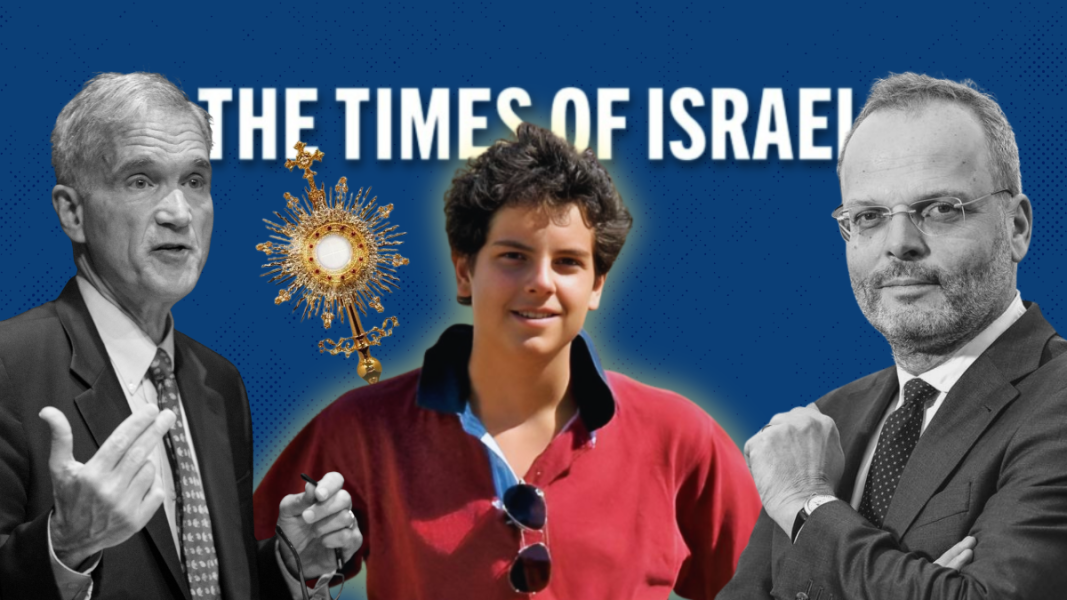
The canonization of Carlo Acutis, the young Italian who dedicated his short life to the Eucharist and digital evangelization, has generated a striking reaction in The Times of Israel. The Israeli media warns that the compilation of Eucharistic miracles carried out by Acutis could “revive” old medieval legends about the desecration of hosts, used in their time as an excuse for persecutions against Jews.
What’s curious, however, is that on the page created by Acutis, no specific religious communities are mentioned. The texts speak only of “wrongdoers” or “non-believers.” Despite this, academics and officials cited by the newspaper question the lack of a modern contextual framework that highlights 21st-century sensitivity.
The German commissioner against antisemitism, Felix Klein, demanded that the Church “better separate” historical contexts, while historian David Kertzer described it as “unfortunate” that these medieval narratives reappear just on the anniversary of Nostra Aetate.
The paradoxical thing is that Carlo, who died in 2006 at just 15 years old, did not intend to write history or fuel prejudices. His interest was to bear witness to the real presence of Christ in the Eucharist, relying on accounts approved by the Church.
The debate goes beyond his figure. What underlies it is the demand for absolute historical immunity: the claim, sustained from certain sectors of cultural and political Zionism, that it must be assumed as dogma that never, neither now nor in past centuries, could a Jew have committed a reprehensible act. In the name of that sensitivity, the Church is posed with the obligation to silence or rewrite medieval episodes if these, in their time, were instrumentalized against a community.
Faced with this pressure, it is worth remembering that the Church canonizes not accounts but saints. In the case of Santo Dominguito de Val, the child martyr venerated in Zaragoza since the 13th century, the Catholic tradition recognized in his testimony a sign of Christian innocence and faith lived to the extreme. It is not about judging entire communities with contemporary eyes, but about recognizing the strength of a martyrial memory that, like that of so many other saints, is part of the history of salvation.
In the same way, Carlo Acutis collected accounts of Eucharistic miracles not to reopen wounds or point out culprits, but to proclaim that Christ is alive in the Eucharist. Rejecting that memory or attempting to censor it under the logic of “historical intangibility” would mean amputating the identity of the Church and denying the strength of the testimonies of faith that have sustained generations of Christians.
In short, the controversy does not revolve around Carlo Acutis—who never promoted prejudices—nor should the legitimate veneration of saints like Domingo de Val be questioned. The real problem lies in the cultural pressure that seeks to impose on the Church a domesticated narrative, where faith and history can only be transmitted if they conform to external criteria alien to the Gospel.