


What is happening in the Insigne and National Basilica of Guadalupe?
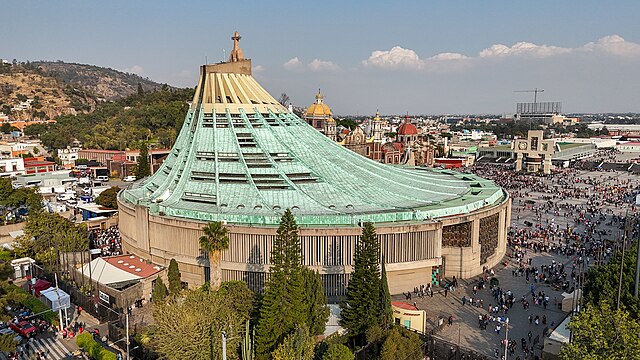
Three days before October 12, the date of the 49th anniversary of the transfer of the Sacred Image of the Virgin of Guadalupe to its current abode, one of the most visited shrines in the world seems to be shrouded in a fog of uncertainty that threatens to darken what should be a jubilee year toward the half-century of that event in 2026.
And it is that the Basilica could be facing an internal storm due to inexplicable absences, questionable interventions, and rumors that are undermining its pastoral work when the milestone of 1976 painfully contrasts with the current opacity. Inaugurated to house the Tilma in a modern and accessible space, the Basilica represented hope and unity. What is happening in the Basilica of Guadalupe? And hypotheses have emerged from the presbytery of the Archdiocese of Mexico that no one in the curia of the archbishopric manages to answer with sufficient transparency to contribute to certainty.
The first thing questioned is the absence of the rector, Efraín Hernández Díaz, who on October 12, 2020, was invested as a canon of the Basilica so that, with the backing of Archbishop Aguiar Retes, he was appointed rector in November 2023. Father Efraín had been visible until August 2025, especially in capitular masses and chapter meetings. However, he practically disappeared until the rare “twinning” of Marian shrines put him in Spain along with the auxiliary of Mexico, Francisco Javier Acero, on September 18, 2025; however, his absence persists without leading the capitular masses, leaving the venerable chapter in limbo.
Among what is circulating in the archdiocesan presbytery is that the canon-rector is limited in his functions and it is the vice-rector who would assume these responsibilities in the face of the authority vacuum, still without a formal interim decree. This has fueled speculations of all kinds of possibilities, from “prolonged vacations of the rector,” health reasons, internal conflicts or even “external pressures”.
Another rumor points directly to the primate archbishop whose intervention in the management of the Basilica has generated frictions due to an unusual replacement of the rector without the consensus of the Guadalupan Chapter that would go toward an authoritarian tone, but would have behind it more serious reasons, the alleged presence of people who would have handled, with many irregularities, human, material resources, and even the finances of the Basilica which could have initiated an internal canonical investigation in relation to the complex and delicate handling of the coffers and economy of the shrine.
These rumors feed a central problem: the lack of reliable information from the Basilica and the Archdiocese of Mexico that has unleashed a whirlwind of rumors that weighs down the life of the Marian shrine.
The legitimate questionings of the archdiocesan presbytery call attention to the need for immediate action to avoid a potential crisis unleashed especially in the final stretch of the current pastoral government of the Archbishop of Mexico; some are already calling for attention to require an intervention from the Mexican Episcopate or from the Apostolic See. At the moment, thanks to the Guadalupan chapter, pastoral care in the Basilica continues, especially in these moments of the year that are heading toward the December festivities.
All this coincides with the appearance of the first apostolic exhortation of Pope Leo XIV addressed to the Church and its attention to the poor and calls attention to the providential nature of his words in these hard times at the Basilica of Guadalupe.
It highlights a very special aspect that touches especially the clerics who have forgotten the why of the ministry by citing Saint Ambrose who wrote about the duties and ethics of the clerics: “And, remembering that the ministers of the Church must never neglect the care of the poor and, even less, accumulate goods for their own benefit, he affirms: «It is necessary that each one of us fulfill this obligation with sincere faith and perceptive providence. Undoubtedly, if someone diverts something for his own benefit, that is a crime; but if he gives it to the poor, if he rescues the captive, that is mercy ». (No. 38). Words that result in devastating timeliness.
Help Infovaticana continue informing