


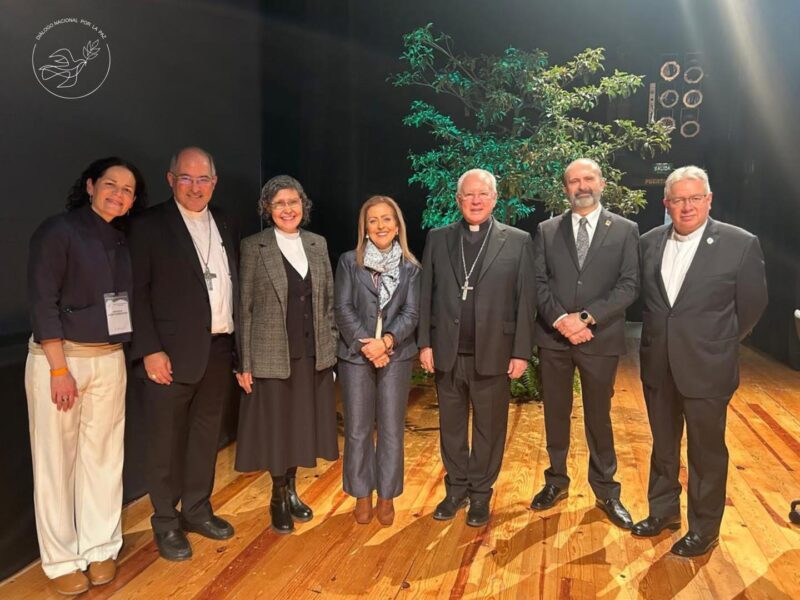
The Technological Institute and Higher Studies of the West (ITESO), Jesuit University of Guadalajara, became a beacon of collective hope by hosting the inauguration of the Second National Dialogue for Peace. Amid Mexico’s persistent violence crisis—with more than 20,000 intentional homicides annually and a number of missing persons that does not decrease—more than 1,370 participants from across the country gathered to move from mere violence management to the active and co-responsible demand for sustainable and territorial peace.
Organized by the Mexican Episcopal Conference (CEM), the Mexican Province of the Society of Jesus, the Conference of Major Superiors of Religious and Societies of Apostolic Life in Mexico, and the Episcopal Dimension for the Laity, the gathering resumed the momentum of the First National Dialogue held in Puebla in 2023, which gave rise to the National Peace Agenda. The inaugural session brought together emotional and committed speeches from religious and lay leaders, centered on action inspired by faith, shared responsibility, and the urgent need for justice, memory, and reconciliation.
The event began with welcoming words from Dr. Alexander Zatyrka Pacheco, SJ, rector of ITESO, who set a tone of ethical and spiritual commitment. Hosting this dialogue, he affirmed, represents “an opportunity to participate in the co-construction of community reflection processes” that the Jesuit university has the obligation to accompany.
Zatyrka recalled the wounded reality of the country: although there was a slight decrease in homicides, violence continues to ravage urban and rural territories. Invoking St. Ignatius of Loyola—“love must be placed more in deeds than in words”—, he presented Jesus of Nazareth as a model of peace built through gestures of humanity, closeness, and solidarity with the most vulnerable. He called on academia to serve victims, systematizing knowledge and validating methodologies with humility, to turn peace into “everyday practice.” He concluded by reaffirming that peace is a “craft task,” a patient weaving that is collectively threaded from the local to the national level.
For his part, Cardinal Francisco Robles Ortega, Archbishop of Guadalajara, offered a deeply reconciliatory message. Greeting those present as “brothers and sisters,” he evoked the image from the inaugural video—lighting candles—as a metaphor for the purpose of the gathering: “In each national or local meeting, we aim to light the light of peace.” However, he acknowledged the opposing forces that “strive to extinguish it through violence and war.” Robles insisted on sowing “seeds of peace” in everyday spaces—family, street, school, neighborhood, and work—to transform violence into signs of hope and rebuild the community. Inspired by Jesus’ resurrection, which reconciled humanity with God and among themselves, he described peace not as a finished goal, but as a “path” presided over by Christ, which demands permanent reconciliation and “specific and concrete actions” in daily life.
Bishop Héctor Mario Pérez Villarreal, general secretary of the CEM, intervened with a speech anchored in Mexico’s persistent pain. “We are here because Mexico continues to suffer from violence, but also because there are people who still believe in peace,” he declared. Pérez Villarreal emphasized that this second dialogue arises from the accumulated pain since the first, from increasing absences, and from stories that resist becoming statistics. He presented peace as an “exigent and everyday responsibility” that demands dialogue despite obstacles, involving everyone from diverse trajectories. United by the certainty that “Mexico can be better,” he rejected the normalization of corruption, lies, and violence, affirming forcefully: “Only truth, the restoration of justice, and reconciliation will achieve peace for us.” He invoked Jesus Christ to illuminate the conversations and guide steps toward a possible peace.
Other voices enriched the inauguration, such as that of Father Luis Gerardo Moro Madrid, SJ, provincial of the Jesuits in Mexico, who presented the event as the beginning of a “pact” of long duration that demands perseverance, coherence, and courage, even when peace is no longer fashionable. “Peace is not decreed; it is built, woven thread by thread,” he affirmed, urging a shift from lament to action.
Sister Juana Ángeles Zárate Celedón, from the Conference of Major Superiors, highlighted the roots of the dialogue in “thousands of voices” from searching mothers, resistant communities, and young people who refuse to give up, recognizing violence as the result of decisions, omissions, and prolonged silences, but also finding hope in the most affected territories.
Representing the Episcopal Dimension for the Laity, Denise María Arana Escobar closed the main interventions by posing the central question: “What country do we want to build together?”. She rejected idealizing a perfect or abstract peace and advocated for a “real and possible peace, rooted in the territories,” emphasizing practical and collective commitment.
The speeches converged in a unified message: peace requires collective effort, inspired by faith and anchored in justice, truth, and reconciliation. Participants—bishops, priests, laity, youth, businesspeople, victims, and representatives from various sectors—formed a broad coalition willing to transcend political cycles.
The three days of the dialogue, under the motto “From managing violence to demanding peace,” were structured to generate concrete results. The first day (“We Look,” January 30) confronted the deep causes of violence—inequality, impunity, criminal economies—through reflections on national pain.
The second (“We Interpret,” January 31) compiles successful methodologies from local and international experiences, including contributions from ambassadors of Ireland, Norway, and Switzerland, and presented 10 proven models such as peace circles in prisons, mental health initiatives in indigenous communities, and community policing.
The third (“We Act,” February 1) focused on building “Local Dialogues for Peace” in the states, identifying resources, needs, and commitments, culminating in an Eucharistic celebration. With 250 projects implemented in 2025 and 14 priority actions—support for victims, restorative justice, strengthening local police, and prison reform—the gathering seeks to turn peace into a shared state policy, urging all sectors to invest in a decade of transformation.
The sessions of the II National Dialogue for Peace can be followed at: https://dialogonacionalporlapaz.org.mx/new/