


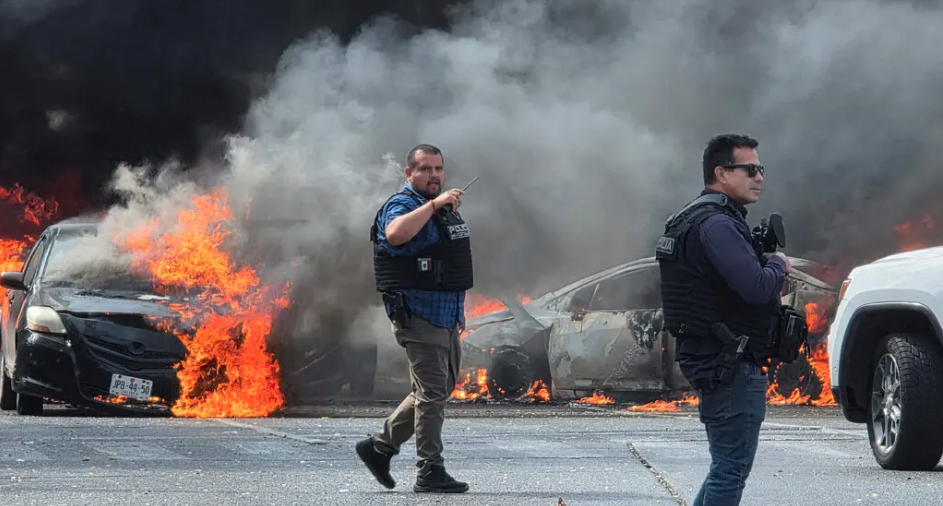
On the morning of Sunday, February 22, the first day of the Lenten season, marked a turning point in the fight against organized crime in Mexico. Federal forces killed Nemesio Rubén Oseguera Cervantes, ‘El Mencho’, leader of the Jalisco New Generation Cartel (CJNG), in an operation in Tapalpa, Jalisco. This blow, although celebrated by Mexican and U.S. authorities, unleashed a wave of violence in at least 20 states of the country, with blockades, vehicle burnings, shootouts, fires in banks, department stores, and convenience stores, and attacks that paralyzed entire communities. Insecurity forced the suspension of Sunday masses in various dioceses, highlighting the impact on the religious and social spheres.
The operation, coordinated by the Mexican Army with support from intelligence from the National Intelligence Center and the Attorney General’s Office, was carried out in the mountainous area of Tapalpa. According to the Secretariat of National Defense, ‘El Mencho’ was seriously injured during a confrontation and died during his air transfer to Mexico City. In the clash, four other CJNG members died at the scene, and three more lost their lives en route, including the boss. Three soldiers were injured. The United States confirmed its collaboration, providing key information, as it had offered 15 million dollars for his capture. This takedown represents one of the most significant blows to drug trafficking in recent years, but also a risk of escalation in the dispute for control of the CJNG.
The cartel’s reaction was immediate and coordinated. The Security Cabinet reported 252 blockades on roadways in 20 federal entities, with Jalisco recording the highest number (65). Other affected states include Michoacán, Guanajuato, Colima, Tamaulipas, Nayarit, Zacatecas, Sinaloa, Aguascalientes, Hidalgo, Querétaro, Estado de México, Veracruz, Puebla, Chiapas, Tabasco, Guerrero, Baja California, Nuevo León, Oaxaca, and Quintana Roo. Vehicle fires, looting of convenience stores, and attacks on gas stations spread rapidly, forcing the activation of «red code» protocols in several regions. In Jalisco, Governor Pablo Lemus reported additional confrontations and asked the population to shelter in place. The violence not only affected critical infrastructure but also generated widespread panic, with suspensions of public transportation and alerts from foreign consulates, such as that of the United States, recommending that their citizens not leave their homes.
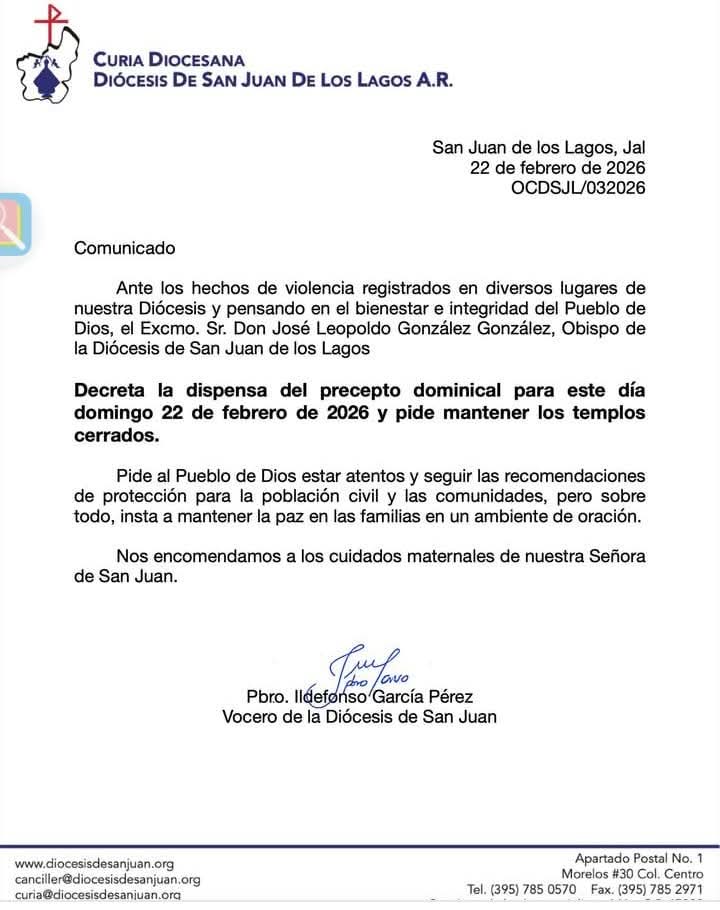
In the State of Jalisco, the epicenter of the chaos, insecurity was felt with particular intensity in municipalities in the Los Altos region. Rural and urban communities reported blockades on highways and direct threats, leading to the cancellation of daily activities. The diocese of San Juan de los Lagos issued a decree dispensing the faithful from the Sunday precept for February 22. In the statement, the diocese’s spokesperson pointed out the need to prioritize the protection of the civilian population in the face of the acts of violence recorded in various places in the diocesan territory. «In the face of the acts of violence recorded in various places in our diocese and thinking of the well-being and integrity of the People of God», reads the document, which urges maintaining peace in families and praying for serenity.
This measure was not isolated. In Tepatitlán de Morelos, priests such as that of San Francisco de Asís chose to suspend evening masses and, instead, held blessings with the Blessed Sacrament to console the parishioners by praying for peace and tranquility in the community.
Likewise, after the blockades and fires at various points in the city, faithful from the communities spread messages from their priests announcing the cancellation of Sunday evening celebrations, as was the case with the parish of the Santísima Trinidad in Tepatitlán, the priest, through an audio, exhorted those responsible and group leaders to communicate the decision for safety reasons “due to the location in which we find ourselves”.
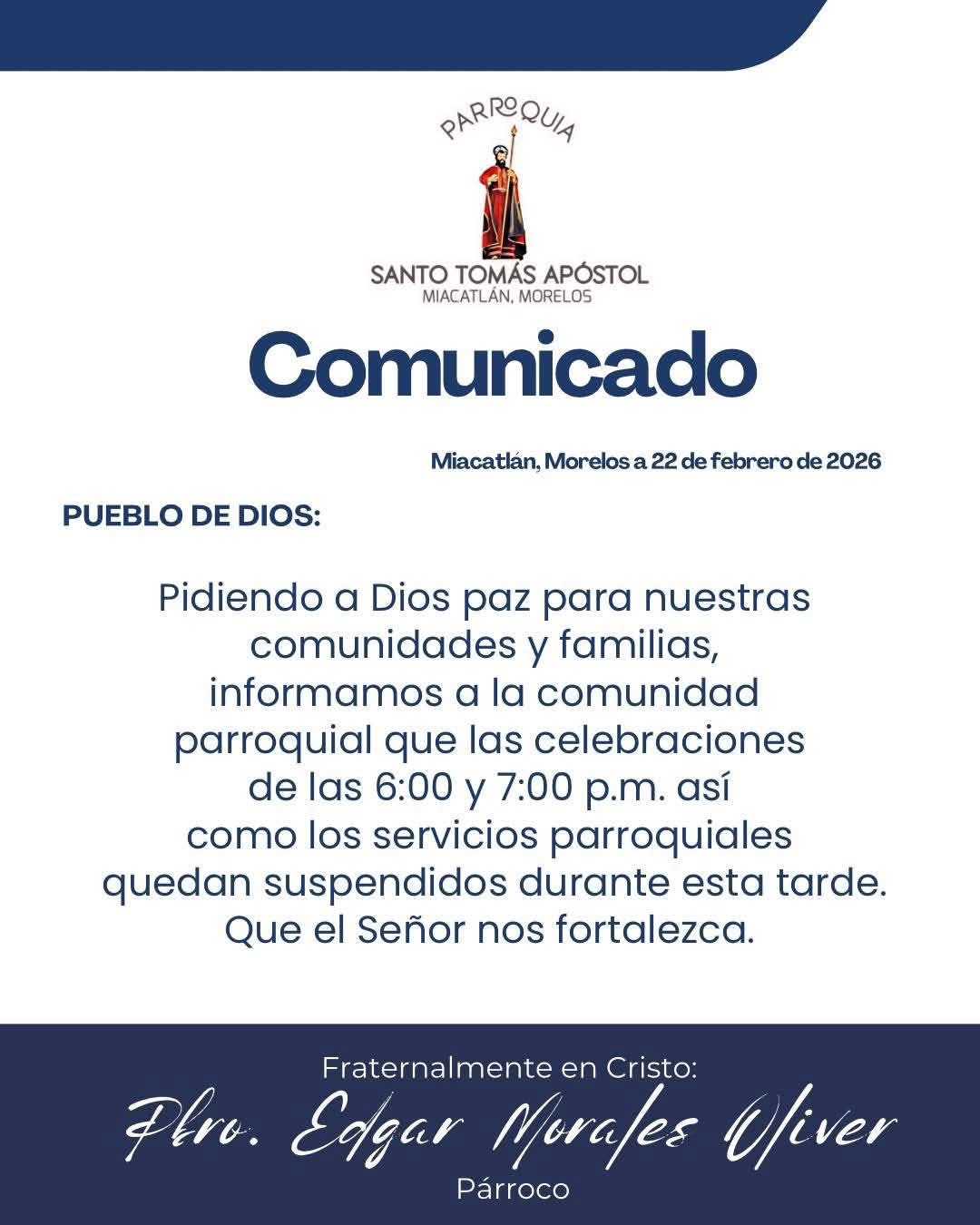
The suspension extended to other entities, such as Morelos, where communities in Temixco and Miacatlán announced the cancellation of Eucharistic celebrations at 6:00 and 7:00 p.m., asking God for strength and protection. In Temixco, the parish of the Asunción lamented the acts of vandalism and emphasized the importance of community prayer, invoking the Virgin of the Assumption as patroness.
The Mexican Episcopal Conference (CEM), presided over by Bishop Ramón Castro Castro, issued a statement to the People of God. Citing the Gospel of John (14:27): «Peace I leave with you; my peace I give to you; I do not give it to you as the world gives. Do not let your heart be troubled, nor let it be afraid,» the bishops expressed closeness to the families affected by the violence stemming from the operation against the criminal leader. They exhorted to strengthen personal security measures, shelter in homes, and avoid unnecessary travel, following the instructions of civil authorities. In addition, they invited to intensify prayer for peace in families, parishes, and communities, emphasizing the commitment to be «sowers of reconciliation and fraternity.» They entrusted the country to the Virgin of Guadalupe, Queen of Peace, asking for her maternal intercession.
This episode of violence is not isolated in Mexico’s recent history. The CJNG, founded in 2010, has expanded its influence to 21 states, surpassing even the Sinaloa Cartel in reach. Its notoriety for trafficking fentanyl and methamphetamines to the United States, along with audacious attacks against officials, has made it a global threat. Experts warn that the death of ‘El Mencho’ could trigger internal struggles for leadership, exacerbating insecurity. Meanwhile, authorities call for calm, although the suspension of classes in at least 10 states for Monday, February 23, reflects the magnitude of the fear.
In a Lenten context, a period of reflection and penance for Catholics, the Mexican Church positions itself as a beacon of hope. «As the People of God, we invite you to intensify prayer for the peace that our nation so needs,» reiterates the CEM. However, reality imposes prudence by adapting faith to adversity, with blessings that seek to restore peace amid the chaos. Mexico now faces the challenge of rebuilding tranquility, while this Monday, in the State of Jalisco under Red Code, most economic activities are suspended and there is uncertainty whether the death of ‘El Mencho’ marks the end of an era or the beginning of a more turbulent one.