


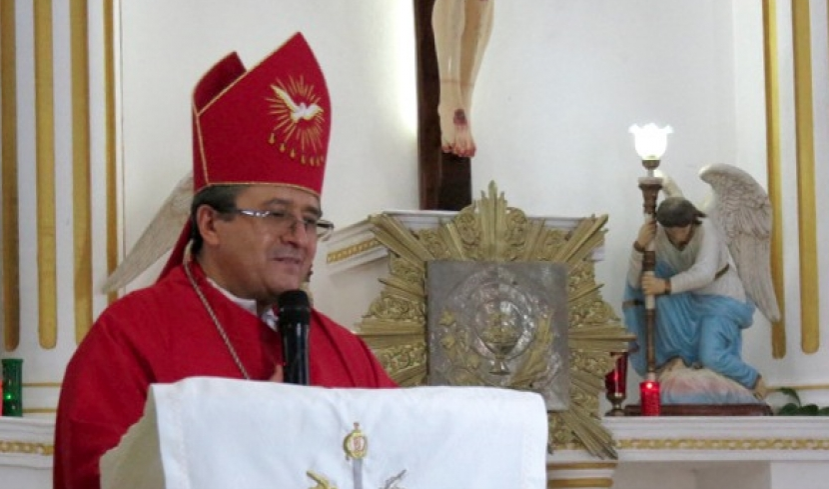
This Thursday morning, November 20, the date on which the Church in Mexico celebrates the 20th anniversary of the beatification of Anacleto González Flores, patron of the laity, and his companion martyrs of the Cristero War, the Mexican Episcopal Conference announced that León XIV accepted the resignation, upon reaching the canonical age limit, of the X Bishop of Zamora, Javier Navarro Rodríguez, from the pastoral government of the Diocese of Zamora and, in his place, has appointed as the eleventh bishop Joel Ocampo Gorostieta, until now the ordinary of the Diocese of Ciudad Altamirano, in Guerrero.
The transfer of the new pastor represents a generational shift in an episcopal see with deep historical roots and a present marked by pastoral challenges in the heart of the Michoacán Bajío.
Joel Ocampo Gorostieta, born on August 21, 1963 in Paso de Tierra Caliente de Melchor Ocampo, municipality of Tuzantla, in eastern Michoacán, comes from a region marked by popular devotion and social difficulties.
He completed his initial studies in Christian-inspired schools and entered the minor seminary in 1978. Later, he studied philosophy and theology at the Major Seminary of Tacámbaro where he received priestly ordination in 1989 from the hands of the then pastor of that diocese, Alberto Suárez Inda.
During his first years as a presbyter, he served in various parishes of Tacámbaro, standing out especially as pastor of Our Lady of Guadalupe in Benito Juárez where he promoted a pastoral approach close to families and rural communities.
In April 2019, Pope Francis appointed him Bishop of Ciudad Altamirano, a diocese erected in 1964 and characterized by contexts of violence and extreme poverty in the Guerrero Tierra Caliente. There, Ocampo Gorostieta has been recognized for his territorial work, his closeness to the faithful in risk areas, and his emphasis on promoting peace and reconciliation, even in the midst of the COVID-19 pandemic, which hit his family and his flock hard.
The Diocese of Zamora, one of the oldest in western Mexico, traces its origins to the turbulent 19th century. On January 26, 1863, Pope Pius IX signed the bull “In Celsissima Militantis Ecclesiae”, erecting the new ecclesiastical circumscription in response to the petitions of Mexican bishops exiled in Rome, including Clemente de Jesús Munguía, Bishop of Michoacán. That vast diocese, founded in the 16th century with its initial seat in Tzintzuntzan and later transferred to Morelia, faced serious geographical, economic, and security difficulties, aggravated by the Reform Laws and the exile of prelates ordered by Benito Juárez between 1861 and 1862. The new diocese was configured with dozens of parishes covering much of present-day western Michoacán, from Zamora to Apatzingán, Uruapan, and bordering areas with Jalisco and the Pacific, becoming suffragan to the Archdiocese of Michoacán.
The first bishop, José Antonio de la Peña y Navarro, took possession in 1864 amid the political instability of the Second Mexican Empire, consecrating himself in the Collegiate Church of Guadalupe and arriving definitively in Zamora in 1865. He was succeeded by pastors who faced turbulent times: José María Cázares y Martínez (1878-1909), promoter of Catholic social doctrine; José Othón Núñez Zárate (1910-1922), who lived through the dawns of the Mexican Revolution; and Manuel Fulcheri Pietrasanta (1922-1946), witness to the Cristero persecution that struck the Zamoran territory with particular virulence.
During the Cristero War, the diocese saw martyrs, hidden priests, and exiled seminarians, while workers’ circles inspired by “Rerum Novarum” were organized. After the subsequent reorganization, bishops such as José Gabriel Anaya Diez de Bonilla, José Salazar López—future cardinal archbishop of Guadalajara—and Adolfo Hernández Hurtado guided the conciliar stage of Vatican II.
In the subsequent decades, the diocese experienced territorial divisions to create new sees such as Tacámbaro, Apatzingán, and Lázaro Cárdenas, ceding southern parishes but incorporating others like Tanhuato and Yurécuaro. Today it has 140 parishes and quasi-parishes, its own seminary, and a vitality manifested in Marian shrines and a strong tradition of popular piety. The last bishops—José Esaúl Robles Jiménez, Carlos Suárez Cázares, and Javier Navarro Rodríguez, who pastored from 2007 until his resignation due to age limit—have promoted synodality, attention to migrants, and lay formation.
With the arrival of Monsignor Ocampo Gorostieta, eleventh in the Zamoran apostolic succession, a chapter of continuity and renewal opens. The Mexican Episcopal Conference has expressed its joy and has invited prayer for the new bishop, wishing him a fruitful ministry. Congratulations!