


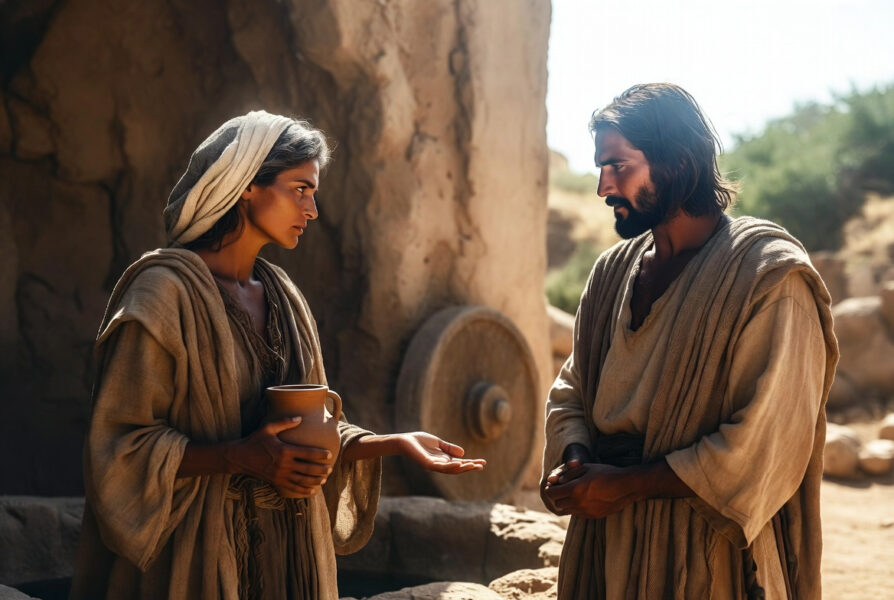
Fr. José Juan Sánchez Jácome / ACN.- It is impressive to see a tired Christ at midday, a thirsty and needy God. Jesus, who so many times sat down to teach divinely as a Master, to quench with his words the thirst for God in people, now also sits like a beggar who places himself in our hands, who appeals to charity in the face of his need.
The Gospels confirm the ardent desire that Jesus has for people’s faith. The gesture described in the Gospel, when Jesus sits down, can be understood in two ways. First, every time Jesus speaks as a teacher, he sits down. This is highlighted in several parts of the Gospel, as in the Sermon on the Mount (Mt 5:1). Like the great teachers, he sits before the people to teach.
But Jesus also sits like the poor, like the blind who cry out their need and have no other way to draw attention than by appealing to the charity of those passing by. He sits like a beggar and vividly expresses his need: “Give me a drink.” These are not rude orders from a man to the Samaritan woman, but his pressing need that demands the woman’s understanding and charity. By sitting by the well of Sychar, he manifests his need and his desire to be helped by man.
The Lord sits to make his need for us more expressive, with his gesture and his words, to move us with the ardent desire he has for our faith. That is why that thirsty Christ disconcerts us, who, like the Samaritan woman, also asks us by the well of Sychar: “Give me a drink.”
The Lord who had quenched the thirst for the infinite in so many people now acknowledges his need for us, for something that we all have and that sin never takes away from us. He needs our faith, our love, our trusting response to the offering of his love.
Seated, tired and assuming the posture of the poor who cries out his need, who begs for water, he resembles those blind people who sit by the roadside asking for help, crying out their need, when they feel life approaching, when they perceive the nearness of the Lord.
The Lord who is always redeeming takes advantage of his defenselessness, his thirst, his suffering, to make more evident and expressive the need he has for us, the longing he has for us to enter into communion with Him so that we may receive from that water which quenches our deepest thirst.
The Lord does not approach our life in a dazzling way nor with all the display of his power, as we so often wish. Rather, he approaches humbly to reveal to us his weakness of love, to convince us of what we ourselves can do for a God who cries out to our heart.
It is surprising that the Lord asks me for a drink when I realize the aridity of my spiritual well, when I feel empty inside, when I cannot sustain myself. But God wants to fill it with his presence and irrigate it with that living water capable of giving eternal life.
It does not matter that we have murmured, that we have strayed, that we have been enemies of God, that we have protested against God. The Lord will always seek us and redeem us not only from his power, but even from his weakness, from his need, begging us to open our interior, to open our well to this source of living water that is his most holy love.
The Samaritan woman, despite her sinful life and even her own complex history, which was revealed by the Lord, had a way to quench Christ’s thirst. In the end, she ran off and although she dropped the pitcher, Jesus had already quenched her thirst, she had already been filled with the faith of this woman.
For their part, the apostles had gone to the town to buy food. It was the only possible relationship that Jews and Samaritans could maintain, historically confronted. They could only sustain commercial relations. In contrast, Jesus breaks the prejudices and barriers that divided them to maintain a personal relationship with this woman and to lead her to faith.
It is also surprising the fascination that the Lord arouses in her to the point of leaving her pitcher behind because of the hurry she felt to go and announce how wonderfully Jesus had treated her. In the Samaritan woman is confirmed what Jesus provokes in people. The encounter with the Lord is so intense and moving that one feels the need to communicate it so that others may also know him and drink from this source of salvation.
At the well of Sychar converge the thirst of man and the thirst of God. After going to so many showy and sophisticated sources that exist in this world, we recognize that they leave us thirsty, tired and frustrated because they do not satisfy us as we would like.
This leads Benedict XVI to affirm that: “Man carries within himself a thirst for the infinite, a nostalgia for eternity, a search for beauty, a desire for love, a need for light and truth, which impel him toward the Absolute; man carries within himself the desire for God.”
God, for his part, shows his weakness for man, the need he has for us: he longs to drink from our inner well. Even if we were to ask with concern, how do you feed a God? How do you give a drink to a God?, we would come to recognize with surprise that, despite our indigence and fragility, God needs us.
On God’s thirst, Mother Teresa of Calcutta reflects: “Why does Jesus say: ‘I thirst’? What is the meaning of those words? It is very difficult to explain it. However, you must remember one thing and it is this: ‘I thirst.’ It is a much deeper word than if Jesus had simply said ‘I love you.’ Until you know, and in a very intimate way, that Jesus thirsts for you, it will be impossible for you to know what he wants to be for you; nor what he wants you to be for him.”
The Catechism of the Catholic Church also refers to this matter in number 2560: “Prayer is the meeting of God’s thirst and the thirst of man. God thirsts for man to thirst for him (St. Augustine, De diversis quaestionibus octoginta tribus 64, 4).”
Amado Nervo said that: “The soul is a vessel that is only filled with eternity.” This aspect is developed in a moving way by the Spanish philosopher Miguel de Unamuno in a letter to a friend who reproached him for his longing for eternity, as if it were a form of pride and presumption:
“I do not say that we deserve an afterlife, nor that logic shows it to us; I say that I need it, whether I deserve it or not, and nothing more. I say that what passes does not satisfy me, that I thirst for eternity, and that without it everything is the same to me. I need that, I NE-ED IT! And without it there is neither joy in living nor does the joy of living mean anything. It is very convenient to say: You have to live, you have to be content with life! And those of us who are not content with it?”
Recognizing with gratitude the thirst that God has for us, I feel moved and with the need to respond to his infinite love. That is why I express my gratitude and my commitment through this prayer:
“Lord Jesus, I do not complain about my life or the things that happen to me, but nothing fully satisfies me, nothing fills me. It is not that I need more and more things, it is that I need you. Only you can fill the thirst for the infinite that is in my heart. That is why I beg you to come into my life and unite me more intimately to you each day, so that I may help you in building a more just and fraternal world. Amen” (Fr. Eduardo Sanz de Miguel, OCD).