


In the midst of scandals that have disrupted public life, narco corruption reaches even the institutions that seemed unassailable due to their loyalty. The armed navy, for example, is in the eye of the hurricane due to fiscal huachicol corruption that benefited high-ranking officials by reporting profits in a fraud accumulated up to 600 billion pesos, making the “Master Scam” look like child’s play.
This escalation leaves no one unscathed. That corruption peeks into religious associations; some are powerful in spiritual influence and in generating millionaire resources. In fact, sects have been used as money laundries, of great influence particularly among those with decision-making capacities.
In the same Catholic Church, a founder, God’s Wolf, used his legion to create “offshore” businesses in a corporate architecture that had the clerical collar as a facade. Imagining every possibility and how far the narco can penetrate can lead to the most implausible speculations… but they could be real: The narco in the Basilica of Guadalupe?
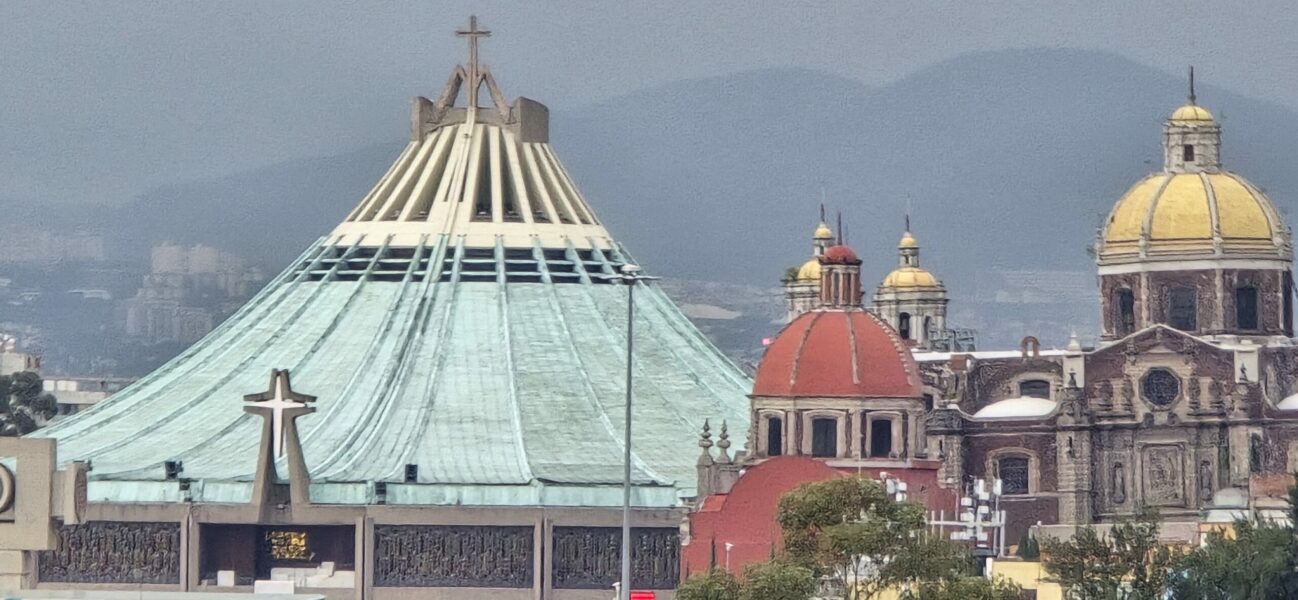
The most important Marian shrine in Latin America rises as a beacon for millions of pilgrims. Every December 12, the Virgin’s mantle covers the devotees with hope, symbolizing unity and faith. A movie poses a possibility that seems impossible: What would happen if the ayate of Saint Juan Diego, guarded for centuries, fell into the hands of crime?
The movie “Morenita, el escándalo” (2008), directed by Alan Jonsson Gavica, also known by the title “El lado oscuro de la devoción”, is a production of Esfera Films-ArteMecánica, financed with tax incentives for Mexican cinema production, explores that hypothesis of narco trafficking penetration in the administration of the Basilica.
It portrays the inconceivable theft of the Guadalupan tilma by a narco operator desperate due to debts he owes his boss and serves as a lens to imagine the devastating consequences and outline a prospective of how organized crime could infiltrate the highest shrine of faith using the mysterious image as a shield and weapon.
With a good-level cast, Mateo (Horacio García Rojas) and his grandfather Santiago (Ignacio López Tarso) take advantage of the position the latter has in the Basilica, that of being the maintenance chief. Mateo has learned the trade from his grandfather, he is a messenger pigeon trainer, but soon he will have no choice but to fall into the nets of «El Pinto», the main boss of the Tijuana plaza.
Santiago falls ill and needs delicate heart surgery; however, the possibilities are useless. Not even one of the canons of Guadalupe, whose face incidentally resembles one of the emeritus of that chapter, is capable of lending the sum for the recovery of the faithful Basilica employee, but there is one last resource…

Mateo’s past pushes him to resort to someone in exchange for top-level treatment. “El Pinto” (Everardo Arzate) is the solution so that the dear grandfather can be treated at an ABC hospital; as currency of exchange, he proposes to Mateo the trafficking of drugs using messenger pigeons to San Diego; although the first flights go off without a hitch, the disoriented birds return to their cages somewhere in Mexico City, which provokes the fury of “Pinto” due to the losses of merchandise.
Threatened with death and with few days to return an exorbitant amount in dollars, without his wife Magdalena (Maya Zapata) knowing, who is expecting a baby, Mateo accepts a scandalous possibility from his own grandfather: Steal the tilma of Guadalupe. Enjoying the trust of the archbishop cardinal of Mexico (Max Kerlow), Santiago makes use of his past. He was a “Commander” in the times of the dirty war and those skills are sufficient for him to steal the venerated image. Executing the theft, they reach the very sacristy to take out, in the darkness of the night, the ayate for which they will ask for 230 thousand dollars as ransom.

Of course, the scandal among the faithful, politicians, and the Church is enormous. A particular chapter meeting, headed by the archbishop, takes place surrounded by politicians: “You have abundant economic resources and we have social stability” says one of them (Miguel Coutorier) to the archbishop posing solutions and investigations because the theft “is work from inside”.
The investigations begin headed by the federal police agent, Vicente, (Dagoberto Gama) who orders the polygraph for all Basilica workers, canons included; of course, suspicions go toward the maintenance chief, Santiago, but his training as Commander distracts the bloodhound who soon loses the trail, although a weak hope remains due to the sporadic connection the detective has with the possessors of the image. A moment shows how Vicente is tempted by corruption, simulating a communication failure, proposes to Mateo entering the business demanding more than 4 million dollars and splitting the reward in half.
The 2008 movie generated scandal for its premise: a narco thriller that unravels how human ambition and desperation can profane the sacred. At the time, it caused reprobation from certain sectors with criticisms that labeled it «irreverent», but also praise for visibilizing the omnipresence of the narco in Mexican society.

Although “narco fiction”, the hypotheses keep emerging. Could the narco penetrate the Basilica of Guadalupe? What would its consequences be?
The tilma of 1531 is not just a canvas: it is the core of Mexican Catholic identity. Although the theft in the movie happens with too much simplicity, if the narco instrumentalized the image—through “blessed” alms or corruptible clerics—, the scandal would shake the very foundations of the faith. To be sure, the finances of Guadalupe are a well of opacity; everyone speculates, but no one, from outside, really knows how much enters the Basilica of Guadalupe, not even active canons have certainty of those finances. That is a privilege of few, a circle too shielded that can operate without much accountability.
Imagining the narco in the Basilica would detonate trust in the Church. Surveys already show that nearly 60% of Mexicans have lost respect for religious institutions (according to INEGI data from 2023). Economically, the Basilica generates considerable sums thanks to the 20 million annual visitors, its income from donations and souvenirs amounts to millions of pesos, particularly from the souvenir shops which are among the main sources of wealth. Could an infiltrated narco launder through «pious works»? with sponsorship of devotional objects and replicas of the tilma as «protective talismans» for crime routes.

The social effects would be worse: endemic violence. In the movie, the theft triggers a hunt; in the hypothetical reality, disputes between cartels for control of the sanctuary could turn Tepeyac into a narco control zone that, in exaggeration, would endanger the security of pilgrims as hostages. Among clerics, the canons, especially the rector, would be forced to use private guards ¿financed by the narco that favors him? to protect him from rivals, even attacks against the building, which would not be new, just remember the 1921 bombing. Polarization would sharpen, devotees against skeptics, Church against the State with the narco behind as puppeteer.
In this mood of speculation, a chilling prospective is outlined: How would the narco reach the administrative dealings of the Basilica to use the sacred image as a battering ram? Stage one: peripheral infiltration. Narcos disguised, collaborators of a heavyweight and influential canon, but very rector, perhaps of the rector or the vice-rector. In reality, this already happens. Cartels invest in rural chapels to legitimize themselves, a boss donates millions for «restorations», gaining favors from laity or corrupted clerics. In the movie, “El Pinto” intends to control Mateo’s debts to appropriate the image… “It’s worth more than 230 thousand”, says the boss to his victim”
Stage two: internal co-optation. The narco recruits insiders. An ambitious, corrupt, rotten priest… surrounded by exclusive collaborators. Tempted by the power to control the largest Catholic temple in Latin America, he uses and promotes «private pilgrimages» where bosses and VIPs`s pray before the tilma… He is the protector and savior of the Basilica and thus the “yellow envelopes” circulate in thanks. The image is sacralized as «protector», narcos venerate it in the very sacristy attributing «miracles» to it and demand blessed replicas for their businesses. And in the prospective, close to the 2031 Quincentennial, a «devout Chapter», narco-financed, vetoing investigations and any apostolic intervention from Rome or the bishops of Mexico…

Stage three: total control. And that has happened with the narco narrative that builds divinities. The tilma becomes a symbol of narcoguadalupan devotion. False prophecies —spread on networks— proclaim that the Virgin «blesses» the «defenders of the homeland» against rivals. The administration passes into the hands of frontmen with the rector as a puppet.
Final consequence: the Basilica, from universal sanctuary, mutates into a criminal enclave exporting not only faith, it is the largest money laundry in Mexico. It would not be strange, just look at the sects that now have accusations of money laundering and organized crime.
Of course, these are pure hypotheses provoked by a 2008 movie. But the Church is not untouchable. That is why transparency is urgent, independent audits, apostolic intervention, and collaboration with intelligence authorities, in addition to the closeness and procurement of the Mexican Episcopate.
Perhaps, the Basilica of Guadalupe is one of the last places of decency, morals, and virtues thanks to the maximum emblem of peace and love. Perhaps its chapter is up to the task to be able to avoid everything that could detonate corruption; they have done it before, in the past, the atrium of the Basilica was a place of shady businesses and frauds.. All that seems to have ended.
The Church of Mexico begins the path toward October 12, celebrating the 49 years of the translation of the Virgin to her new Sanctuary. This reflection is an exercise in the face of the excessive corruption that overwhelms us. Undoubtedly, the stings are capable of poisoning many souls with sin. As the politician in the movie said well: “You are given abundant economic resources”, a lapidary phrase that encloses a great temptation for someone to open the doors of hell to those who are making Mexico a hell. But this is… pure speculation.
Saint Mary of Guadalupe, save our homeland and preserve our faith!
The full movie can be seen here:
https://www.youtube.com/watch?v=2b94-l5OyVw&t=4989s