


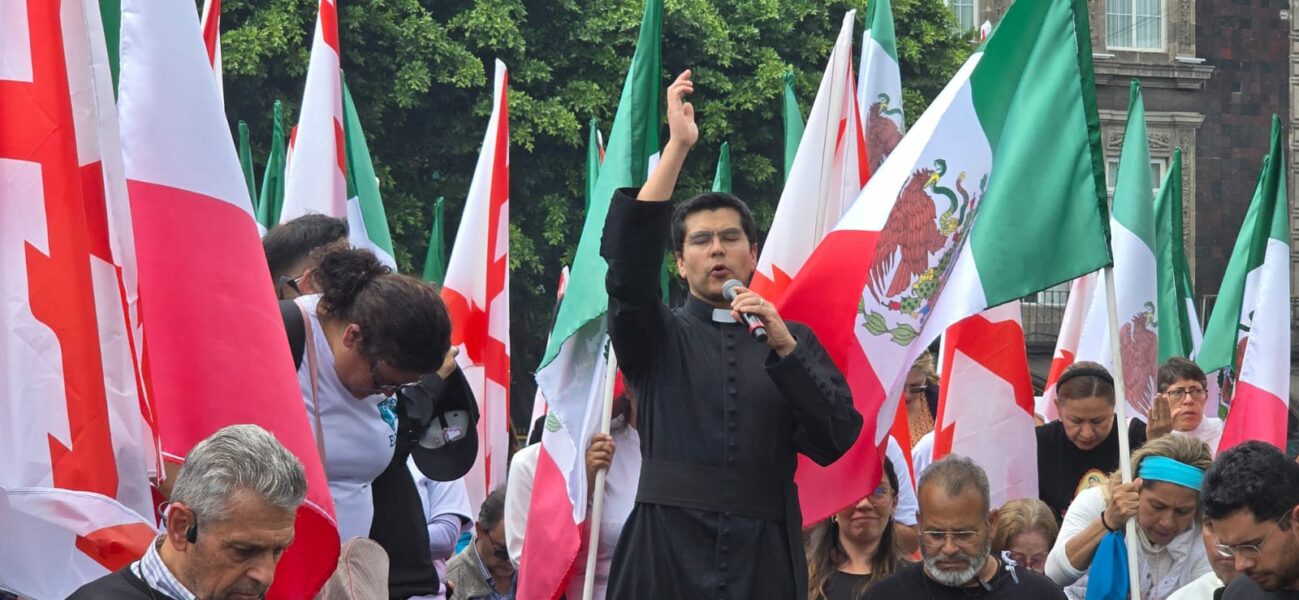
ACN / Under a cloudy autumn sky, hundreds of the faithful gathered this noon on Francisco I. Madero street, in front of the National Expiatory Temple of San Felipe de Jesús. The third assembly of the Knights of the Rosary, promotes the public recitation of the Holy Rosary as a spiritual weapon against the impieties and challenges of the modern world. What began as a discreet call turned into a great living testimony of collective faith, a procession of devotion that advanced proudly through the streets of the country’s capital, waving the highest emblems of the undeniable Catholic culture that has shaped Mexico’s mestizaje.

After noon, men of all ages, entire families who joined the call, and women with rosaries in their fingers, accompanied this march-procession that broke through the bustle of Madero street, the pedestrian artery of commerce and tourism, yielding the way to a praying murmur. Tourists with cell phones stopped to photograph the formation waving flags and banners, while others asked each other: “Who are those?” “I think it’s a sect…” stopping intrigued; street vendors paused their sales and offers, to stand up and give honor and respect to the prayer on the World Day of the Rosary as a public act of spiritual freedom.

At the front of the procession, two sacred images led the cortege, a venerable statue of Saint Joseph, the silent custodian of the Holy Family. His figure radiated a protective paternity that resonated in the hearts of those present, patron of workers and of the universal Church that seemed to guard the monumental image of the Virgin of Guadalupe, the Empress of the Americas. Dressed in her starry mantle, embroidered with gold and pearls, and with the brown face that Juan Diego saw on the hill of Tepeyac in 1531, the Guadalupana was the beacon of the procession, bridging heaven, earth, and secular society that recognized in Her Mexico’s patroness.

Flanking the images, the banners of the Knights of the Rosary waved, pendants held by the group’s leaders, symbolizing the spiritual militia of the knights, men committed to the defense of the faith in the public sphere, inspired by the words of Fatima, where the Virgin asked for rosaries for the conversion of sinners and world peace.

The flags of Mexico, tricolor and vibrant, contrasted with the cloudy sky that reminded that this devotion is not alien to the homeland, but its deepest root. The Virgin of Guadalupe, proclaimed patroness of the nation since 1910, is the national shield and her image evokes independence and unity. But the banner that moved the most was the flag with the Cross of Burgundy, that red saltire cross on a white background, emblem of the Spanish Empire and the Catholic heritage of Hispanoamerica. Brought from the depths of tradition, this flag was not an anachronism, but a living reminder of the evangelization that brought faith to these lands. The Cross of Burgundy, adopted by Charles V in the 16th century, represents universal Catholicism, the cross that was planted in Tenochtitlan and that, despite the storms of secularization, remains upright as a pillar of Hispanic identity. The knights carried it with pride, not as a colonial relic, but as an inheritance of holiness, of missionaries who with it built cathedrals and hospitals, fusing the eagle devouring the serpent with the paschal mystery.

On the street, a few steps from the Metropolitan Cathedral, the Rosary would be prayed on their knees. But the path was more a journey of discipline, order, and hope. The bagpipe tunes gave serenity and martiality, intoning the Guadalupan hymns with the musical instrument of another culture in a rhythmic pulse that quickened hearts.


The shouts arose reaffirming identity and belonging: “Long live Christ the King! Long live the Virgin of Guadalupe! Who are we? Knights of the Rosary!”. These cries, inherited from the Cristero War of 1926, when thousands died for religious freedom, filled the space with contagious energy. All united in a chorus that echoed in the Constitution Square. It was not a boisterous parade; it was a testimony. In a city where state laicism sometimes stifles processions, this was an act of presence, of reclaiming public space for prayer.

What was admirable was the respect. In a polarized Mexico by debates on secularism and rights, this spontaneous respect was a sign of the latent spiritual thirst. “The Virgin walks with us,” murmured a young woman, with tears in her eyes. The procession advanced without incidents, guarded by some elements of the auxiliary police who, more than watching, seemed discreet escorts of the faith.
Upon turning the corner toward the Metropolitan Cathedral, the Knights stopped. Organized, they had a welcome that was spontaneous. Upon entering the plaza, an unexpected gesture sealed the miracle of the day. In the Zócalo, Aztec dancers were performing their rituals as a tourist attraction in honor of the ancient gods. Dressed in multicolored tilmas and feathered headdresses, one of them, upon seeing the procession approaching, with Saint Joseph at the front, stopped his dance to bring the smoking censer of copal, the sacred resin that the Mexica used to invoke the teotl. Spontaneously, without words, he offered the aromatic smoke to the image of the Holy Patriarch; Saint Joseph receiving the indigenous tribute, recalling how evangelization did not destroy, but elevated the native roots.


The procession settled in the Zócalo, in front of the Cathedral. Nearly six hundred people occupied one of the corners at the foot of the Cathedral: families with babies in their arms, young people with tattooed crucifixes, children imitating the prayer with intertwined little fingers, elderly people seated in folding chairs they had brought from home. The recitation of the Rosary was organized with devotion, an amplified announcer guiding the mysteries while volunteers distributed pamphlets with the meditations.


The climax came with the simple blessing imparted by a young priest who, discreetly, soon left the gathering. Dressed in a cassock, he raised his right hand and traced the sign of the cross over the kneeling crowd. There were no speeches, proclamations, or belligerence, only the pure grace of a priestly gesture amid the people. Upon standing, the Knights posed for the group photo: orderly rows in front of the Cathedral, with Saint Joseph and the Guadalupana in the center, banners in the wind. Tired but radiant smiles, hands joined in shared rosaries . It was the seal of a day that, in its humility, shouted spiritual victory.

In a Mexico of contrasts, where faith is sometimes confined to temples, this October 11 reminded that the Rosary is a weapon and shield, crown and hope. Nearly six hundred people took it up, but its echo was of thousands: Long live Christ the King. Long live the Virgin of Guadalupe, children of a Mother who never abandons and her Rosary that took the heart of Mexico City.
