


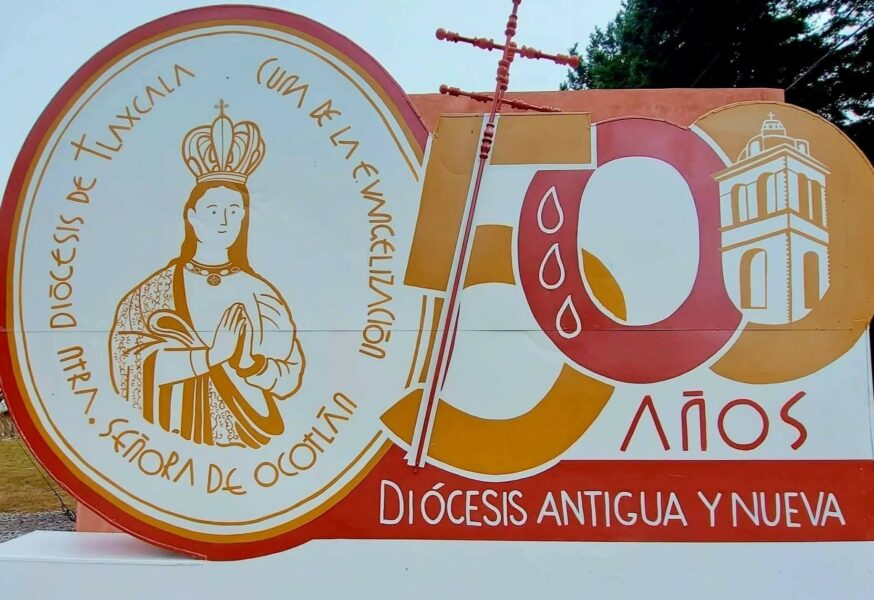
A celebration laden with symbolism and devotion that gathered thousands of faithful on October 12 at the Seminario Conciliar de Nuestra Señora de Ocotlán to commemorate an event that marked the beginning of the ecclesiastical organization of the primordial Church of Mexico: the 500 years of the foundation of the Diocese of Tlaxcala, the first in Mexican territory and cradle of evangelization in the country. A religious milestone and reflection on the cultural roots and missionary zeal that have defined this region for five centuries.
The day began early with the solemn procession that traversed a path adorned with traditional carpets, a nod to the local customs that fuse Catholic faith with Tlaxcaltecan indigenous traditions. The Apostolic Nuncio in Mexico, Joseph Spiteri, presided over the ceremony on behalf of Pope Leo XIV, blessing a commemorative sign that symbolizes the perpetuity of faith in these lands. Approximately 15 thousand attendees, from 90 parishes of the diocese, filled the venue, including the presbytery, ministers, catechists, religious sisters, and committed laity. That day, masses in the local parishes were suspended to centralize the celebration, emphasizing diocesan unity.
In his address, Julio César Salcedo Aquino, Bishop of Tlaxcala, was one of the concelebrants in the Eucharist alongside the Nuncio and who highlighted: «we are an ancient and new diocese. Ancient because it was created in 1525 and new because, in 1959, St. John XXIII restored it. This anniversary urges us to keep alive the tree of faith linked to our cultural roots», recalling how Tlaxcala has been a pillar in the history of the Mexican Church, from the first baptisms of indigenous chieftains in 1520 to the formal erection of the diocese in 1525 by Clement VII.
Originally erected as the «Carolense» bishopric in 1519 by Leo X on the Island of Yucatán, it never materialized due to the sparse population. In 1524, Emperor Charles V requested its transfer, and on October 13, 1525, Clement VII relocated it to Tenochtitlan, although the first bishop, Fr. Julián Garcés OP., chose to establish it in Tlaxcala in 1527, elevating the Church of the Assumption to cathedral. This decision was due to the alliance between the Tlaxcaltecas and the Spaniards, as well as the rapid acceptance of the Catholic faith in the region, marked by events such as the apparitions of St. Michael the Archangel, which the Nuncio Spiteri described as «pillars of faith for the Tlaxcaltecan people» and «living forces that animate our hope today».
During the homily, Archbishop Spiteri exhorted the faithful to «live the faith more intensely today, here in our society and in the midst of the world in which we live, full of divisions«. A culminating moment was the procession with the tilma of the Virgin of Guadalupe, granted by the Mexican Episcopal Conference (CEM), which was solemnly placed before the Mass began. After the homily, the symbolic sending of catechists as missionaries took place, inspired by the Holy Child Martyrs of Tlaxcala –Christopher, Anthony, and John–, who in the 16th century represented the first martyrial fruit of evangelization in America. This act underscored the missionary commitment of the diocese, which has produced vocations, martyrs, and an enduring witness for the Universal Church.
The apostolic blessing of Pope Leo XIV, read during the ceremony, united the participants in a «thanksgiving for the abundant fruits of Christian life achieved during these years of fruitful evangelizing labor». The Holy Father exhorted to «intensify efforts so that, walking united in Christ, the light of the Word of God reaches everyone and fraternal and charitable help never lacks for the most needy». Almost at the end of the Eucharist, the tilma was delivered, along with three palms and a symbolic heart, to the Parish of San Isidro Labrador Buensuceso, marking the beginning of its journey through the entire diocese. This itinerant gesture seeks to bring the jubilee message to every corner of Tlaxcala, fostering spiritual renewal.
The celebration not only honored the past but projected a future of hope. In the words of Bishop Salcedo, this anniversary impels the diocese to revalue its role in contemporary evangelization, integrating Tlaxcaltecan cultural roots –such as indigenous and Franciscan traditions– with the current challenges of a divided society. Complementary events, such as the dedication of the Cathedral of Our Lady of the Assumption the following day, expanded the commemorations, attracting civil and ecclesiastical authorities.
In a Mexico where the Catholic faith faces new challenges, this Eucharist served as a reminder that Tlaxcala, with its legacy of missionary zeal, remains a beacon of hope. The 500 years of the diocese are not just an anniversary, but an invitation to revitalize the evangelizing mission on the continent. As the Nuncio affirmed, these historical events «are not distant memories, but living forces». The Tlaxcaltecan community, united in prayer, demonstrated that its spiritual heritage endures, ready to face the coming centuries with renewed vigor.