


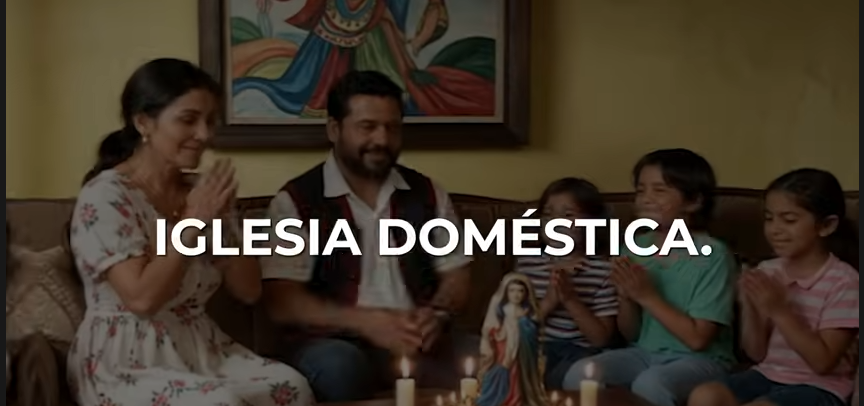
In chapter 28 of the catechesis series “Venga a nosotros tu reino”, the president of the Mexican Episcopal Conference (CEM) and bishop of Cuernavaca, Ramón Castro Castro, has delivered a profound reflection on the family as the “Domestic Church”. This message, disseminated through the CEM’s social networks and digital platforms, invites Mexican faithful to discover in the home the true seed of the Kingdom of God.
The series “Venga a nosotros tu reino” was launched on the occasion of the centenary of the encyclical *Quas Primas* (1925) by Pius XI, which instituted the solemnity of Christ the King of the Universe. Throughout its chapters, Mexican bishops have explored how Christ’s sovereignty must permeate all areas of personal, social, and ecclesial life in a country marked by violence, migration, and family disintegration.
In this installment, Castro Castro focuses on the core of Christian existence: the family. “Today we turn our gaze to the heart of our Christian life. What is it? The family. It is there, amid joys and challenges, where the kingdom of Christ is called to flourish first,” affirms the prelate with pastoral clarity.
It is not a reign of imposition or rigid norms, but rather “a reign of love that transforms”. The Church, he recalls, has traditionally called the family the “Domestic Church”, an expression that refers to the Second Vatican Council and, especially, to the apostolic exhortation Familiaris Consortio by St. John Paul II. Faith is not exhausted in the temple on Sundays; it is lived and transmitted at the table, in daily conversations, in moments of tiredness and joy.
“Fathers, mothers, grandparents, and children, we are protagonists of the proclamation of the Gospel with simple gestures, even amid our imperfections”, the bishop emphasizes. This affirmation resonates strongly in a Mexico where, according to data from various institutions, thousands of families face deep crises: separation due to migration, domestic and criminal violence, addictions, poverty, and the painful absence of opportunities for young people.
Castro Castro does not evade reality. “Let us be realistic, family life is not easy. In Mexico many families face deep wounds, forced migration, violence, addictions, absence of opportunities. There are homes marked by silence, tiredness, separation,” he acknowledges. And precisely there, in the midst of the wound, the evangelical call to ongoing conversion resounds.
“Jesus always calls for conversion. Being Christian is not a point of arrival, but a continuous journey that begins in the family, at home. We must not be ashamed of our falls; the shame that paralyzes does not come from God. His grace lifts, heals, and rebuilds, especially in wounded homes and families,” he assures with a hopeful tone.
When Christ truly reigns in the home, his love does not remain enclosed within four walls. It spills over into the parish community and into society as a whole. The bishop cites St. Monica as an example, the mother who never stopped praying for her son Augustine, the future Doctor of the Church. “Today there are also many Monicas in Mexico, mothers who pray for sons trapped in violence, fathers who do not lose hope. Their everyday love builds the kingdom”.
Family holiness, he insists, does not require great heroics. It is lived in the concrete: asking for forgiveness after an argument, sharing the burdens of work and home, praying together even if only for a few minutes, serving the most needy in the neighborhood. “We don’t need to go far to be missionaries. Our home, our neighborhood, our community are mission territory”.
Ramón Castro Castro addresses a particularly realistic message to families who feel “wounded and tired”. Far from idealizing domestic life, he presents it as the privileged place where God’s grace acts with the greatest force. “May our families, even wounded and tired, be light and hope. May they live the Gospel with authenticity and joy,” he exhorts.
This vision recovers the oldest Christian tradition. Already the Fathers of the Church spoke of the family as ecclesia domestica. In the current Mexican context, where family disintegration is one of the factors that most fuels violence and insecurity, the episcopal call acquires a prophetic dimension. Rebuilding the social fabric begins with healing and evangelizing the home.
The catechesis concludes with the same invocation that gives the series its name: “Venga a nosotros tu reino”. It is not an empty pious phrase, but a prayer that becomes flesh when families decide to let Christ reign in their everyday relationships. When a father asks forgiveness from his son, when a mother reads the Bible with her children, when grandparents transmit the faith with their stories, the Kingdom of God is already arriving.