


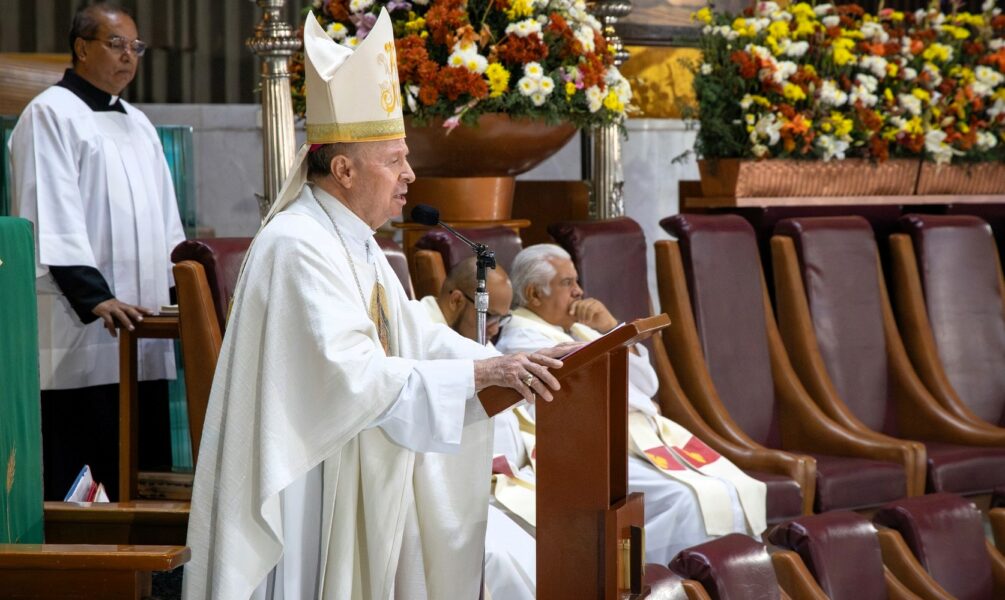
On a morning filled with faith and a longing for justice, hundreds of faithful from the diocese of Apatzingán, in the turbulent state of Michoacán, carried out their annual pilgrimage to the Basilica of Our Lady of Guadalupe. The event, held on Wednesday, November 5, at 7:00 a.m., became a powerful cry for peace in a region battered by criminal violence, extortion, and insecurity. Presided over by Bishop Cristóbal Ascencio García, the mass not only represented an act of devotion but also an urgent call to authorities and society to combat the scourge that has devastated entire communities. Despite a personal accident that the prelate suffered moments before, his homily resonated strongly, inspiring pilgrims and online viewers to join in prayer.
The diocese of Apatzingán, known for its rich agricultural production of lemons, mangos, and avocados, has been for years the epicenter of conflicts between drug cartels. According to recent reports, farmers face systematic extortions, known as «cobro de piso,» which have led many to abandon their lands.
In 2025, the situation has not improved: lemon producers in the region have denounced threats and economic demands from criminal groups, which include payments for protection and control over prices and distribution. This grim reality was the backdrop of the pilgrimage, which had as its main moment the homily of the bishop who commented on the accident he suffered outside the Basilica when he tripped on a curb on the sidewalk while crossing the street toward the back entrance of the atrium—he described how he fell to his knees, suffering blows to both, with greater swelling in the left one, which made it difficult for him to walk. «Immediately when I fell, I said, Lady, Mother, I am very close to you, I am almost there, and this is for the good, because everything that happens to us is for the good,» he shared, interpreting the incident as a spiritual offering that brought him closer to the Virgin of Guadalupe. On repeated occasions, while remaining at the headquarters, the bishop brought his hand to the affected area to mitigate the pain.
Thanking God and the Virgin for allowing the bishop’s arrival, he extended his gratitude to the priests, nuns, and laity of Apatzingán who represented the entire diocese. Invoking the Virgin’s apparition to San Juan Diego, he emphasized the fraternity between Spaniards and indigenous people as a model for the present: «Am I not here, I who am your Mother?» This historical reference served as a bridge to address the everyday concerns of families and communities, inviting everyone, including those following the broadcast online, to unite their voices in a collective prayer: «Lord, grant us the peace we so desperately need!»
The heart of the homily was a raw diagnosis of the violence plaguing Mexico, particularly Michoacán. «We continue in the midst of insecurity and violence. We ask the Virgin Mary to intercede for our diocese so battered for years and more recently by violence, for our country where violence spreads like plagues,» denounced Ascencio. He did not limit himself to a passive peace; he insisted on an active commitment from all, criticizing the lack of action by authorities who promised the common good. «The most urgent good is peace, security,» he affirmed, quoting the words of peasants: «Bishop, we don’t need so many welfare food baskets so much; our land and our sweat give us what we need and more; what we want is peace to be able to sow, cultivate our products, and take them to market.»
Ascencio dedicated a special segment to justice for the farmers, pillars of the local economy. In a region where «cobro de piso» has become a «second tax,» many have abandoned lemon and mango orchards, leaving families without sustenance. «We ask for justice for the sweat of their brow… May the products of the field have the monetary value they deserve,» he implored, highlighting how injustice and extortion generate discouragement and migration. Reports indicate that in Michoacán, extortion of avocado producers and other crops has raised food prices and provoked death threats to those who report it.
Interpreting the Gospel of Luke on discipleship, the bishop called for an exclusive love for Jesus, with concrete renunciations: affective, intellectual, and material. He criticized politicians for denying reality –»we keep hearing that nothing is happening»– and for the arrogance of power, urging them to see service as an opportunity. «We are witnesses to what is happening to us,» he emphasized, warning against the fear that paralyzes: «When Christians distance ourselves from Jesus, we will be enveloped not only by fear, panic, and terror.»
Promoting fraternity, he compared the victimizers to Cain and asked for prayer for their conversion, including those who sin by omission. «Holy Virgin, intercede so that God grants us peace… and bless our peasants that they receive justice. They do not ask for crumbs, alms; they ask for justice,» he pleaded. He closed with his episcopal motto: «Meam pacem do vobis» (My peace I give you), inviting to welcome Christ’s peace without weapons, but as brothers.
This pilgrimage, announced on diocesan social networks as a «path of hope for peace,» continued the next day with a mass at the Sanctuary of Christ the King in El Cubilete. In a Mexico where criminal violence diversifies its tactics—from extortion to territorial control—the message of Ascencio resonates as a beacon of resilience. Apatzingán is not just violence, he insisted: «I wish you could live there to see the quality of families, the love for God.» In times of terror, his homily reminds us that faith and collective action can rebuild hope.