


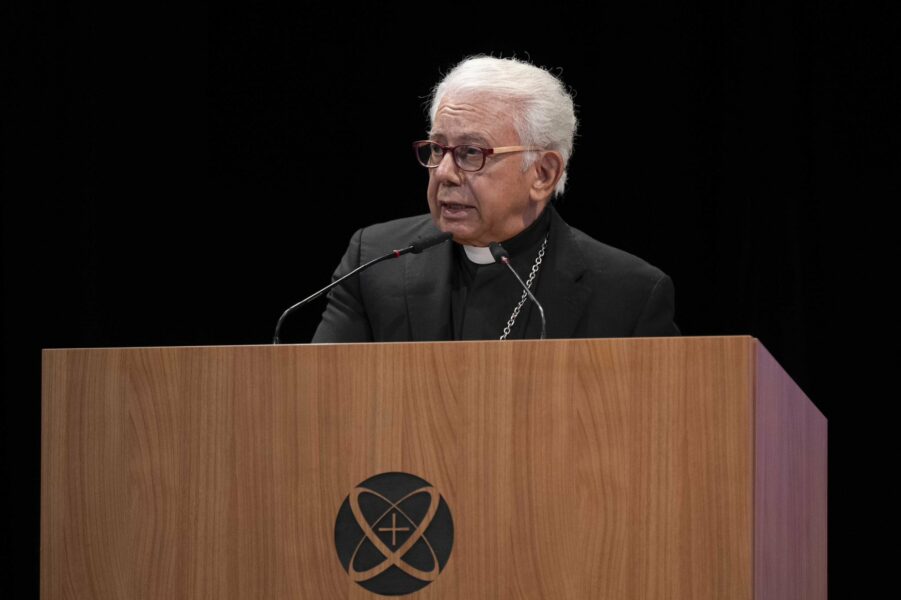
Bishop Ramón Castro exposes theological and ethical keys to building lasting peace in Mexico
Before an audience charged with expectation and accumulated pain, the bishop of Cuernavaca, Ramón Castro Castro, president of the Mexican Episcopal Conference (CEM), delivered a masterful conference that resonated like a cry of hope amid the storm. Before hundreds of participants at the II National Dialogue for Peace, held in Guadalajara, Jalisco, Castro not only reflected on the scourge of violence plaguing Mexico, but also outlined a concrete map for its overcoming. «Peace is not a utopia, but a creative and generative task», he quoted Pope Leo XIV, setting the tone for a speech that combined theology, anthropology, and practical action, urging a wounded country to move from listening to sustained commitment.
The event, organized as the closing of the second national meeting for peace, brought together victims, ecclesiastical leaders, civil society, academics, and representatives from various sectors. After days of intense debates on the structural causes of violence—from impunity to social fragmentation—, Bishop Castro took on the responsibility of synthesizing the path traveled. Speaking from «the awareness of belonging to a wounded but undefeated people», he emphasized that this dialogue does not arise from improvisations, but from a «deep wound» that crosses Mexico: thousands of interrupted lives, damaged dreams, and a social fabric torn by everyday violence.
In his intervention, Castro invoked the theological foundation of peace, anchored in the Bible and papal magisterium. He recalled that the biblical «Shalom» is not mere absence of conflict, but a fullness of life that unites justice, truth, and communion. Quoting Isaiah 32:17, he underlined: «The work of justice will be peace», warning that any peace without justice is fragile and ephemeral. In Jesus Christ, peace is incarnated, tearing down walls of enmity, as Saint Paul expresses it.
The bishop contrasted this «paschal peace» with that of the world, based on imposition or balance of forces and presented it as a gift that demands personal and social conversion. «Peace is a historical vocation entrusted to the People of God and to all humanity», he affirmed, quoting John XXIII and his emphasis on truth, justice, love, and freedom as unshakable pillars.
But Castro did not stop at the spiritual; he delved into an anthropological key, diagnosing violence as a «human wound» that fractures relationships and disfigures dignity. In a Mexico where fear, indifference, and the reduction of the other to a threat have been normalized, the bishop warned of an «anthropological fracture» that goes beyond statistics: it is a darkness of the heart that denies the neighbor. Quoting Pope Leo XIV in his message for the World Day of Peace in 2026, he described peace as a «small flame threatened by the storm», which must be guarded by remembering names and stories of testimonies.
This vision demands a cultural and spiritual transformation, overcoming logics of armed domination. «Peace requires healing the human wound«, he insisted, promoting a conversion that recovers empathy, memory, and justice, with victims as the irrenunciable ethical center.
The national dialogue, according to Castro, has been a «historical pedagogy» that educates the collective conscience. Its method—see, interpret, act—is not only organizational, but ethical: see without euphemisms the causes of violence; interpret with collective discernment; act with concrete commitments. This process has matured from mere listening to the demand for co-responsibility, dismantling the «logic of the spectator» and promoting active subjects. The bishop praised its territorial approach: peace is not abstract, but embodied in local communities, aligned with the Mexican Church’s Global Pastoral Project (PGP), which advocates for close and long-term actions.
Here lies the dynamic core of the speech: the concrete demands for building peace today. Castro enumerated five indispensable pillars, presenting them not as magic recipes, but as normative orientations for the next stage.
First, the real and permanent centrality of the victims. Not as rhetorical symbols, but as an ethical criterion that challenges and judges. «Where victims are made invisible or instrumentalized, peace is emptied of content», he warned, remembering that God hears the cry of the oppressed as a place of revelation.
Second, the ethical co-responsibility of all social actors. Peace is not an exclusive task of the State; it demands participation from churches, civil society, academia, businesses, youth, and indigenous communities. Abandon accusations and assume proper roles, under an «ethics of shared commitment» that resists individualism. «Peace is a common good that is built or destroyed collectively», he sentenced.
Third, the construction of territorial and long-term processes. Violence did not arise overnight, so it requires historical patience and perseverance. Strengthen local capacities and sustain commitments, protecting oneself from frustration in the face of non-immediate results.
Fourth, the courage of prophetic denunciation. Do not normalize injustice or remain silent before evil. Inspired by the biblical prophets, Castro urged the Church to be an «uncomfortable witness to the truth», denouncing without resentment, but out of love for conversion.
Fifth, an organized and persevering hope. Not naive or passive, but active, translating into structures and processes that resist discouragement. «Christian hope is a transformative force», he emphasized, capable of sustaining good in adverse contexts.
In his conclusions, Castro transformed the closing into a missionary sending. This dialogue does not close, but «moves toward the territories», with verifiable and sustained commitments. He urged state meetings to create bonds, identify resources, and strengthen actions. «Good will and declarations are not enough; continuity, evaluation, and co-responsibility are required», he repeated, emphasizing the Church’s role in offering memory, continuity, and organized hope.
Ehe bishop closed with an emotional call: return to the territories interpellated by concrete faces, not as spectators, but as faithful builders. Quoting Martin Luther King, Mother Teresa, and Jesus, he recalled that peace is embodied in small acts with great love, questioning us about what we did in the face of hunger, fear, and the brother’s wound. «Peace needs all of us», he concluded, applauded by an audience that dispersed with the flame of hope lit.