


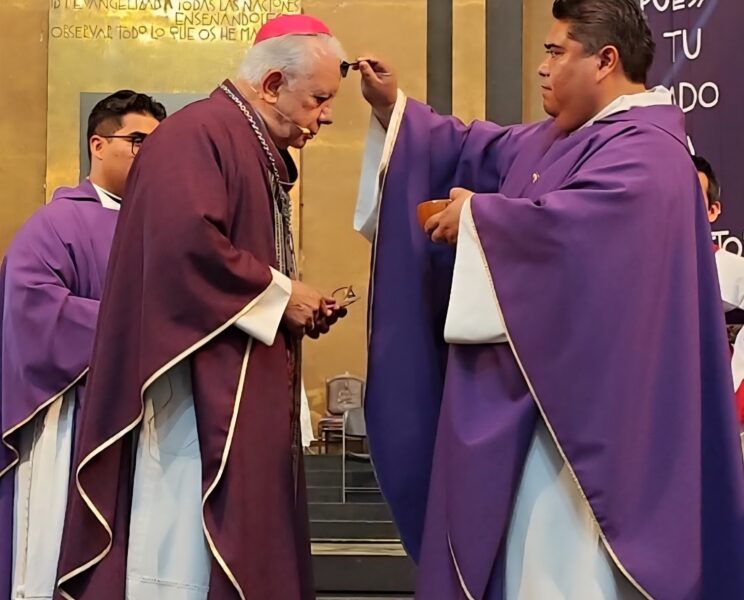
President of the Mexican bishops opens Lent emphasizing the need for conversion and to end the normalization of corruption and violence
In the Cathedral of Cuernavaca, Bishop Ramón Castro Castro presided over the Ash Wednesday Mass on February 18, 2026, marking the start of Lent with a homily that fused liturgical spirituality with an incisive diagnosis of the Mexican reality. Before the gathered faithful, the prelate emphasized that the imposition of ashes «admits no frivolities» nor is reduced to a «decorative symbol», but represents a «serious call to the conversion of the heart».
«We are dust indeed, but beloved dust, redeemed, called to conversion», proclaimed Castro, recalling human fragility while invoking the words of Saint Paul: «let us make the most of this favorable time». He insisted that Lent is not «just another time in the liturgical calendar» nor an «inherited custom», but a «opportunity of grace that we must not waste». This exhortation resonates in a national context of crisis, where the bishop described Mexico as a «wounded nation» by «accumulated griefs, fractured families, youth without horizons, communities marked by violence and inequality».
The bishop’s message focused on the need for integral conversion, inspired by Pope Francis’s Lenten message –which he mistakenly referred to as «Pope Leo XIV» in the transcription–, which advocates for a transformation «personally, communally, and ecologically». «There is no true penance if it does not touch the conscience, if it does not transform relationships, if it does not reorder our way of inhabiting the world», he affirmed. Quoting the prophet Joel, he urged to «rend your hearts, not your garments», rejecting «religious dramatizations» in favor of «interior truth». He warned against the «incoherence» of covering oneself with ashes while the heart remains «hardened», and criticized the tendency to reduce Lent to «external practices» or «fleeting emotions».
Focusing on the social and political reality, Castro lamented how Mexico has «dangerously learned to get used to» injustices: «We get used to numbers, we get used to headlines, we get used to social injustices, we get used to small or large corruptions that we justify in some way. We get used to indifference». This normalization of corruption, he argued, undermines institutions: «If the heart does not change, laws become empty. If the interior does not transform, society fractures again». According to the 2025 Corruption Perceptions Index by Transparency International, Mexico scored 27 out of 100 points, ranking 141 out of 182 countries, reflecting a persistent perception of corruption in the public sector despite a slight improvement.
Violence was another central axis, with the bishop highlighting how «the fracture that Mexico lives is not only political or economic. It is deeply relational». Trust has been «weakened», the word «eroded», and «permanent suspicion installed«. Preliminary data indicate that in 2025, Mexico recorded 23,374 homicides, with a rate of 17.5 per 100,000 inhabitants, the lowest since 2016, although high levels persist in regions like Morelos. Castro called to «rebuild from below»: from the family, the parish, and work, to achieve «national peace» through «everyday reconciliation». «We are ambassadors of Christ», he pleaded, recalling that reconciliation with God has «visible consequences» in conflict resolution and social participation.
The Gospel of Matthew inspired his exposition of Lenten practices: prayer, fasting, and almsgiving, performed «in secret» without ostentation. Prayer «returns us to the center» in a world of «noise», fostering discernment and remembering dependence on God. Fasting is «interior liberation», not just abstinence, but breaking «dependencies» and questioning lifestyles that harm oneself, others, and creation, integrating «ecological conversion». Almsgiving is «active solidarity», sharing resources and recognizing Christ in the poor, countercultural in a country marked by inequality.
Invoking the Virgin Mary, Castro asked for an «undivided heart» to cross the «desert of uncertainty» and resist «indifference». «Mary is the woman of the everyday yes», he said, interceding so that Lent does not «pass by» and leads to an Easter with a «new heart». He concluded by encouraging: «Courage! May God help us all».
This homily positions Castro, president of the Mexican Episcopal Conference, as a prophetic voice in a Mexico facing structural challenges. His call to break with the normalization of social ills invites a conversion that transcends the individual, fostering collective actions to heal divisions.