


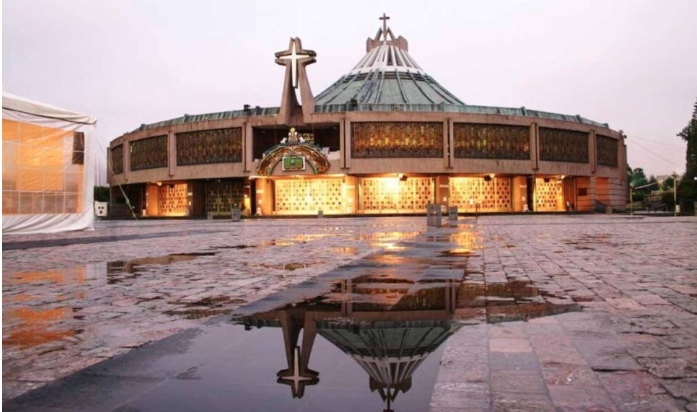
In a context of profound transformations for the Catholic Church in Mexico, the analyst and journalist Felipe Monroy, director of VCNoticias, has published an opinion column titled Good Hope | Basilica of Guadalupe, critical scenario of transition and decisions, which highlights the complexities facing the Guadalupan sanctuary on the threshold of 2026. Monroy, known for his analysis of religious and social issues, warns of a «critical scenario» marked by internal transitions, lack of transparency, and risks of political instrumentalization, all in the spiritual heart of the Mexican nation.
The article, published on the portal VCNoticias, contextualizes the plans of the Mexican bishops for the coming year. On one hand, the centenary of the religious persecution under the Calles Law, redefined as «Cristero Resistance» will be commemorated. Monroy emphasizes the need to avoid turning this memory into nostalgia or violent prophecy, citing Pope Leo XIV in his message for the World Day of Peace: «Believers must actively disprove, especially with their lives, those forms of blasphemy» that bless nationalism or justify armed struggle. This perspective, according to the journalist, obliges the Church to assume a dual responsibility, to reject armed violence and avoid confusions between Catholicity and political reactionism.
However, the main focus of Monroy falls on the second horizon: the preparations for 2031, the fifth centenary of the Guadalupan Event. The Basilica of Guadalupe emerges as a symbol that «entirely reconfigures the people and the homeland.» The journalist describes how, at the close of 2025, the sanctuary received a historic record of more than 13 million pilgrims between December 9 and 13, an achievement that dimensions not only spiritually, but in operational and functional terms. However, this demonstration of faith hides a «serious internal crisis» that has been silenced for months.
Monroy details the sudden absence of Canon Efraín Hernández Díaz, episcopal vicar and rector of the sanctuary, who did not participate in key institutional acts. This situation, still unexplained officially, led unofficially to operational changes and a torrent of gossip and speculation mainly on social networks and platforms. The journalist cites the sources, published through Infovaticana, as a letter from the Guadalupe Chapter to Archbishop Carlos Aguiar Retes on September 19, 2025, followed by a removal decree (protocolized as 817/2025) and a canonical investigation initiated on October 3 (key IP 17/2025). The lack of transparency, Monroy argues, not only affects the structure of the sanctuary, but generates distrust among the faithful and clergy.
This opacity worsens in the context of the archiepiscopal succession, as Aguiar Retes exceeds the canonical retirement age. The Apostolic Nunciature sends reports to the Holy See on potential candidates, and the Mexican Episcopate will have to evaluate the new custodian of the tilma and the venerated image.
In addition, the journalist highlights the popular illusion for a possible visit from Pope Leo XIV, the first American pontiff with a «Latin American heart,» who has expressed his desire to pilgrimage to Guadalupe. However, Monroy warns of risks in 2026, the politico-religious instrumentalization of the Cristero centenary, interests of the government of Claudia Sheinbaum in a pontifical visit, and internal problems «swept under the rug» to guarantee an event without mishaps. In an ironic touch, he mentions that next year will also bring «soccer in geopolitical code,» alluding to broader tensions.
The opinion can be read here: