


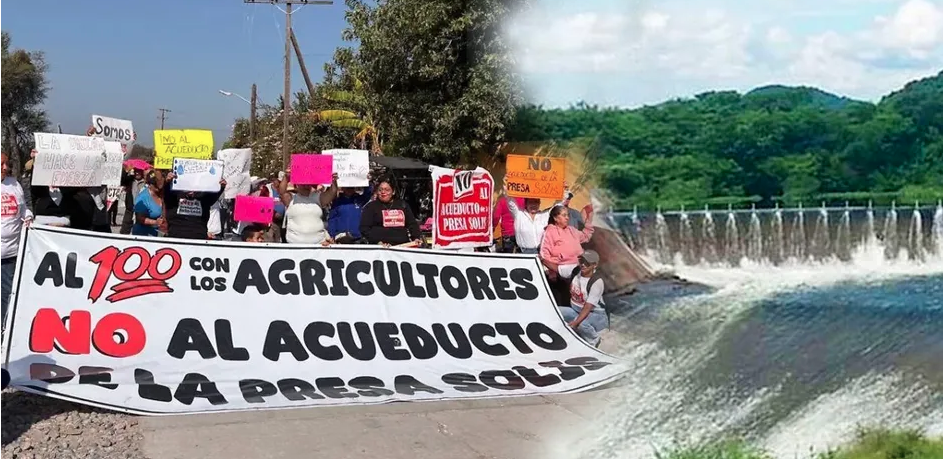
The emeritus bishop of Saltillo, fray Raúl Vera López, born in Acámbaro 80 years ago, issued on November 10 a statement that has shaken the discussion on the Solís-León Aqueduct: “I express my firm, absolute, and permanent opposition to the Solís-León Aqueduct project. I do so out of love for water, for the land, and for a dignified life”. With these words, he joined the thousands of peasant voices from southeastern Guanajuato who, for weeks now, have managed to physically halt the works of the controversial megaproject.
The aqueduct, promoted by the federal and state governments, seeks to transfer up to 120 million cubic meters of water per year from the Solís Dam to Celaya, Salamanca, Irapuato, Silao, and León, with an investment of 15 billion pesos. The official argument is that the water comes from the “savings” that will be generated by the modernization of Irrigation District 011, and that not a drop will be taken from the fields.
“The Solís Dam currently stores 325 million cubic meters according to Conagua itself, and everything is concessioned to 24,000 peasant families from 11 municipalities. Where are they going to get 120 million ‘saved’ if the modernization has barely begun and won’t be completed until 2029?”
Raúl Vera’s statement names what the peasants have been denouncing for months: “Once again, peasants are the last to find out and the first to be sacrificed. They are the thinnest thread of the political-business voracity that appropriates community resources, while decisions are made from the pinnacles of power”.
The emeritus bishop also warns of the risk to Lake Chapala: “It will put at risk the flow that feeds Lake Chapala and, with it, the very viability of the ecosystem that gives life to thousands of families.” The riparian communities of Jalisco, who experienced the dispossession attempt from the El Zapotillo Dam, have sent messages of solidarity to their Guanajuato neighbors: “Don’t let them do to you what they tried to do to us in Temacapulín, Acasico, and Palmarejo.”
In the last two weeks, blockades at the dam accesses and sections of federal highway 61D have been permanent. On November 18, peasant women from San Juan Jaripeo and La Moncada kept the road to the machinery closed for 14 hours straight.
The works on the Solís-León Aqueduct are practically paralyzed. The construction companies have withdrawn heavy machinery from several fronts in Acámbaro and Jerécuaro for safety reasons, according to sources from the workers themselves who prefer anonymity. The state government, through the Secretariat of Environment and Territorial Planning, has announced “dialogue tables” for the coming days, but peasant organizations respond that they will not accept any conversation unless the project is definitively suspended and a binding popular consultation is held.
“Policies that affect the rights of people and nature should never again be imposed without a popular consultation, citizen participation, and transparency,” wrote Vera, words that today are repeated as a slogan at every blockade.
While the government of Libia Dennise García Muñoz Ledo insists that “the water is for the people” and that the project is going ahead, the reality on the ground is different: the people of southern Guanajuato have said NO, and they have done so with their own bodies on the road.
Bishop Raúl Vera closed his statement with a phrase that today resonates in every ejido in the southeast: “When water is treated as a commodity and not as a right, an injustice is committed, an ecological crime, and a sin against life”.
The full text of the statement from the emeritus bishop of Saltillo can be read below:
ROUND OPPOSITION to the Solís-León Aqueduct
STATEMENT
To the Acámbaro Civil Society
To the communities of southeastern Guanajuato
To Mexican Civil Society
Sisters and brothers,
Having been born in Acámbaro, Guanajuato eight decades ago, I feel the responsibility to listen to those who, as friends, family, and organized civil society, have expressed their opposition to the works of the Solís-León Aqueduct. I express my absolute opposition to the construction of the Aqueduct, joining the legitimate demand of the people who raise their voice. I include the inhabitants of the Lake Chapala towns, who from their experience and love for the land warn of the consequences of this new attempt at dispossession.
With the Solís-León Aqueduct, they intend to supply the water that never arrived from the El Zapotillo Dam, a project that threatened the existence of three Jalisco communities: Temacapulín, Acasico, and Palmarejo. Those populations continue their restructuring process after the betrayal and fear sown by the authorities. Now, under a new promise, an aqueduct is projected that would run through Celaya, Salamanca, Irapuato, Silao, and León, ensuring –as they say– to leave water in the cities it passes through. Behind those words hides a grave danger: The diversion of 120 million cubic meters of water per year, which would put at risk the flow that feeds Lake Chapala and, with it, the very viability of the ecosystem that gives life to thousands of families.
Once again, peasants are the last to find out and the first to be sacrificed. They are the thinnest thread of the political-business voracity that appropriates community resources, while decisions are made from the pinnacles of power. According to the CONAGUA dam monitor, the Solís Dam currently stores 325 million cubic meters of water, concessioned to the Irrigation District that sustains 24,000 peasant families from 11 municipalities in southern Guanajuato. Despite this, the so-called “modernization” of irrigation has begun in Irapuato, the municipality farthest from the Dam, leaving for last the farmers of Acámbaro, who are the closest and most in need of this resource.
For decades, in this region, an alliance between political and economic power has been consolidated that has made nature an instrument of domination and profit. Under the extractivist logic of companies –many of them foreign, with terrible records of human rights violations– this project is being pushed. A local expression of the neoliberal model that subordinates life to private benefit and displays its contempt for the people. As has happened in other regions of Mexico, the water will not be for the people, but for industries and big capital. When water is treated as a commodity and not as a right, an injustice is committed, an ecological crime, and a sin against life.
I exhort the civil society of Acámbaro, my birthplace; southeastern Guanajuato; the involved communities; and the populations of the Jalisco Highlands who have already learned to resist, to remain united and organized, informed and vigilant, so as not to allow water –the blood of the land– to be negotiated as if it were a mere consumer good. It is time to defend the territory, the water, and life, before they fall into the hands of foreigners who do not know or love this land.
I respectfully call on the authorities to stop the works on the Solís-León Aqueduct and to set up working tables where the voice of organized groups is not only heard, but has real impact on decisions. Policies that affect the rights of people and nature should never again be imposed without a popular consultation, citizen participation, and transparency.
Progress cannot be spoken of when, under the pretext of quenching the thirst of the people, the greed of a few powerful is fed. Our opposition is not to the human right to water, but to the unjust and dishonest use of water, which dispossesses the poorest to benefit those who already concentrate wealth. True development can only exist with justice, respect, and truth. For all these reasons, I express my firm, absolute, and permanent opposition to the Solís-León Aqueduct project. I do so out of love for water, for the land, and for a dignified life.
Saltillo, Coahuila, Mexico, November 10, 2025
The Solís-León Aqueduct will not be built today!
Together against the Aqueduct!
No to the Aqueduct!
+Fray Raúl Vera López, O.P.
Emeritus Bishop of Saltillo
Hidalgo Sur 166 Zona Centro
Saltillo, Coahuila, Mexico C.P. 25000
Diocese Telephone: (844) 412.3717 – 412.3784 and 412.3794
diocesisdesaltillo.org.mx