


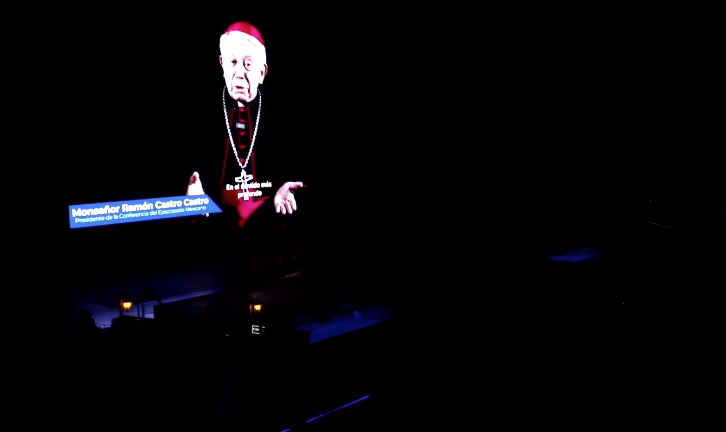
At a crucial moment for the political opposition in Mexico, the National Action Party (PAN) held its “relaunch” on October 18 at the Frontón México. This event aims to be a turning point for the main opposition force after recent electoral challenges and to position itself as a citizen alternative to the Morena government. Among the highlights was the video message from Bishop Ramón Castro Castro, president of the Mexican Episcopal Conference (CEM) and bishop of Cuernavaca, who emphasized the importance of the common good as an ethical pillar for any political project.
The PAN’s relaunch seeks a structural transformation aimed at opening the party’s doors to citizens, under a «total openness» to citizens who wish to become candidates, eliminating traditional bureaucracies and focusing on direct participation. Party leaderships indicated that they will set aside partisan alliances, returning to their essence as an independent and conservative force, with special nods to youth and civil society.
One of the key novelties is a new mobile application that allows anyone to affiliate with the PAN with just one click, opine on policies, and even aspire to candidacies without intermediaries. This approach seeks to democratize the party by making it more accessible and representative of the aspirational middle class, defending values such as the homeland, family, and freedom.
The event brought together national leaders, governors, former governors, senators, deputies, mayors, and militants. Support messages were projected from prominent figures such as historian Enrique Krauze, former INE president counselor Lorenzo Córdova Vianello, and former president of the Spanish government José María Aznar. Krauze and Córdova urged PAN members to resist what they called an «authoritarian regression,» while Aznar emphasized the need to defend liberal democracy. One of the contributions from the spiritual sphere was the video message from Bishop Ramón Castro Castro, who connected the PAN’s ideals with ethical and Christian principles.
Without mentioning the party’s name, Castro Castro, in the message addressed to the «panistas,» delved into the concept of the common good as a moral, social, and spiritual category rooted in human dignity. Citing the Second Vatican Council, he defined the common good as «the set of conditions of social life that allow groups and each of their members to achieve their own perfection more fully and easily». He highlighted two fundamental keys: first, that the common good encompasses that of all and each one, not opposing the individual but elevating it, and only achievable collectively. Second, that it goes beyond material well-being, aiming at the integral development of people, including moral and spiritual aspects.
The bishop emphasized the communal dimension of the human being: «None of us is sufficient unto ourselves. We all need others to realize our humanity». He linked this to the teaching of Pope Francis in his encyclical Fratelli Tutti, describing work for the common good as an «act of social love» and a «concrete form of political charity” and underscored the shared responsibility of each citizen in their everyday sphere: family, work, school, and community. He warned that forgetting this co-responsibility leads to social decay, while assuming it strengthens coexistence in justice, truth, and solidarity.
The president of the CEM presented the common good as the «ethical horizon» that gives meaning to coexistence and the moral criterion for evaluating political projects. He concluded with a spiritual call: «Working for the common good is, in a certain way, cooperating with the divine plan of love that seeks to gather all humanity into one family. Take heart. May God bless you». This message resonated particularly in a party with Catholic roots, reinforcing the idea that politics must transcend partisanship to focus on the human.
The relaunch occurs in a context of historical weakness for the Mexican right, after the 2024 elections where Morena consolidated its dominance. The PAN, founded in 1939, has governed Mexico in two presidential periods (2000-2012) and maintains strengths in states like Guanajuato and Querétaro. However, it faces criticism for its past association with opposition alliances that did not bear fruit. By distancing itself from coalitions with the PRI and the defunct PRD, the party is betting on its own identity, even attracting former militants from those parties. The new image includes a modernized logo in blue tones, symbolizing renewal and closeness.
Critics argue that this relaunch is more of an internal event than a true shift toward society, further polarizing the political debate. Nevertheless, for PAN members, it represents an opportunity to reconnect with the citizen base tired of the «poor results» of the current regime. The video message from Castro Castro adds an ethical nuance, reminding that the opposition must not only criticize but propose a path toward a more human society.
In summary, the PAN’s relaunch seeks to transform the party into an open and citizen platform, with digital tools and a focus on traditional values. Support from figures like Bishop Castro Castro underscores its commitment to the common good, potentially attracting conservative and Catholic sectors. If this strategy succeeds in mobilizing youth and civil society, the PAN could strengthen itself as the main opposition in Mexico, defending democracy in an increasingly challenging landscape.
The video message projected at the Frontón México can be seen here
https://www.youtube.com/watch?v=F7biR4FDYBU