


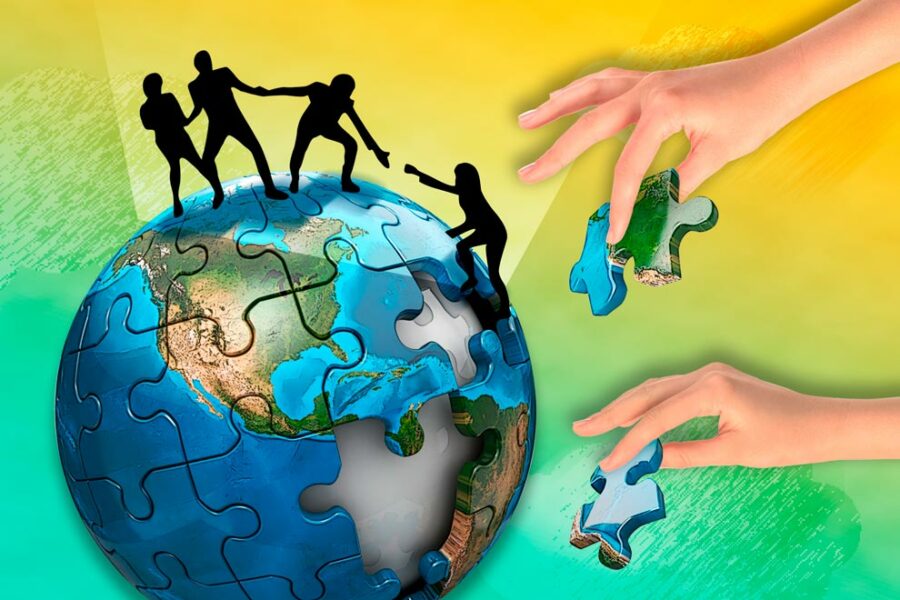
In the most recent installment of the catechesis series “Thy Kingdom Come,” the bishop of Cuernavaca and president of the Mexican Episcopal Conference (CEM), Mons. Ramón Castro Castro, invites Mexican Catholics to move from superficial solidarity to an authentic “ethical-social solidarity” that builds the common good. In chapter 27, titled Weavers of Solidarity, the pastor reflects with depth and pastoral closeness on one of the most evident wounds of current Mexican society: the lack of real bonds that allow us to face national problems together.
“There is a solidarity that can remain superficial. For the Christian, however, solidarity is called to mature until it becomes a true ethical-social solidarity,” affirms Castro Castro. It is not enough to multiply contacts or “likes” on social networks; those relationships must grow in depth and be oriented with passion toward the common good.
The bishop strongly reiterates the teaching of Pope Francis: “No one is saved alone.” This spiritual truth, he says, illuminates with special urgency the social and political life of Mexico. “The problems that hurt us—violence, corruption, poverty, forced migration, disappearances—will not be resolved by one person or one group alone. Either we get out together or we don’t get out.”
Castro Castro warns that this awareness cannot remain at the level of ideas. It must become “blood that runs through our relationships” and transforms environments according to the moral good. Quoting St. John Paul II, he recalls that sin not only harms the people directly involved but generates “structures of sin” that poison the social body. In Mexico, these structures manifest in impunity, perpetuated systems of corruption, and networks of complicity that normalize injustice.
In the face of them, “good wishes are not enough.” It is necessary to build “structures of solidarity” that are concretized in just laws, equitable economic rules, and institutions that truly work for everyone. Solidarity, according to the classic definition of John Paul II, is “the firm and persevering determination to commit oneself to the common good, to the good of all and to the good of each one.” It is not a matter of simple benevolence, but of a concrete commitment: deciding to serve rather than exploit, to share rather than accumulate, and to carry the other rather than use them.
The bishop recognizes the everyday pain of the country: mothers searching for their disappeared children, young people without a horizon, families shattered by violence, and a polarization that poisons public debate. In the face of this panorama, he calls to “guard the heart” and make it grow in God’s charity to respond with “active hope.”
The center of the catechesis is Christological. “Christ Jesus is the new man, in solidarity with humanity to the extreme of the cross. In Him, God assumes the wounds of his people and makes us one body.” When businesspeople share justly, rulers serve with honesty, and citizens organize for the common good, “we see clear signs that another Mexico is possible.”
The catechesis concludes with a heartfelt invocation to Our Lady of Guadalupe to intercede and help us live this solidarity that transforms and builds the Kingdom.
“Thy Kingdom Come,” the bishop repeats at the end, thus closing chapter 27 of a series begun in 2025 on the occasion of the centenary of the feast of Christ the King. The weekly videos seek to offer the faithful formation tools to respond, from faith, to the challenges of today’s Mexico.