


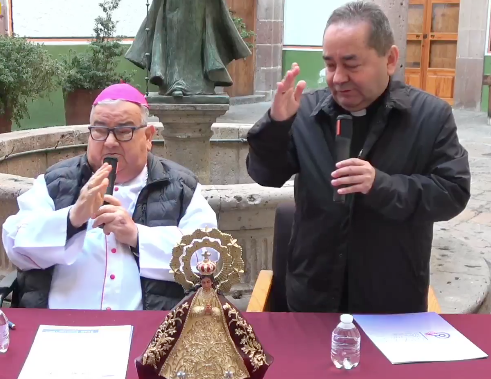
In an announcement marking a new chapter for the Catholic Church in Michoacán, the Mexican Episcopal Conference announced the acceptance of the resignation of Carlos Garfias Merlos from the pastoral governance of the Archdiocese of Morelia. Immediately, José Armando Álvarez Cano, until then coadjutor archbishop, assumed the leadership of the archdiocese.
This change occurs in compliance with the Code of Canon Law, which requires bishops to submit their resignation upon reaching 75 years of age. Garfias Merlos, who reached this age on January 9, 2026, had sent his resignation letter on that date. During a press conference held in Morelia, both prelates expressed gratitude and hope for the future of the ecclesial community.
Carlos Garfias Merlos, emeritus archbishop, is originally from Tuxpan, Michoacán. He was born on January 9, 1951. He completed his studies in humanities, philosophy, and theology at the Tridentine Seminary of Morelia and obtained a master’s and doctorate in psychotherapy and spirituality at the Intercontinental University of Mexico City. Ordained a priest on November 23, 1975, his career includes roles such as formator in the diocesan seminary, bishop of Ciudad Altamirano (1996-2003), bishop of Nezahualcóyotl (2003-2012), and archbishop of Acapulco before arriving in Morelia in 2016. During his nine years at the helm of the Archdiocese of Morelia, Garfias Merlos distinguished himself for his commitment to social peace in a region marked by challenges such as violence and migration, promoting interreligious dialogues and psychological-spiritual support programs.
Archbishop José Armando Álvarez Cano, born on January 30, 1960, in Jiquilpan de Juárez, Michoacán, is the third of ten siblings. He entered the minor seminary of Zamora at age 12, completing secondary school, philosophy, and theology studies there, and obtained a bachelor’s degree in pastoral theology at the Pontifical University of Mexico. Ordained a priest in 1986, he served as a parish priest in several Michoacán communities before being appointed bishop of Tampico in 2012 and coadjutor archbishop of Morelia in 2025. Álvarez Cano is recognized for his pastoral approach close to rural communities and his emphasis on lay formation, as well as his work in promoting hope in difficult times.
The leadership transition does not go unnoticed by the Michoacán faithful. In a gesture of unity and reflection, a thanksgiving celebration for the ministry of Garfias Merlos has been scheduled for next Thursday, January 22, at noon, in the Cathedral of Morelia. This thanksgiving mass will also commemorate the nine years since his arrival at the archdiocese, offering the faithful the opportunity to bid farewell and recognize his legacy of generous service. Garfias Merlos has expressed his intention to continue participating in religious activities from an emeritus role, focusing on building peace and teaching.
The highlight of this transition will be the enthronement mass of Álvarez Cano, scheduled for Friday, January 30, in the same Cathedral of Morelia. This ceremony will not only formalize his canonical possession, but it will also coincide with his 66th birthday, adding a personal touch to the celebration. A wide participation of bishops, priests, religious, and laity is expected, symbolizing the archdiocese’s renewed commitment to evangelization and peace-building in Michoacán. Álvarez Cano has called on the community to «build hope in difficult times,» emphasizing unity and service as pillars of his ministry.
In a national context where 30% of episcopal leaderships will soon be renewed, this change in Morelia highlights the vitality of the Mexican Church. The archdiocese, with more than one million Catholics, faces challenges such as secularization and violence, but with leaders like Álvarez Cano, a path of pastoral renewal is envisioned. The Michoacán faithful prepare for these events with faith and expectation, honoring the past while embracing the future.